
Aug 6, 2026Product Development & Case Studies
How Four-Drawer Desktop Storage Cabinets with Bamboo Drawers Are Manufactured for Bulk Orders
Learn how desktop storage cabinets with bamboo drawers are made for bulk orders, including component cutting, drawer fit, surface control, packaging and QC.
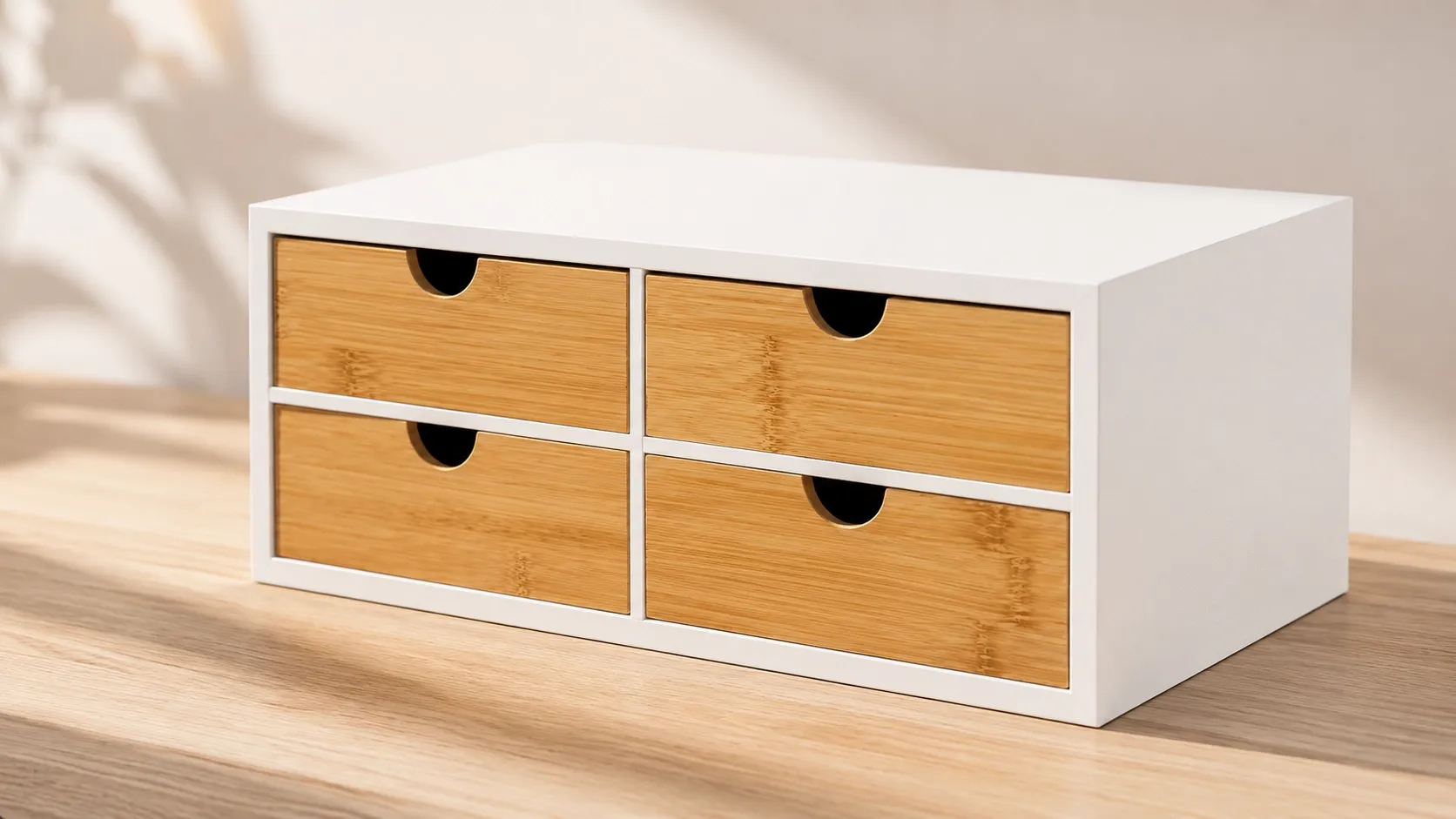
For importers, distributors, retailers and private-label home organization brands, a four-drawer desktop storage cabinet should be evaluated as a fitted product rather than as a simple decorative storage box.
The bamboo drawers, outer cabinet, finger-pull openings, drawer clearances, visible front gaps and packaging must work together as one finished unit. A sample may look attractive, but bulk production can still create problems if the bamboo components vary in size, the cabinet is not square, the drawer fronts do not align or the finished surfaces are damaged during handling and transport.
This guide uses real production-stage images to explain how desktop storage cabinets with bamboo drawers are prepared for bulk orders and which quality-control points professional buyers should confirm before sampling, private-label packaging or mass production.
Quick Answer: How Is a Four-Drawer Desktop Storage Cabinet Manufactured?
A typical bulk-production project may include the following stages:
- Product specification and approved sample confirmation
- Bamboo drawer-component preparation
- Cutting and dimensional machining
- Bamboo drawer assembly
- Finger-pull and hand-contact edge finishing
- Outer-cabinet production
- Drawer-to-cabinet fit adjustment
- Drawer-front alignment and visible-gap control
- Surface and appearance inspection
- Batch identification and model separation
- Private-label packaging development
- Final functional and pre-shipment inspection
The production sequence is important, but experienced buyers should focus equally on cabinet squareness, drawer fit, front alignment, surface protection and sample-to-bulk consistency.
Key Quality-Control Points for Professional Buyers
Evaluation Area | What the Buyer Should Confirm |
|---|---|
Product Structure | Four-drawer layout, outer cabinet, drawer construction and assembly method |
Outer Cabinet | Actual substrate, dimensions, squareness, base flatness and surface-finish system |
Bamboo Drawers | Panel thickness, internal dimensions, assembly quality and visual appearance |
Drawer Fit | Smooth movement, suitable clearance, controlled side movement and closed position |
Front Alignment | Even horizontal lines, consistent gaps and aligned finger-pull openings |
Bamboo Appearance | Grain, color range, sanding, cracks, joints, glue marks and surface finish |
Outer Surface | Color consistency, scratches, chips, corner coverage, curing and cleanliness |
Branding | Logo method, position, size, orientation and approved appearance |
Packaging | Drawer fixation, corner protection, surface protection and carton efficiency |
Batch Control | Model, size, finish, logo and packaging-version identification |
Repeat Orders | Approved sample, drawings, specifications, artwork and change control |
1. Define the Finished Product Correctly
This product is a complete desktop storage cabinet with four independent bamboo drawers arranged in a two-by-two layout.
It should not be confused with:
- Adjustable drawer dividers
- Cutlery drawer trays
- Drawer inserts
- Organizers installed inside an existing drawer
- Individual bamboo drawer components
Depending on the confirmed dimensions and internal capacity, the finished cabinet may be developed for office stationery, small accessories, craft supplies, cosmetics, tea or coffee accessories, household items or gift-oriented storage collections.
The intended use should be confirmed before sampling because it affects drawer depth, cabinet dimensions, expected load, packaging and product positioning.
Professional buyers should clarify:
- Intended application
- Overall external dimensions
- Internal drawer dimensions
- Expected contents
- Target retail channel
- Required visual style
- Whether the product will ship assembled or partially assembled
- Whether stacking is an intended function
- Logo and packaging requirements
2. Create One Controlled Product Specification
Bulk production should be based on one current specification connected to the approved sample.
The specification should include:
- Overall length, width and height
- Four-drawer two-by-two configuration
- Bamboo drawer-panel thickness
- Internal drawer dimensions
- Drawer-front dimensions
- Finger-pull shape and position
- Outer-cabinet substrate and construction
- Outer-surface color and finish standard
- Drawer clearance
- Visible front-gap standard
- Base and back-panel construction
- Logo method and position
- Individual packaging
- Barcode, label and carton-mark requirements
- Inspection criteria
- Order quantity and destination market
The white appearance of the outer cabinet does not identify the underlying material. The specification should clearly state whether the substrate is wood-based board, solid wood, bamboo, plastic or another material, together with the applicable surface-finish requirement.
When dimensions, finish, drawer fit or front gaps change during sampling, the revision should be recorded. Production, packaging and quality-control teams must all work from the latest approved version.
Buyers preparing a new project can also review our guide to requesting a quote for custom bamboo and wood houseware.
3. Cut Bamboo Drawer Components Accurately
The bamboo components must be cut according to the approved dimensions before drawer assembly.
Relevant parts may include:
- Drawer fronts
- Drawer side panels
- Drawer backs
- Drawer bottoms
- Supporting strips or internal components
Small dimensional differences at this stage may accumulate after assembly and affect how the drawer fits inside the outer cabinet.
Critical dimensions commonly include:
- Drawer-body width
- Drawer-body height
- Drawer depth
- Drawer-front width and height
- Finger-pull position
- Panel thickness
- Bottom-panel position
Cut components should also be inspected for chipped edges, visible cracks, open bamboo joints, surface damage, incorrect component size and obvious thickness variation.
Similar-looking parts should be separated by model and production stage to reduce mixing risk.
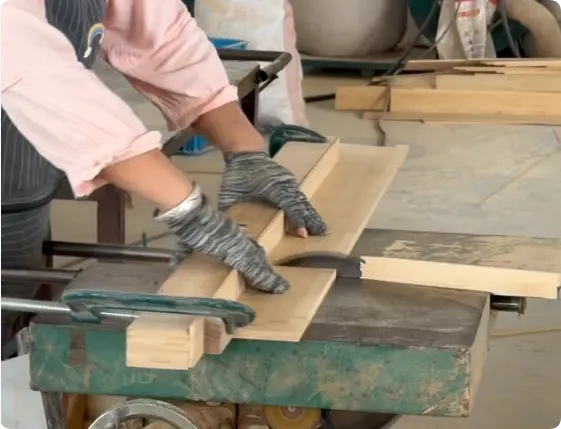
Bamboo panel components are cut to controlled dimensions before drawer assembly.
4. Assemble the Bamboo Drawers Squarely
After component preparation, the bamboo parts are assembled into complete drawer units.
Each drawer should remain square, stable and dimensionally consistent.
Important assembly checks include:
- Front, side and back panels meeting correctly
- Opposite sides remaining parallel
- Drawer bottom sitting in the intended position
- No excessive movement in the assembled structure
- No open joints
- No visible excess adhesive
- No strong twist or distortion
- Internal corners remaining clean
A drawer may appear acceptable when inspected separately but still stick, tilt or create uneven gaps after being inserted into the cabinet. Drawer squareness should therefore be evaluated together with the corresponding cabinet opening.
5. Control Finger-Pull Position and Edge Quality
Each drawer uses a semicircular finger-pull opening. This feature affects appearance, comfort and visible consistency.
The buyer should confirm:
- Finger-pull width and depth
- Horizontal and vertical position
- Symmetry
- Shape consistency
- Smooth internal edges
- No chips or loose bamboo fibers
- No sharp hand-contact areas
When four drawers are visible on one cabinet, inconsistent finger-pull positions become easy to notice. Production should use an approved positioning reference or fixture rather than relying only on visual judgment.
Internal drawer edges must also be inspected. A smooth front does not guarantee that the inside corners, bottom edges and back panel have been finished to the same standard.
6. Confirm the Outer-Cabinet Construction
The outer cabinet provides the structural frame for all four bamboo drawers.
Its actual substrate, panel thickness, joint system and surface finish must be confirmed as part of the project specification.
Important construction checks include:
- Overall external dimensions
- Internal opening dimensions
- Center-divider position
- Horizontal-divider position
- Cabinet squareness
- Side-panel alignment
- Top and bottom alignment
- Back-panel position
- Base flatness
- Structural stability
The completed cabinet should sit on a flat surface without rocking.
If the cabinet is distorted, the drawers may show uneven gaps, difficult movement, side rubbing or different closed positions even when the individual drawers were assembled correctly.
7. Inspect the White Outer Surface
The white outer surface requires a different visual standard from the natural bamboo drawer fronts.
Professional buyers should confirm:
- Approved color reference
- Surface-finish method
- Coverage on edges and corners
- Surface smoothness
- Scratch and chip standard
- Pinholes, bubbles or visible repair marks
- Dirt or embedded particles
- Odor and curing condition where applicable
- Color consistency between units
White surfaces make scratches, dirty marks and edge damage more visible. Workshop handling and packaging protection therefore require particular attention.
The buyer should also confirm whether internal drawer openings and less-visible surfaces require the same finish standard as the external cabinet.
8. Control Drawer-to-Cabinet Fit
Drawer fit is one of the most important functional checks for this product.
The drawer needs enough clearance to move smoothly, but not so much clearance that it feels loose or creates an inconsistent front appearance.
If the Clearance Is Too Small
- The drawer may stick during opening
- The drawer may rub against the cabinet
- Closing may require excessive force
- Surface finishing may make the fit tighter
- Minor production variation may cause functional failure
If the Clearance Is Too Large
- The drawer may move from side to side
- The drawer may tilt during opening
- Visible gaps may become uneven
- The product may feel unstable
- Drawer fronts may sit at different depths
There is no single universal clearance suitable for every cabinet. The appropriate fit depends on drawer dimensions, cabinet-opening dimensions, component construction, surface finish, production tolerance and approved sample performance.
Functional checking should include:
- Opening from the fully closed position
- Closing without excessive force
- Smooth movement through the complete travel
- Side-to-side movement
- Tilting during use
- Contact with neighboring surfaces
- Closed front position
- Performance after all finishing processes are completed
9. Check Drawer-Front Alignment and Visible Gaps
The product front is the area most likely to influence the buyer’s first impression.
The four bamboo drawer fronts should create a controlled two-by-two arrangement.
Inspection points include:
- Top drawers aligned with each other
- Bottom drawers aligned with each other
- Center vertical division appearing straight
- Horizontal division appearing level
- Similar gaps around corresponding drawers
- Drawer fronts sitting at the intended depth
- No drawer visibly projecting forward
- No obvious tilt
- Finger pulls aligned consistently
The contrast between the white outer cabinet and natural bamboo fronts makes small deviations more visible. The buyer and supplier should approve a reference standard showing acceptable gaps, alignment, closed position and finger-pull location.
10. Manage Bamboo Grain and Color Across Each Cabinet
Natural bamboo drawer fronts will not look completely identical.
However, four drawer fronts positioned next to each other form one visible product. Strong differences between adjacent drawers may therefore appear accidental or inconsistent.
Buyers should confirm the acceptable range for:
- Light and dark bamboo tones
- Grain direction
- Visible bamboo joints
- Natural marks
- Panel matching
- Front-to-front coordination
- Surface-finish consistency
The objective is not to remove every natural variation. The objective is to avoid combinations that fall outside the brand’s intended visual position.
For this product, it may be practical to coordinate the four fronts within each completed cabinet rather than assigning drawers entirely at random.
11. Use Batch Identification for Drawer Components
The production photographs show assembled bamboo drawer components grouped in larger quantities before final cabinet assembly.
When several drawer sizes, cabinet models or customer projects are produced at the same time, clear batch identification is necessary.
Batch information may include:
- Customer reference
- Product code
- Drawer dimensions
- Cabinet model
- Finish version
- Logo version
- Packaging version
- Quantity
- Production stage
- Inspection status
Batch control helps prevent different drawer sizes, cabinet models, logo versions or packaging files from being mixed.
Temporary wrapping may be used for dust protection, workshop handling or grouping. It should not be described as final export packaging unless the complete packaging specification has been confirmed.
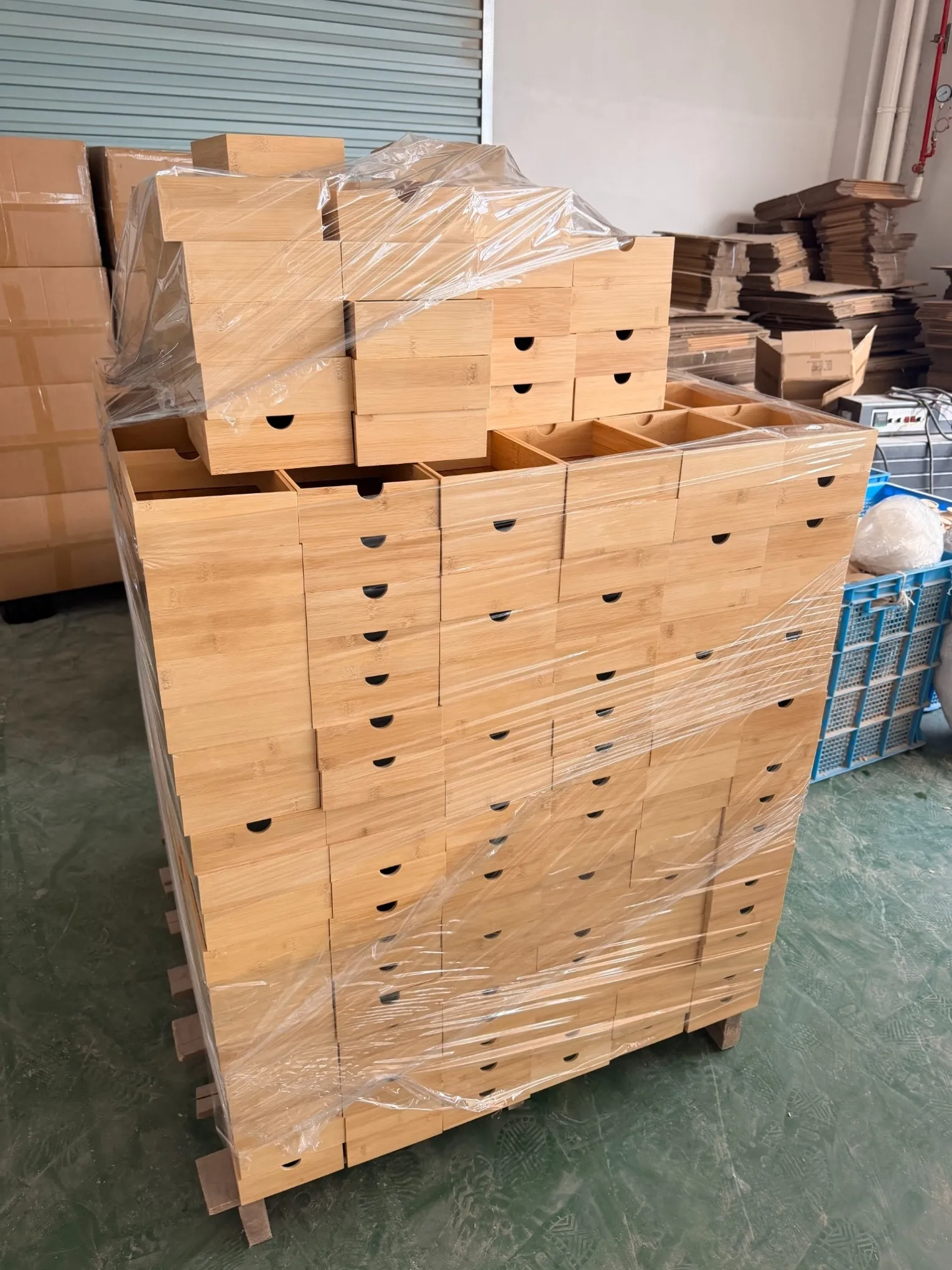
Assembled bamboo drawers are grouped by model before fit checking and final cabinet assembly.
12. Develop Packaging for the Actual Shipping Configuration
The packaging method should reflect whether the cabinet will ship fully assembled, partially assembled or in another confirmed configuration.
For a fully assembled rigid cabinet, practical packaging may include:
- Size-matched kraft box
- Printed retail color box
- E-commerce mail-order box
- Protective bag or paper wrap
- Corner and edge protection
- Surface-protection sheets
- Internal drawer fixation
- Separators where finished surfaces may rub
- Product-specific insert or care card
A simple sleeve or belly band should not be treated as the default packaging solution for a rigid cabinet because it may leave corners, drawer fronts and finished surfaces exposed.
The packaging should prevent:
- Drawers opening during transport
- Bamboo fronts rubbing against the cabinet
- The white surface being scratched
- Corners being crushed
- Excessive movement inside the box
- Incorrect drawer and cabinet combinations
Before packaging artwork is printed, buyers should confirm:
- Individual-pack dimensions
- Product orientation
- Protective-material thickness
- Quantity per export carton
- Export-carton dimensions
- Net and gross weight
- Total CBM
- Pallet requirements where applicable
If the product ships fully assembled and cannot be nested, packaging volume may become an important part of the landed-cost calculation.
13. Establish an In-Process Quality-Control Plan
Quality control should be performed during production rather than beginning only after the complete order has been finished.
Bamboo Component Inspection
- Correct component and model
- Dimensions and thickness
- Surface quality
- Cracks and open joints
- Chipped edges
- Component identification
Drawer Assembly Inspection
- Squareness
- Drawer dimensions
- Structural stability
- Bottom-panel position
- Joint quality
- Finger-pull position
- Internal edge quality
Outer-Cabinet Inspection
- Overall dimensions
- Internal opening dimensions
- Squareness
- Base flatness
- Divider alignment
- Surface finish
- Edge and corner condition
Functional Fit Inspection
- Smooth drawer movement
- Appropriate clearance
- Controlled side movement
- Tilting
- Closed front position
- Contact or rubbing
- Performance after finishing
Appearance Inspection
- Bamboo color range
- Drawer-front coordination
- Outer-surface color consistency
- Scratches and chips
- Glue marks
- Rough areas
- Finger-pull alignment
Packaging Inspection
- Correct cabinet model
- Four correct drawers
- Drawer fixation
- Surface protection
- Logo and artwork
- Barcode and labels
- Insert card
- Packaging dimensions
- Export-carton information
Depending on the project, inspection may use internal process sampling, critical-feature checks, selected 100% inspection items, agreed AQL criteria or third-party pre-shipment inspection.
The inspection method should be agreed before production because different requirements may affect cost and lead time.
Common Quality Risks and Recommended Controls
Potential Issue | Possible Cause | Recommended Control |
|---|---|---|
Drawer sticks | Cabinet distortion, insufficient clearance or finish buildup | Check drawer fit after all surfaces are finished |
Drawer feels loose | Excessive clearance or inconsistent components | Approve a functional fit standard and inspect multiple units |
Front gaps are uneven | Component or cabinet-alignment variation | Use an approved visible-gap reference sample |
Cabinet rocks | Base or outer structure is not flat | Inspect completed units on a flat surface |
Finger pulls do not align | Inconsistent machining position | Use a positioning fixture or approved guide |
White surface is scratched | Insufficient workshop or packaging protection | Protect finished surfaces during handling and packing |
Drawer fronts strongly mismatch | Uncontrolled bamboo appearance sorting | Coordinate four drawer fronts within each cabinet |
Drawers open inside the box | No internal fixation | Add suitable removable drawer restraint |
Different models are mixed | Weak batch identification | Separate by SKU, dimensions and packaging version |
Packaging volume is excessive | Oversized box or inefficient carton layout | Confirm pack dimensions and CBM before artwork approval |
Outer finish chips at corners | Insufficient curing or weak corner protection | Confirm finish condition and add corner protection |
Logo position varies | No placement reference | Approve a logo-position guide before production |
14. Control Sample-to-Bulk Consistency
A good development sample does not automatically guarantee a consistent mass-production order.
Before production begins, the project should have:
- An approved reference sample
- A dated product specification
- Confirmed cabinet dimensions
- Confirmed outer-cabinet substrate
- Approved outer color and finish
- Confirmed bamboo drawer dimensions
- Approved drawer fit
- Approved front-gap appearance
- Approved finger-pull design
- Approved bamboo appearance range
- Approved logo
- Approved packaging artwork
- Agreed inspection criteria
For repeat orders, the supplier should retain the final specification, drawings, color references, logo position, packaging files, approved sample where practical, inspection requirements and previous production notes.
Any significant change in material, construction, finish or packaging should be communicated and approved before the next production run.
Importers evaluating long-term suppliers can also review our bamboo and wood houseware manufacturer evaluation checklist.
15. Evaluate the Product as a Complete Retail Program
Professional buyers should evaluate the complete commercial structure rather than only the appearance of the product.
Important questions include:
- Which retail category will the cabinet be sold under?
- What items are the drawers intended to hold?
- Are the internal dimensions suitable for the target use?
- Will the product ship assembled or partially assembled?
- Is the packaging volume commercially acceptable?
- Can the intended retail price support the landed cost?
- Does the bamboo-and-white appearance fit the brand?
- Does the sales channel require mail-order packaging protection?
- Are custom colors or drawer configurations required?
- Can repeat orders maintain the same visual and functional standard?
Potential buyers may include office organization brands, home storage brands, craft-storage brands, cosmetic organization brands, tea and coffee accessory brands, importers, distributors, wholesalers, retailers and private-label home-and-living programs.
How Rewood Supports Desktop Storage Cabinet Projects
Rewood supports importers, distributors, wholesalers, retailers and private-label brands with bamboo, wood and mixed-material home and office organization products.
Project support may include:
- Product-structure review
- Custom cabinet and drawer dimensions
- Bamboo component development
- Outer-cabinet material and finish confirmation
- Sample development
- Logo application
- Size-matched private-label packaging
- Barcode, label and insert-card coordination
- Production tracking
- Pre-shipment quality inspection
- Export and delivery preparation
The final structure, materials, finish, MOQ, production schedule and packaging method are confirmed according to the individual project requirements.
Buyers can review a related bamboo desk organizer with drawer and file slot or explore our current bamboo and wooden houseware product range.
What Information Is Needed for a Quotation?
To prepare a practical quotation, please provide:
- Product photo, drawing or reference sample
- Intended use
- Overall dimensions
- Number and arrangement of drawers
- Internal drawer dimensions
- Outer-cabinet material preference
- Cabinet color and finish
- Bamboo finish
- Logo artwork
- Packaging preference
- Estimated order quantity
- Target market
- Barcode and label requirements
- Inspection requirements
- Delivery destination
- Required timeline
When some details are not finalized, a reference product and intended application can be used as the starting point for evaluation.
Discuss Your Desktop Storage Cabinet Project
Send Rewood your product design, dimensions, drawer configuration, target quantity, logo, packaging requirements, target market and delivery destination.
Our team will review the product structure, material combination, drawer-fit requirements, packaging protection and production feasibility before preparing the next practical step.
Request a Desktop Storage Cabinet Quotation
Frequently Asked Questions
What is the correct name for this product?
It is best described as a four-drawer desktop storage cabinet with bamboo drawers. It is not an adjustable drawer divider or an organizer inserted inside an existing drawer.
What are the most important quality checks?
The most important functional checks are cabinet squareness, drawer fit, drawer-front alignment and base flatness. The outer finish, bamboo appearance, finger-pull edges and packaging protection should also be inspected.
Can the cabinet size and drawer layout be customized?
Yes. Overall dimensions, drawer dimensions, drawer quantity, drawer arrangement, cabinet color and finger-pull design can be evaluated for OEM or private-label projects. The final structure should be confirmed through drawings and sample approval.
What material is used for the white outer cabinet?
The actual outer-cabinet material should be confirmed for each project. A white finished appearance alone does not identify the underlying substrate. The specification should state the material, thickness, construction and surface-finish requirement.
Can drawers from different cabinets be interchangeable?
Interchangeability is possible only when it is defined as a product requirement and controlled through consistent dimensions and fit testing. It should not be assumed automatically.
Can the cabinet be stacked?
A stackable version can be developed, but stability, contact surfaces, load, anti-slip details and overall structure must be evaluated. The product should not be marketed as stackable unless the function has been confirmed.
What packaging is most suitable?
A fully enclosed, size-matched kraft box, color box or mail-order box is generally more suitable than an exposed sleeve for a rigid assembled cabinet. The packaging should protect the outer surface, bamboo drawer fronts and corners while keeping the drawers closed during transport.
Can a custom logo and private-label packaging be added?
Yes. Depending on the project, options may include laser engraving, printing, cabinet branding, packaging artwork, labels, barcodes, insert cards, kraft boxes, color boxes and mail-order packaging.
Can FSC-related documentation be provided?
FSC-related requirements must be evaluated according to the actual bamboo or wood material source, supply chain, manufacturing entity and order requirements. Availability should be confirmed for the specific project rather than assumed for every product.
About the Author
Written by Jessie Jiang
Overseas Business Development, Rewood Houseware
Jessie works with importers, distributors, retailers and private-label brands on bamboo and wood houseware manufacturing, product development, mixed-material product coordination, custom packaging, quality control and export projects.
Reviewed by the Rewood Product Development & Quality Control Team
This article is based on Rewood’s practical experience supporting bamboo drawer components, desktop storage products, sample development, bulk production, private-label packaging and quality inspection.
Last updated: August 6, 2026