Aug 27, 2026Materials, Quality & Compliance
FDA, LFGB, REACH & FSC for Bamboo and Wooden Kitchenware: A B2B Buyer’s Guide
A practical guide to FDA, LFGB, REACH and FSC for bamboo and wooden kitchenware, explaining what each covers, what buyers should ask for and when testing may be needed.
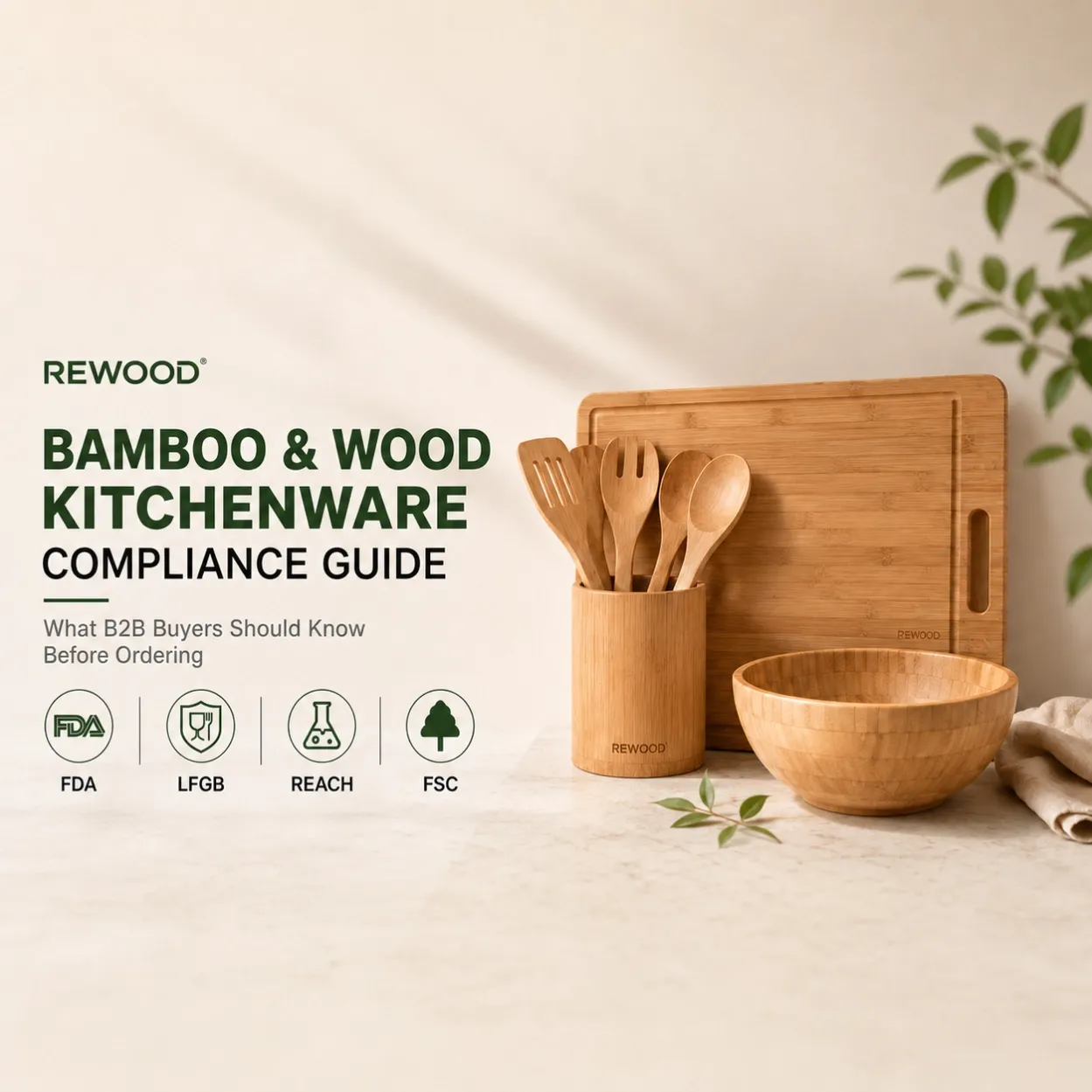
If you are importing bamboo or wooden kitchenware for the first time, compliance terminology can become confusing very quickly.
A supplier may mention:
- FDA
- LFGB
- REACH
- FSC
- Food-contact testing
- Test reports
- Certificates
- Declarations
- Material documents
But these terms do not all mean the same thing.
A common mistake is asking a supplier:
“Do you have all the certificates?”
A better question is:
“What requirements apply to this specific product, material, surface finish and target market?”
For bamboo and wooden kitchenware buyers, compliance should be evaluated product by product and market by market, rather than assuming one certificate covers an entire product range.
This guide explains the practical difference between FDA, LFGB, REACH and FSC, what first-time buyers should ask suppliers for, and when product-specific testing may be necessary.
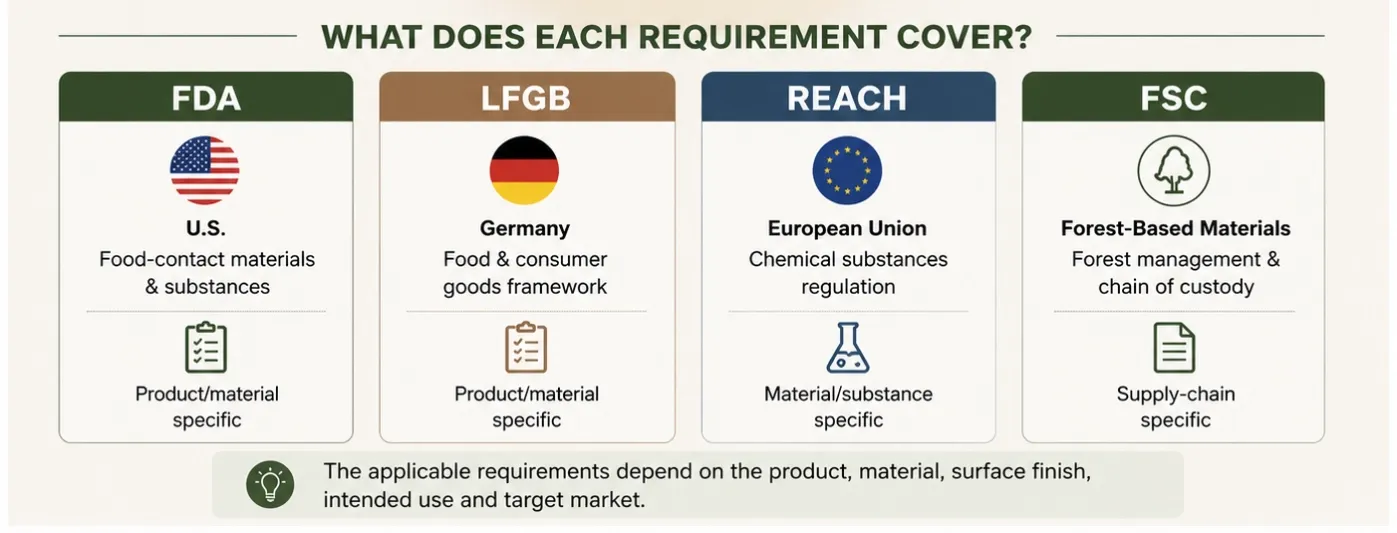
Quick Answer: What Do FDA, LFGB, REACH and FSC Actually Cover?
Term | Main Purpose | What Buyers Should Understand |
|---|---|---|
FDA | U.S. food-contact regulatory framework | Relevant materials, coatings, adhesives and other food-contact components must be suitable for their intended use |
LFGB | German food and consumer-goods legal framework | Often referenced by buyers and labs when evaluating food-contact products for Germany |
REACH | EU chemicals regulation | Focuses on chemical substances and obligations related to substances in products |
FSC | Forest-based material traceability | Concerns responsible forest sourcing and chain of custody, not food-contact safety |
The key point is simple:
These four terms solve different compliance questions.
An FSC claim does not replace food-contact testing.
A food-contact test does not prove FSC chain of custody.
A REACH report does not automatically prove that a product meets every food-contact requirement.
And an existing FDA-related report does not automatically cover every material, coating or product design.
1. There Is No Single “Bamboo Kitchenware Certificate”
Bamboo and wooden kitchenware can contain more than one material or substance.
A product may include:
- Bamboo
- Acacia, beech or another wood species
- Adhesive used in laminated construction
- Surface oil
- Lacquer or coating
- Printing ink
- Laser engraving
- Silicone accessories
- Metal components
- Packaging materials
Compliance therefore depends on the actual construction of the product.
Consider two products that both look like bamboo cutting boards.
Product A
- Bamboo board
- No printed food-contact surface
- One specified surface treatment
Product B
- Bamboo board
- Different adhesive system
- Printed decoration
- Silicone feet
- Different coating
They may look similar in a product photograph, but the compliance questions may not be identical.
This is why serious B2B sourcing should begin with the product specification rather than a generic request for “all certificates.”
2. What Does FDA Mean for Bamboo and Wooden Kitchenware?
For the U.S. market, buyers often use phrases such as:
“FDA certificate”
or:
“FDA approved.”
These phrases can be misleading if they are not explained properly.
The U.S. FDA regulates substances and materials that may come into contact with food, including materials used in cookware, food-preparation surfaces and other food-contact articles.
For a food-contact product, the important question is whether the relevant materials and substances are suitable for the intended conditions of use.
For bamboo and wooden kitchenware, buyers should pay particular attention to components such as:
- Surface coatings
- Adhesives
- Printing inks
- Added plastic components
- Silicone components
- Other materials that may contact food
Instead of asking only:
“Do you have FDA?”
ask:
- What exact product was evaluated?
- Which material was tested?
- Was the surface coating included?
- Which food-contact conditions were considered?
- Which laboratory issued the report?
- When was the report issued?
- Does the tested product match my current specification?
These questions make an existing report much more useful.
3. Why One FDA-Related Report May Not Cover Every Product
Suppose a supplier has an existing report for one bamboo cutting board.
Your new product is:
- A bamboo salad bowl
- With a different surface finish
- Manufactured at a different production location
- Using a different adhesive or coating system
The old report should not automatically be treated as proof that the new product has the same compliance status.
The same issue can occur when changing:
- Material
- Wood species
- Coating
- Glue
- Printing
- Product construction
- Supplier of a component
A professional buyer should compare the tested sample with the actual product being ordered.
The closer those two are, the more relevant the report becomes.
4. What Does LFGB Mean for European and German Buyers?
LFGB stands for Germany’s Lebensmittel-, Bedarfsgegenstände- und Futtermittelgesetzbuch, commonly referred to in English as the German Food and Feed Code.
For houseware buyers, the important point is:
LFGB is legislation, not a universal product certification issued by one central certification organization.
In sourcing discussions, however, buyers and testing laboratories often use expressions such as:
- LFGB test
- LFGB report
- LFGB food-contact testing
These usually refer to testing or evaluation against applicable German and European food-contact requirements.
For a buyer importing bamboo or wooden kitchenware into Germany, the supplier should not simply say:
“Yes, LFGB.”
The buyer should ask:
- Which product was tested?
- Which material and finish were included?
- Which test items were performed?
- Which standard or legal basis appears on the report?
- Does the report cover the current product?
- Is the report still relevant to the current material and manufacturing configuration?
That is much more meaningful than the word “LFGB” by itself.
5. EU Food-Contact Compliance Is Broader Than LFGB
For products sold in the European Union, buyers should understand the broader EU Food Contact Materials framework.
Kitchenware and tableware intended to contact food fall under the general European food-contact rules.
The basic principle is that food-contact materials should not transfer their constituents into food in quantities that could:
- Endanger human health
- Unacceptably change the composition of food
- Deteriorate the taste, smell or other organoleptic characteristics of food
Food-contact materials must also be manufactured under appropriate Good Manufacturing Practice.
For some materials, the EU has detailed harmonized legislation.
For other materials, national requirements may also be relevant.
This is important for natural materials such as bamboo and wood because buyers should not assume that a plastic food-contact regulation automatically applies in exactly the same way to a solid bamboo or wooden product.
6. Solid Bamboo Is Different From Plastic Products Containing Bamboo Powder
This distinction is particularly important for European buyers.
A product made from solid or laminated bamboo should not be confused with a plastic product containing bamboo powder or plant fibers as additives.
These are different material systems.
For example:
Solid Bamboo Kitchenware
may include:
- Bamboo cutting boards
- Bamboo utensils
- Bamboo bowls
- Bamboo trays
while another product may actually be:
Plastic + Bamboo Powder / Plant Fiber Composite
The European market has taken enforcement action against certain plastic food-contact articles containing unauthorized bamboo or other plant-based additives.
For sourcing purposes, buyers should therefore confirm the actual material rather than relying on marketing words such as:
- Bamboo fiber
- Eco bamboo
- Natural bamboo composite
- Plant-based tableware
Ask the supplier:
“Is this product made from solid/laminated bamboo, or is bamboo powder mixed into a plastic resin?”
That one question can prevent a major misunderstanding.
7. What Is REACH?
REACH is the European Union regulation concerning the registration, evaluation, authorization and restriction of chemicals.
For houseware sourcing, the simplest way to understand REACH is:
REACH is primarily about chemical substances—not about whether a wooden spoon functions correctly or whether a cutting board is properly sanded.
Depending on the product, relevant substances may be associated with:
- Coatings
- Paints
- Printing inks
- Adhesives
- Plastic accessories
- Silicone components
- Metal finishes
- Other chemical treatments
For articles placed on the EU market, certain substances can trigger specific obligations.
For example, Candidate List substances above applicable thresholds can create supply-chain communication requirements.
This is why a professional REACH discussion should focus on the materials and substances in the actual product, rather than simply asking for a PDF called “REACH Certificate.”
8. Does Every Bamboo or Wooden Product Need a New REACH Test?
Not necessarily.
The correct approach depends on:
- Product construction
- Materials
- Chemical treatments
- Existing supplier documentation
- Target market
- Buyer requirements
- Retailer requirements
For one simple unpainted wooden item, the compliance approach may differ from a mixed-material product containing:
- Painted metal
- Silicone
- Plastic
- Printed components
- Adhesives
The buyer and supplier should first identify the material composition.
Then determine which supporting documents or testing are appropriate.
Testing without understanding the product specification can result in unnecessary cost—or testing the wrong thing.
9. What Is FSC?
FSC stands for the Forest Stewardship Council.
FSC is fundamentally different from FDA, LFGB and REACH.
It focuses on forest-based material sourcing and traceability through the supply chain.
FSC Chain of Custody certification helps verify that eligible FSC material is properly identified and controlled through processing and distribution.
For B2B buyers, FSC may be relevant when:
- A retailer requires FSC-certified products
- A private-label brand wants FSC claims
- Tender documents specify FSC
- The buyer needs traceable forest-based sourcing
- Packaging or marketing will carry an FSC claim
But FSC does not prove:
- Food-contact safety
- Chemical migration performance
- REACH compliance
- Product durability
- Product dimensions
- Surface-finish quality
This is one of the most important distinctions for first-time buyers.
FSC = sourcing and chain of custody
Food-contact testing = product/material safety for intended food contact
They should not be treated as interchangeable.
10. An FSC Certificate Does Not Automatically Mean Every Product Is FSC-Certified
Another common sourcing mistake is seeing an FSC certificate from a factory and assuming:
“Every wooden or bamboo item from this supplier is automatically FSC.”
That is not how Chain of Custody claims should be evaluated.
Buyers should confirm:
- Which manufacturing entity is involved?
- Is the entity covered by the relevant FSC certification?
- Is the product/material within the applicable scope?
- Is FSC-certified material being used for this order?
- Can the appropriate FSC claim be maintained through the transaction?
- What claim will appear on sales documents?
- Is on-product FSC labeling required?
The actual order and supply chain need to support the claim.
For this reason, FSC requirements should be discussed before production, not after the goods are already finished.
11. Test Report, Certificate and Declaration Are Not the Same Thing
Buyers often use these terms interchangeably, but they describe different types of documents.
Test Report
Usually issued by a laboratory after testing a defined sample against defined test items.
A test report should identify information such as:
- Tested product
- Sample description
- Test method
- Test items
- Results
- Date
- Laboratory
Certificate
Usually confirms that an organization, process or management system has met the requirements of a particular certification scheme.
FSC Chain of Custody is an example where certification applies to an organization and its certified supply-chain system.
Declaration
A supplier, manufacturer or responsible economic operator may issue a declaration regarding a product or material based on relevant supporting information.
The exact legal value depends on the regulation and document type.
Material Documentation
This may include:
- Material specification
- SDS where applicable
- Coating information
- Adhesive information
- Supplier declaration
- Material source information
Professional buyers should ask what the document actually proves, not judge it only by the word written at the top of the page.
12. Product Material and Surface Finish Can Change the Testing Scope
For bamboo and wooden kitchenware, the natural material is only part of the compliance picture.
Consider a wooden utensil.
The project may involve:
Wood
plus
Adhesive
plus
Surface coating
plus
Printed logo
plus
Packaging
If the food-contact surface is treated with oil, lacquer or another finish, that finish should be considered when determining the appropriate compliance approach.
Similarly, when developing:
- Painted products
- Printed products
- Mixed-material utensils
- Silicone-and-wood sets
- Metal-and-bamboo products
the relevant material components should be clearly identified.
For buyers still deciding between bamboo, acacia and beech, our Bamboo vs. Acacia vs. Beech material guide explains the sourcing differences between these common houseware materials.
13. Check Whether an Existing Report Matches Your Actual SKU
An existing supplier report can be helpful.
But before relying on it, compare:
Check | Buyer Question |
|---|---|
Product | Is the tested product the same or genuinely comparable? |
Material | Is the bamboo or wood construction the same? |
Finish | Is the coating/oil/lacquer the same? |
Accessories | Are silicone, metal or plastic parts included? |
Manufacturing | Is the relevant manufacturing source the same? |
Test Scope | Does the report test what my market requires? |
Date | Is the report still appropriate for the project? |
Target Market | Does the legal/test basis match the destination? |
If several important factors are different, new or additional testing may be more appropriate.
14. Who Should Arrange Product Testing?
There is no single answer for every B2B project.
Testing may be arranged by:
- The manufacturer
- The exporter
- The importer
- The private-label brand
- A third-party testing laboratory appointed by the buyer
For first-time buyers, an effective process is:
Step 1 — Define the Product
Confirm:
- Material
- Surface finish
- Construction
- Accessories
- Intended food-contact use
Step 2 — Define the Market
For example:
- United States
- Germany
- France
- Netherlands
- Other EU market
Step 3 — Review Existing Documentation
Check what the supplier already has and whether it is relevant.
Step 4 — Identify Gaps
Determine what is not covered.
Step 5 — Agree on Testing Before Bulk Production
Confirm:
- Laboratory
- Sample
- Test scope
- Cost responsibility
- Timing
- Acceptance criteria
This avoids discovering a testing requirement after the production order is already complete.
15. Should Testing Be Done on a Sample or Bulk Product?
The answer depends on the buyer’s compliance plan and the product.
Testing an approved sample can help confirm the development direction before mass production.
However, the tested sample should accurately represent the product that will actually be produced.
If the mass-production product changes in a way that affects compliance—for example:
- Different coating
- Different adhesive
- Different raw material
- Different component supplier
the relevance of the earlier test should be reassessed.
For some projects, buyers may also request testing using production samples.
The appropriate method should be agreed before the order begins.
16. What Should a First-Time Buyer Ask the Supplier?
You do not need to become a regulatory specialist before sending an inquiry.
Start with these questions:
Ask the Supplier | Why It Matters |
|---|---|
What is the exact material? | Compliance begins with correct material identification |
What surface finish is used? | Coatings may affect food-contact evaluation |
Is adhesive used? | Laminated products may contain additional substances |
What existing reports are available? | Helps identify what may already be covered |
What exact product did the report test? | Prevents using an unrelated report |
Which market was the test intended for? | Requirements differ by destination |
Can FSC be supplied for this specific order? | FSC depends on the actual certified supply chain |
Are there mixed materials? | Plastic, silicone and metal can change the compliance scope |
Can new testing be arranged if required? | Important when existing documentation is insufficient |
This is much more useful than sending:
“Please send FDA, LFGB, REACH and FSC certificates.”
17. Common Compliance Mistakes First-Time Buyers Should Avoid
Mistake 1: Assuming One Report Covers the Entire Catalog
A bamboo cutting-board report may not automatically cover a coated wooden bowl, utensil set or mixed-material organizer.
Mistake 2: Treating FDA as a Product Certification Logo
The relevant question is whether the materials and components comply for their intended food-contact use.
Mistake 3: Treating LFGB as a Universal Certificate
LFGB is German legislation. Always inspect the actual laboratory report and test scope.
Mistake 4: Assuming FSC Means Food Safe
FSC concerns forest-based sourcing and chain of custody, not food-contact migration or chemical safety.
Mistake 5: Requesting REACH Without Identifying Materials
The relevant chemical questions depend on what the product actually contains.
Mistake 6: Changing Coating After Testing
A change in coating or other relevant material can affect whether an earlier report still represents the production item.
Mistake 7: Waiting Until Shipment to Discuss Compliance
Compliance requirements should be identified during product development and quotation, not after the goods are packed.
18. Compliance Requirements Should Be Part of the RFQ
A professional RFQ should include the destination market.
For example:
Product: Bamboo salad bowl set
Market: Germany
Quantity: 1,000 sets
Material: Bamboo
Finish: To be confirmed
Branding: Laser logo
Packaging: Custom color box
Compliance Requirement: Food-contact requirements for Germany/EU; FSC requested if available for the confirmed supply chain
This gives the supplier a much clearer basis for reviewing the project.
Buyers preparing an inquiry can also use our guide to requesting a quote for custom bamboo and wood houseware.
19. Compliance Is Part of Supplier Evaluation
Documents matter, but compliance management is also about supplier discipline.
Professional buyers should evaluate whether the supplier:
- Identifies the actual material correctly
- Controls the approved surface finish
- Can connect reports to the actual product
- Communicates when materials change
- Separates general certificates from product-specific reports
- Understands the target market
- Keeps compliance requirements connected to the production specification
A supplier who immediately sends twenty unrelated certificates is not necessarily more reliable than a supplier who first asks:
“Which product and which market are you developing?”
For a broader qualification process, see our bamboo and wood houseware manufacturer evaluation guide.
How Rewood Approaches Compliance for Bamboo & Wooden Houseware Projects
At Rewood, compliance requirements are handled according to the actual product and project, rather than assuming one document applies to every SKU.
Depending on the project, the review may consider:
- Bamboo or wood species
- Product construction
- Surface finish
- Adhesive
- Additional materials
- Intended food-contact use
- Target market
- Existing documentation
- Buyer or retailer requirements
- Required testing scope
For FSC-related projects, the manufacturing entity, material source and applicable chain of custody should be confirmed for the specific order.
For FDA-, LFGB- or REACH-related requirements, existing documentation can be reviewed first, while additional third-party testing may need to be arranged when the actual product or buyer requirement is not adequately covered.
The objective is not to collect the largest possible number of certificates.
The objective is to determine:
What does this specific product need for this specific market?
A Simple Compliance Workflow for First-Time Buyers
For a new bamboo or wooden kitchenware project, use this sequence:
1. Confirm the Product
Material, construction and surface finish.
2. Confirm the Destination Market
United States, Germany, other EU country or another market.
3. Identify the Intended Use
Food preparation, serving, storage or another function.
4. Review Existing Documents
Determine what the supplier already has.
5. Check Whether the Documents Match the Product
Do not rely only on document titles.
6. Identify Missing Requirements
Ask the buyer, importer, retailer or testing laboratory where necessary.
7. Complete Required Testing Before Shipment
Agree on the relevant sample and acceptance requirements.
This approach is more reliable than requesting every possible certificate before the product has even been defined.
Frequently Asked Questions
Do Bamboo Kitchenware Products Need an FDA Certificate?
There is no single universal FDA certificate that automatically covers every bamboo kitchenware product. Buyers should evaluate the actual food-contact materials, substances and conditions of use and review any relevant supporting documentation or testing.
What Does “FDA Tested” Mean?
It should mean something specific. Ask which product was tested, what material and surface finish were included, what test or regulatory basis was used and which laboratory issued the report.
Is LFGB a Certification?
LFGB is German legislation rather than a standalone universal product-certification scheme. Buyers commonly request LFGB-related food-contact testing, so the actual laboratory test scope should be reviewed.
Is LFGB Only Relevant to Germany?
LFGB is German law. Products sold in the wider EU also need to consider applicable EU food-contact legislation and, where relevant, national requirements in the destination country.
Does REACH Mean Food Safe?
No. REACH concerns chemical substances and related obligations. It does not by itself replace food-contact compliance requirements.
Does FSC Mean a Wooden Product Is Food Safe?
No. FSC relates to forest-based material sourcing and chain of custody. It does not replace food-contact safety assessment or testing.
Can One FSC Certificate Cover Every Product?
Not automatically. The relevant manufacturing entity, material, supply chain and FSC claim need to support the specific product and order.
Can I Use My Supplier’s Existing Test Report?
Possibly, but first compare the tested product, material, coating, construction, manufacturing source, test scope and target market with your actual SKU.
Should I Arrange Testing Before Ordering?
Compliance requirements should ideally be clarified before mass production. Whether testing occurs during sampling, before production or using production samples depends on the specific project.
Who Is Responsible for Compliance?
Responsibilities can depend on the market, supply chain and commercial arrangement. Importers and brands should not assume that receiving a supplier document automatically removes their own regulatory responsibilities.
Planning a Bamboo or Wooden Kitchenware Project?
Compliance does not need to be the most confusing part of a first sourcing project.
Start by defining:
- The product
- Material
- Surface finish
- Intended use
- Target market
- Estimated quantity
- Branding
- Packaging requirements
Then identify which documents and tests are actually relevant.
This creates a more practical sourcing process than collecting unrelated certificates before the product specification is clear.
Discuss Your Kitchenware Compliance & Sourcing Requirements with Rewood
About the Author
Written by Jessie Jiang
Overseas Business Development, Rewood Houseware
Jessie works with importers, distributors, retailers and private-label brands on bamboo and wood houseware sourcing, OEM/ODM product development, material selection, packaging, quality control and export projects.
Reviewed by the Rewood Product Development & Quality Control Team
This guide is intended as practical B2B sourcing information. Regulatory and testing requirements can vary by product, material, intended use, destination market and current legislation. Buyers should confirm project-specific requirements with the relevant importer, retailer, testing laboratory or regulatory specialist where necessary.
Last updated: August 27, 2026