Jun 26, 2026B2B Buying & Sourcing Guides
How to Request a Quote for Custom Bamboo & Wood Houseware
Learn what information buyers should prepare before requesting a quote for custom bamboo and wood houseware, including size, material, MOQ, packaging, and target market.
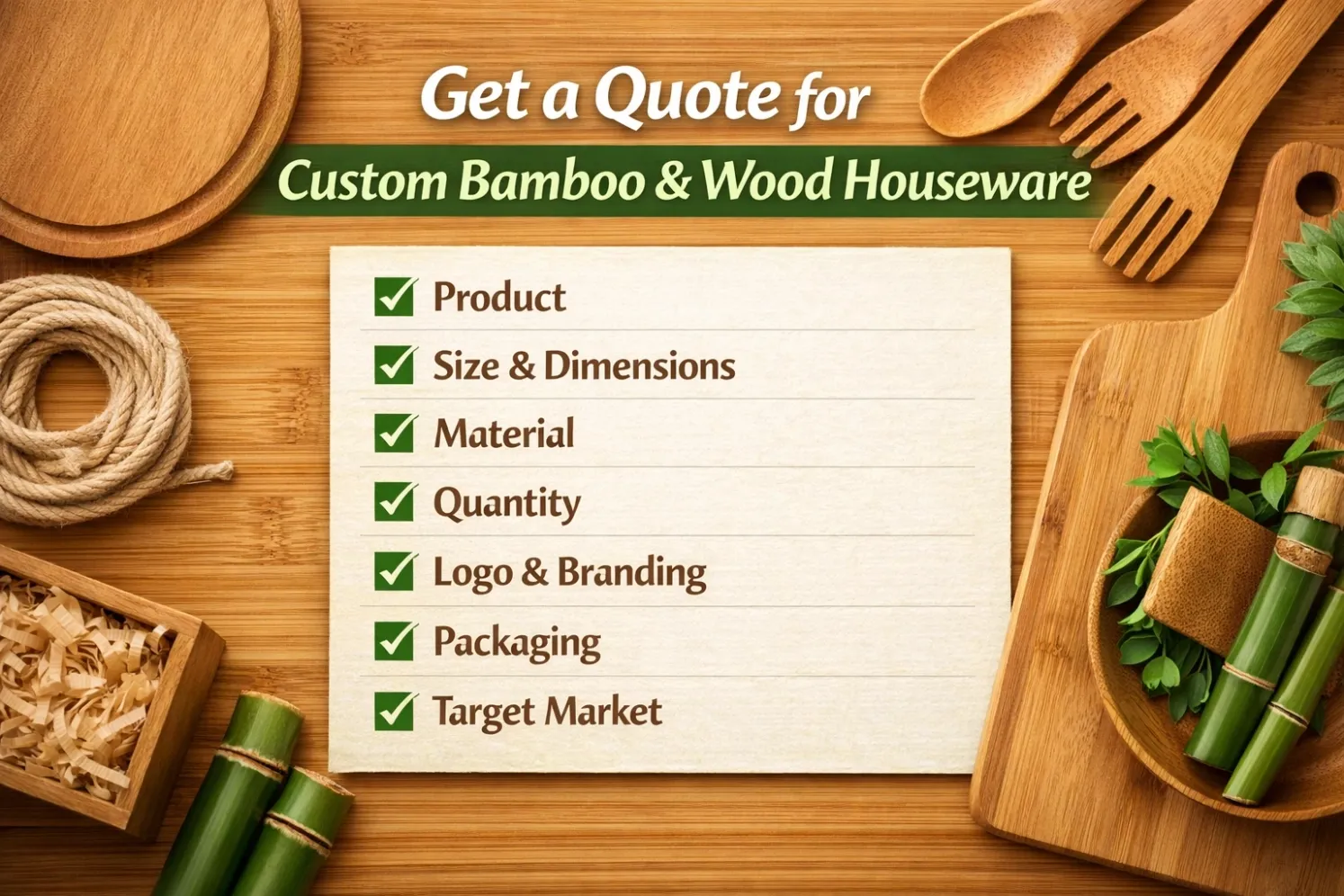
When sourcing custom bamboo and wood houseware, many buyers want a quotation as quickly as possible. However, an accurate quote depends on having the right project details from the beginning.
Whether you are a wholesaler, retailer, importer, e-commerce seller, or private label brand, preparing a few key points before sending your inquiry can save time and make communication much smoother.
In this article, we explain what information helps suppliers provide a faster and more accurate quotation for custom bamboo and wood products.
Why Some Quotations Take Longer Than Expected
In many cases, buyers send a short message such as “Please quote me bamboo kitchen products” or “I need a wooden houseware supplier.” While this is a good first step, it usually does not provide enough information for a clear quotation.
Custom houseware projects often involve different product types, sizes, materials, finishes, packaging methods, logo requirements, and order quantities. Even similar-looking products can have very different costs depending on the details.
The more complete your inquiry is, the easier it is for the supplier to evaluate your request and recommend the right solution.
1. Tell Us What Product You Need
The first and most important step is to clearly describe the product you are looking for.
For example, instead of saying “kitchenware,” it is much better to say:
- bamboo cutting board
- teak wood utensil set
- bamboo drawer organizer
- wooden bathroom tray
- bamboo storage box
A clear product category helps the supplier understand your project immediately and reduces unnecessary back-and-forth communication.
If you already know the exact product you want, mention it directly in your inquiry.
2. Share Reference Photos or Drawings
Reference images are extremely helpful for custom product development.
If you already have a product sample, concept image, sketch, or design drawing, sending it together with your inquiry will make the quotation process much faster. A picture often explains details that are difficult to describe in words, such as shape, handle style, thickness, compartments, edges, or overall appearance.
Even if the final product will not be exactly the same, reference images help the supplier understand your direction and recommend suitable options.
3. Confirm the Size and Specifications
Dimensions have a direct impact on material usage, production cost, packaging, and shipping.
When requesting a quote, try to include the basic product specifications, such as:
- length, width, and height
- thickness
- number of pieces per set
- weight or target weight range
- structure or functional details
For example, a large bamboo cutting board with a juice groove and handle slot will be priced differently from a simple flat board. The same applies to utensil sets, storage organizers, trays, and other wood houseware products.
If you do not have final dimensions yet, an approximate size range is still useful.
4. Specify the Material You Prefer
Bamboo and wood houseware products can be made in different materials, and the material choice affects both appearance and pricing.
Some buyers prefer bamboo for its clean look and sustainability. Others may choose acacia wood, teak wood, rubber wood, pine, or other materials depending on their market positioning and budget.
If you already know which material you want, mention it in your inquiry. If not, you can explain your target style, market level, or product usage, and the supplier can recommend a suitable option.
5. Let Us Know Your Estimated Quantity
Order quantity is one of the most important factors in quotation.
MOQ, unit price, packaging cost, and production planning all depend on the expected quantity. A project for 100 pieces is very different from a project for 1,000 or 5,000 pieces.
Even if you are not ready to place the final order, it is still helpful to give an estimated range, such as:
- trial order
- 300 pieces
- 500 pieces
- 1,000+ pieces
This allows the supplier to provide a more realistic quotation and advise you on possible MOQ options.
6. Explain Your Logo and Packaging Requirements
For OEM and private label projects, logo and packaging details matter a lot.
If you need custom branding, try to mention:
- logo printing or engraving
- sticker or label application
- color box, kraft box, sleeve, or gift box
- barcode or shipping mark
- insert card or instruction card
- carton packing requirements
Sometimes the product itself is simple, but custom packaging makes a big difference in total cost. Including this information early will help avoid major quotation changes later.
7. Tell Us Your Target Market
Different markets may have different product standards, testing requirements, and packaging expectations.
For example, buyers selling into Europe, North America, or other specific markets may need certain compliance support, labeling standards, or packaging details. If the supplier understands your target market from the beginning, it becomes easier to recommend suitable materials, finishes, and production solutions.
You can simply mention where you plan to sell the product, such as:
- USA
- Europe
- Amazon FBA
- supermarket chain
- gift market
- home organization category
This helps the supplier better understand your business needs.
What If You Do Not Have All the Details Yet?
Not every buyer has complete information at the beginning, and that is completely normal.
Some customers come with only a product idea, a rough reference image, or a target category. In these cases, the supplier can often help refine the concept, suggest materials, discuss customization options, and guide the project step by step.
The important thing is to share as much information as you currently have. Even partial details can help start the discussion.
Sample, MOQ, and Lead Time Questions
Many buyers also want to know about sample cost, MOQ, and production lead time before moving forward.
These details usually depend on the product type, customization level, material, and order quantity. For standard or simple customization projects, suppliers may be able to provide sample arrangements and estimated lead times relatively quickly. For more complex OEM or ODM developments, the timeline may require additional discussion.
That is why a detailed inquiry is always the best starting point.
Final Thoughts
Requesting a quote for custom bamboo and wood houseware does not need to be complicated. In most cases, a faster and more accurate quotation simply depends on better project information.
To summarize, the most helpful details include:
- product category
- reference photos or drawings
- dimensions and specifications
- material preference
- estimated order quantity
- logo and packaging requirements
- target market
With these details, suppliers can better understand your needs and provide a quotation that is more practical, accurate, and useful for your business planning.
Contact Us
If you are looking for custom bamboo and wood houseware for your brand, wholesale business, retail program, or private label project, feel free to contact us with your product details.
Send us your inquiry with your reference images, quantity, customization needs, and target market, and we will review your project and reply with suitable next steps.