
Oct 9, 2026B2B Buying & Sourcing Guides
How to Source a Bamboo & Wood Cutting Board Collection from China
Learn how importers and retail brands can source a bamboo and wood cutting board collection from China, including SKU planning, samples, packaging, QC and RFQ.
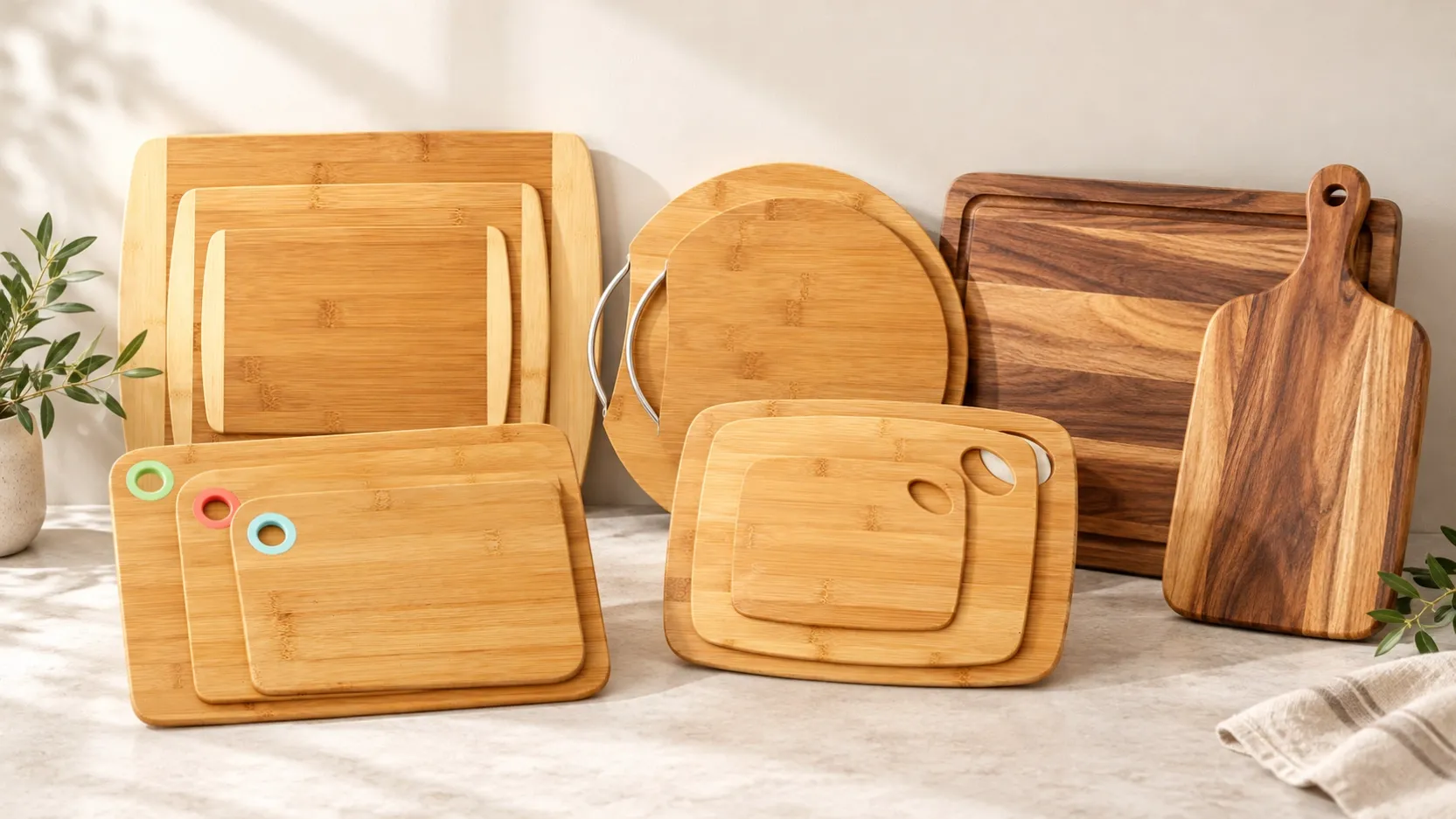
A cutting board collection should not be built by simply selecting as many designs as possible.
For importers, distributors and private-label kitchenware brands, a stronger sourcing approach is to define the role of each SKU, choose the right material and product format, control specification differences, and confirm samples, packaging, quality requirements and order structure before mass production.
When sourcing a bamboo and wood cutting board collection from China, buyers should therefore plan the collection first and the individual products second.
A practical sourcing sequence is:
Target Market → Product Assortment → Materials → Specifications → MOQ & SKU Structure → Samples → Packaging → Quality Control → Compliance Review → RFQ & Bulk Order
This approach helps reduce unnecessary SKU complexity and makes the first order easier to evaluate, quote and reproduce.
1. Start With the Product Assortment, Not the Supplier Catalogue
One of the easiest mistakes when developing a new cutting board line is selecting products one by one without deciding how they will work together as a collection.
A supplier catalogue may contain many attractive options, but a retail assortment normally needs clear product roles.
For example, a cutting board collection may include:
- A simple everyday preparation board
- A three-piece size set
- A board with a juice groove
- A serving or presentation board
- A round board
- A long-handle cutting and serving board
- A board set with a holder or stand
- A premium wood option for a higher retail price point
The goal is not to include every format.
The goal is to create a range in which each SKU has a clear reason to exist.
Different board shapes, sets and storage formats can serve different price points and customer needs within one collection.
2. Give Each SKU a Clear Commercial Role
Before requesting quotations, classify each proposed product.
A simple framework is:
Product Role | Typical Purpose |
|---|---|
Core SKU | Everyday product with broad customer appeal |
Set SKU | Higher basket value through multiple sizes or pieces |
Premium SKU | Stronger material, appearance or presentation |
Functional SKU | Added feature such as groove, handle or holder |
Serving SKU | Combines food preparation and presentation |
Test SKU | New design introduced in a controlled first quantity |
This prevents several products from competing with each other for the same customer.
For example, three rectangular boards that are almost identical in size, material and function may create unnecessary inventory complexity.
A better range might combine:
- One basic preparation board
- One multi-size set
- One higher-value acacia serving board
- One compact holder set
The exact assortment depends on the retailer, market and sales channel, but the principle is consistent:
Every SKU should have a defined customer, function or price position.
3. Choose Materials According to Product Positioning
Bamboo and wood should not be selected only by appearance.
Material choice can affect:
- Product positioning
- Natural color and grain
- Weight
- Construction
- Surface finishing
- Cost
- Customer perception
- Packaging requirements
- Compliance and documentation questions
Bamboo is often used where buyers want a clean, natural and coordinated appearance across a wider collection.
Acacia can provide stronger natural grain variation and a more distinctive wood appearance for products positioned toward serving, gifting or premium kitchenware.
Neither material is automatically the better choice.
The correct decision depends on the product format and the intended market position.
For a broader explanation of material characteristics, buyers can review Rewood's guide to bamboo, acacia and beech wood for B2B houseware sourcing.
Material selection should support the product's role in the collection rather than being decided independently for every SKU.
4. Build a Specification Sheet for Every Cutting Board SKU
A reference photograph is useful for starting a discussion, but it is not enough for repeatable bulk production.
Each cutting board should have a controlled specification.
Depending on the design, this may include:
- Material
- Overall length
- Width
- Thickness
- Board construction
- Corner profile
- Edge profile
- Juice groove dimensions
- Handle shape or handle-slot position
- Hanging hole
- Feet or anti-slip components
- Holder or stand structure
- Surface finish
- Logo method and position
- Individual packaging
- Label and barcode requirements
For a set, also confirm:
- Number of boards
- Size of each board
- Arrangement in the holder or package
- Whether the boards are interchangeable
- Holder dimensions
- Finished set dimensions
If a feature matters to the product's function or appearance, it should be part of the specification rather than left to interpretation during production.
5. Do Not Create Too Many Variants Before Understanding MOQ
A buyer developing a first collection may want:
- Three materials
- Four sizes
- Two colors
- Two logo styles
- Three packaging versions
That can quickly turn a small product range into dozens of separate variants.
The commercial problem is that MOQ may apply differently to:
- The product
- Each size
- Each material
- Each finish
- Each logo version
- Each packaging artwork
- Special packaging components
Packaging MOQ may also be different from product MOQ.
Therefore, before finalizing the assortment, ask:
- Is the MOQ calculated per SKU or across the order?
- Does changing the material create a separate MOQ?
- Does each printed package require its own minimum quantity?
- Can several standard products be combined in the same shipment?
- Which customization creates the largest increase in minimum quantity or cost?
For many projects, a focused assortment of clearly differentiated SKUs is easier to launch and repeat than a large number of low-volume variants.
6. Decide Which Products Need Samples
Not every sourcing project needs the same sample strategy.
A buyer should first identify which SKUs contain the greatest technical or commercial risk.
Sample approval becomes especially important when the product includes:
- Custom dimensions
- New shapes
- Juice grooves
- Handle slots
- Special edge profiles
- Multi-piece sets
- Holders or stands
- Custom colors or finishes
- Custom logos
- Custom packaging
For a simple existing design, a standard sample may be sufficient for initial evaluation.
For a customized product, the sample should represent the approved specification as closely as practical.
The important point is not simply:
“Did I receive a sample?”
It is:
“Does this sample represent the version that will be used as the bulk-production reference?”
Once changes are approved, the updated specification and approved sample should remain aligned.
7. Evaluate the Sample Like a Buyer, Not Only Like a Consumer
A consumer may look at one sample and ask:
“Does this board look good?”
A professional buyer needs additional questions.
Check:
- Is the material correct?
- Are the dimensions correct?
- Is the thickness acceptable?
- Is the board flat?
- Are edges and corners smooth?
- Are grooves and holes positioned correctly?
- Is the natural grain range acceptable?
- Is the surface finish correct?
- Is the logo in the correct position?
- Does the product fit the intended packaging?
- Does the set fit correctly in its holder?
- Does the approved product match the retail positioning?
These questions should become part of the bulk-order control plan.
For more detail, Rewood's wooden cutting board manufacturing and quality-control guide explains the main production stages and inspection points involved in bulk orders.
The approved sample should connect product development with bulk-production inspection.
8. Finalize the Product Before Finalizing Printed Packaging
Packaging should not be treated as a separate design project.
A small change to a cutting board can affect:
- Package dimensions
- Internal fit
- Product photography
- Printed dimensions
- Carton quantity
- Shipping volume
- Barcode position
- Care instructions
A safer sequence is:
Product Specification → Sample Approval → Packaging Fit → Artwork Approval → Bulk Packaging
rather than:
Artwork Printing → Product Revision → Packaging Rework
For flat cutting boards, buyers may evaluate options such as sleeves, belly bands, boxes or other protective retail packaging.
For multi-piece sets or products with holders, packaging may require more control because components can move or rub during transportation.
The correct packaging depends on the actual product, sales channel, quantity and presentation requirements.
Buyers planning branded packaging can review Rewood's guide to private-label packaging for bamboo and wooden houseware.
Packaging should protect the product, support the sales channel and remain commercially practical for the order quantity.
9. Plan Quality Control Before the Purchase Order Is Finished
Quality control should begin with the specification, not only at final inspection.
For cutting board orders, relevant control points may include:
- Correct material
- Dimensions and agreed tolerances
- Board construction
- Flatness
- Cracks or open joints
- Surface sanding
- Edge smoothness
- Groove or handle positioning
- Natural grain and color acceptance
- Surface finish
- Logo appearance and position
- Product-to-holder fit
- Packaging fit
- Barcode and label accuracy
- Carton marks
- Final quantity
Not every product requires exactly the same inspection points.
A simple bamboo board and an acacia board set with holder should not automatically use an identical QC checklist.
The inspection plan should follow the actual product structure.
10. Review Compliance by Product and Destination Market
“Do you have all the certificates?” is rarely the best compliance question.
The more useful starting point is:
What requirements apply to this specific product, material, finish and target market?
A cutting board may involve:
- Bamboo or wood
- Laminated construction
- Adhesive
- Surface oil or coating
- Printing or logo application
- Silicone or metal components
- Packaging materials
The relevant documentation or testing therefore depends on the finished product configuration and destination market.
For EU and US projects, buyers should confirm applicable food-contact and chemical requirements according to the specific product.
For European wood-based products, traceability and current regulatory obligations should also be reviewed separately from food-contact documentation.
Rewood's FDA, LFGB, REACH and FSC guide for bamboo and wooden kitchenware provides a broader framework for these discussions.
11. Consider Packaging Volume Before Finalizing the Collection
Two products with similar factory prices can produce very different landed-cost results.
A buyer should also consider:
- Individual package dimensions
- Units per carton
- Master-carton size
- Gross weight
- Empty space
- Holder or stand volume
- Protective packaging
- Shipping method
A large premium board may justify more packaging volume because of its retail position.
A basic everyday board may need a more space-efficient solution.
For multi-SKU programs, carton efficiency becomes more important because several products are sharing the same shipment.
This is another reason collection planning should happen before the final purchase order.
12. Prepare One Structured RFQ for the Collection
Once the assortment is reasonably defined, send the supplier one structured RFQ instead of discussing each SKU in unrelated messages.
A useful RFQ may include:
Information | Example of What to Provide |
|---|---|
Product | Cutting board / set / serving board |
Material | Bamboo, acacia or material to be recommended |
Size | Dimensions or target size range |
Structure | Groove, handle, holder, feet or other features |
Quantity | Estimated quantity per SKU |
Logo | Method, size and position if known |
Packaging | Standard, kraft, sleeve, color box or reference |
Sales Channel | Retail, e-commerce, wholesale or mixed |
Target Market | Country or region |
Compliance | Known buyer or market requirements |
Timeline | Target sampling or delivery schedule |
If some information is not yet finalized, mark it clearly instead of inventing a specification.
A supplier can provide more useful feedback when it knows which decisions are fixed and which are still open.
13. What Should Be Final Before You Place the First Bulk Order?
Before production begins, buyers should try to have a controlled version of:
- SKU list
- Material
- Dimensions
- Product structure
- Finish
- Logo
- Approved sample or reference
- Packaging
- Artwork
- Labels and barcode
- Inspection requirements
- Quantity per SKU
- Shipping terms
- Target market documentation requirements
Not every item needs to be resolved on the first day of sourcing.
But unresolved points should not remain hidden.
The purpose of pre-production confirmation is to convert a product idea into a repeatable order specification.
Common Mistakes When Building a Cutting Board Collection
Choosing Too Many Similar SKUs
Several boards with almost identical functions can create inventory without creating a stronger assortment.
Comparing Unit Price Without Comparing Product Specification
Material, thickness, construction, finish, packaging and quantity all affect quotation.
Printing Packaging Before the Product Is Stable
Product revisions can make approved artwork, dimensions or inserts incorrect.
Approving a Sample Without Recording Changes
A sample only becomes a useful bulk-production reference when the approved specification is also clear.
Treating Compliance as a Generic Certificate Request
Testing and documentation should match the actual product and market.
Leaving Freight Considerations Until the End
Packaging dimensions, carton quantity and product format can change the landed-cost picture.
Frequently Asked Questions
How Many Cutting Board SKUs Should a New Collection Start With?
There is no universal number.
The right assortment depends on the buyer's sales channel, market size, target price points and ability to manage inventory.
A smaller group of clearly differentiated SKUs is often easier to test and manage than many similar designs.
Should I Source Bamboo and Acacia Cutting Boards in the Same Collection?
They can be evaluated together when they serve different product positions.
For example, bamboo may support one visual or price direction while acacia provides a stronger natural wood character for another part of the range.
The final mix should be based on the intended customer and retail positioning.
Can Different Cutting Board Designs Be Combined in One Order?
This depends on each product's production requirements, MOQ, materials, packaging and supplier arrangement.
Ask whether MOQ applies per SKU, per material or across the broader order before finalizing the assortment.
Should Every SKU Have Custom Packaging?
Not necessarily.
Packaging can be developed according to product role, quantity and sales channel.
A buyer may use simpler packaging for some products and more developed retail packaging for strategic SKUs.
Do I Need a Sample of Every Cutting Board?
The sampling plan should reflect product risk and customization.
Products with different materials, structures, finishes or packaging may require separate confirmation even if they belong to the same collection.
What Should I Check Before Approving a Cutting Board Sample?
Confirm the approved material, dimensions, construction, surface, edges, functional features, finish, logo and packaging fit.
Any changes should be reflected in the final specification used for bulk production.
What Compliance Documents Do I Need?
Requirements depend on the finished product, materials, surface treatment and destination market.
Confirm the applicable requirements for each project rather than assuming one certificate covers every SKU.
What Information Should I Send Rewood for a Cutting Board Project?
Useful starting information includes product references or drawings, estimated quantities, material or target positioning, dimensions if known, logo and packaging requirements, sales channel, target market and delivery schedule.
Planning a Cutting Board Collection?
If you already have complete specifications, send your SKU list, dimensions, target quantities, material requirements, logo files and packaging brief.
If the collection is still under development, share your reference products, target market, price positioning and expected number of SKUs. The project can then be reviewed before final specifications are confirmed.
Explore Rewood's cutting board collection to review current bamboo and wood product formats and private-label options.
Send Rewood your cutting board sourcing requirements to start an RFQ review.
About the Author
Written by Jessie Jiang — Overseas Business Development, Rewood Houseware
Jessie works with importers, distributors and private-label brands on bamboo and wood houseware product development, sourcing coordination, packaging, quality control and export projects.
Reviewed by the Rewood Product Development & Quality Control Team
This guide is intended to help B2B buyers structure a cutting board sourcing project. Final materials, specifications, MOQ, packaging, testing, documentation and production arrangements should be confirmed according to the actual project.
Last updated: October 9, 2026