OEM vs ODM for Bamboo & Wood Houseware: What's the Difference?
OEM vs ODM for bamboo & wood houseware: who provides the design, who owns it, and which route fits your product — plus the private label middle path.
Quick Answer
If you have a complete design — drawings, dimensions and specifications — choose OEM: the factory manufactures your product exactly as specified. If you only have an idea or a market in mind, choose ODM: the factory develops the product for you, and you select, brand and sell it. If you want to sell an existing product under your own logo and packaging, choose private label — the most common route, and the fastest way to start selling. The three routes are not rivals; many buyers start with private label, move to ODM for a differentiated product, and later use OEM for their own designs. This guide explains how each one works in practice for bamboo and wood houseware, what it costs in time, and how to choose.
The standard terms behind all three routes at Rewood are the same: a minimum order quantity (MOQ) of 500 pcs per product (custom designs or special packaging may have a separate minimum), samples in 7–15 days, and production in 20–35 days after sample confirmation. Logos are applied by laser engraving or printing, packaging runs from kraft boxes to color, gift and mailer boxes, with barcode & FNSKU labels and insert cards, and final inspection follows ISO 2859-1 Level II sampling with zero tolerance for critical defects.
OEM vs ODM at a Glance
| OEM | ODM | |
|---|---|---|
| Design provided by | The buyer — drawings, CAD files, specifications | The factory, developed from the buyer's brief |
| Tooling & molds | Based on the buyer's design; usually buyer-specific | Developed with the product; confirmed per project based on complexity |
| IP ownership | The buyer's design stays the buyer's | Agreed before development starts; the buyer owns the branding and the agreed design rights |
| Development time | Shorter — the design already exists; time goes to sampling and approval | Longer — concept, drawings, prototyping and sampling come first |
| Sampling | Normally 7–15 days, to confirm the factory can make your design | 7–15 days for samples based on existing structures; fully new structures confirmed per project |
| MOQ | Standard 500 pcs per product; custom designs may have a separate minimum | Standard 500 pcs per product; the same rule applies once the design is confirmed |
| Best for | Brands and importers with a finished design | Buyers with a market and an idea, but no finished design |
One honest note: MOQ does not really differ between OEM and ODM. The standard is 500 pcs per product either way; what changes the minimum is the product and the level of customization — a highly custom design or special packaging may have a separate minimum, confirmed per project before you commit.
What OEM Looks Like in Practice
In an OEM project, you bring the design and we bring the manufacturing. You send technical drawings or CAD files, product dimensions, material and finish requirements, your logo file and your packaging requirements. We check the files, confirm what can be made as drawn — bamboo and wood have their own limits on thin sections, joints and tolerances — and quote the product, logo, packaging and shipping terms.
Then we make a sample, normally in 7–15 days, and you approve it before production starts. The sample is the contract in physical form: it fixes the size, the material, the finish, the logo position and the packaging. Mass production then takes 20–35 days after sample confirmation, with in-process checks and a final inspection under ISO 2859-1 Level II sampling, with zero tolerance for critical defects.
OEM works best when your design is genuinely finished. If the drawings are incomplete, the factory has to guess — and guessing is where delays and rework come from. Send reference samples or photos alongside the drawings where you can. For the full picture of how we run OEM, ODM and private label together, see our services hub for OEM, ODM & private label.
What ODM Looks Like in Practice
In an ODM project, you bring the idea and the market, and we bring the development. You describe the product — what it is for, who will use it, the size and price you have in mind — and share reference products, photos or sketches. We check material and structure feasibility: will it work in bamboo or wood, will it hold up in use, can it be made at your target price?
Then we produce technical drawings and dimensions, and make a prototype and sample. Samples based on existing structures are normally ready in 7–15 days; a fully new structure takes longer, and we confirm the timing per project. You test the sample, ask for changes, and approve it before mass production. Production then takes 20–35 days after sample confirmation, with in-process quality control and a final inspection under ISO 2859-1 Level II sampling, with zero tolerance for critical defects.
ODM suits buyers who know their customers but do not have a design team. The trade-off is honest: development takes longer than OEM, and any development costs are confirmed per project based on complexity. What you gain is a product your competitors do not have. The full journey is described in the ODM journey from concept to mass production.
The Middle Path: Private Label on Existing Products
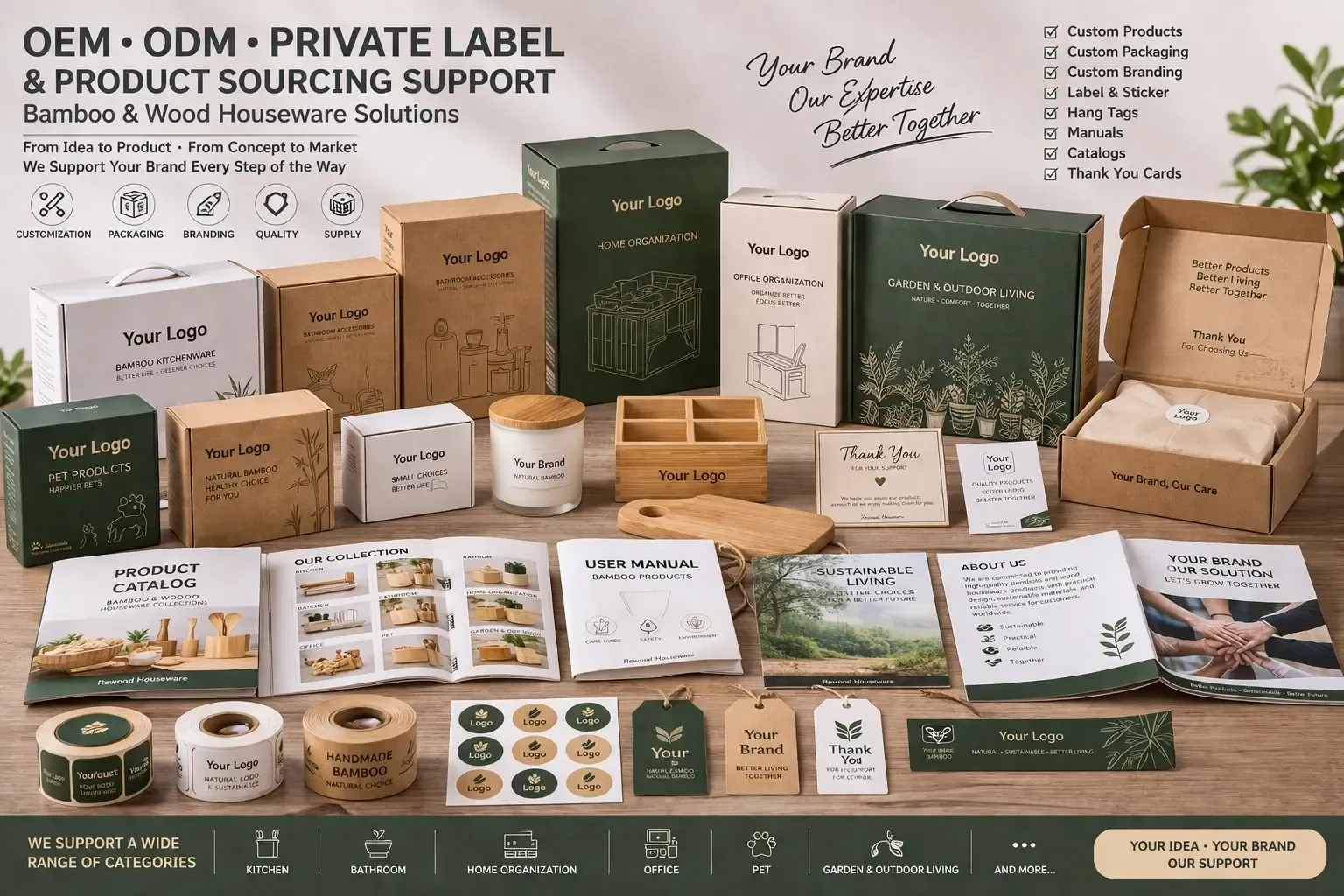
Private label sits between OEM and ODM, and for most new brands it is the sensible first step. The product already exists in our range, so there is no development time and no development cost. What changes is the branding: your logo by laser engraving or printing, your packaging — kraft, color, gift or mailer boxes — and your barcode & FNSKU labels and insert cards.
You choose the product, send your logo file and packaging requirements, and we make a branded sample for your approval. The standard MOQ of 500 pcs per product applies, and samples are normally ready in 7–15 days. Because the product is already proven, the risk is low: you are testing your brand and your market, not an unproven design. Many buyers use private label to test a market, then invest in ODM when they know what sells. If you want to build a brand this way, read our guide on how to start a private label bamboo & wood houseware brand.
How to Choose: Three Buyer Scenarios
1. A brand with CAD files and a finished design
Choose OEM. Your design is your asset; send the drawings, the material and finish specifications, and your packaging requirements, and ask for a quotation and a sample. Check tolerance and finish before you commit: ask for a sample, measure it against your drawing, and confirm the logo method and packaging before production. Do not skip the sample to save time — it is the cheapest insurance in the whole order.
2. An e-commerce seller who wants a differentiated product
Choose ODM, but start from a clear brief. Write down the product's purpose, the target size and price, and two or three reference products you like, then let development do the rest. Expect sample rounds: the first sample tests the concept, the second refines it. Budget for that in your launch timeline, and remember that development time and any development costs are confirmed per project based on complexity.
3. A retailer who wants to launch quickly
Choose private label. Pick proven products from the existing range, add your logo and packaging, and you can be selling in weeks rather than months. The standard MOQ of 500 pcs per product keeps the first order manageable, and the branded sample shows you exactly what your customers will receive. Once the range sells, you can move selected products into ODM for your own versions.
Common Mistakes to Avoid
1. Choosing ODM with a finished design, or OEM with only an idea
The most common mistake is starting on the wrong route. If you already have a finished design, ODM development only adds time and cost. If you only have an idea, OEM has nothing to manufacture — the factory cannot produce from a description. Match the route to what you actually have, not to the term you heard first. In ODM projects, also agree before development starts who owns what — the design, the tooling and the branding. It is a short conversation at the start and a difficult one at the end.
2. Sending an unfinished design as if it were finished
Drawings with missing dimensions, no material specification or no finish requirement force the factory to guess, and the sample will come back wrong. Before you send an OEM brief, check that the dimensions, the material, the finish, the logo position and the packaging are all specified. If a detail is not decided, say so — it is a design question, not a production one.
3. Skipping the sample to save time
Approving production from photos alone, or skipping sampling entirely, is how bulk orders go wrong. The sample is where size, finish, logo and packaging problems show up while they are still cheap to fix. Production takes 20–35 days after sample confirmation; skipping the sample rarely saves that time, because rework takes longer.
Frequently Asked Questions
What is the difference between OEM and ODM?
In OEM, you provide the finished design and the factory manufactures it. In ODM, the factory develops the product from your brief and you brand and sell it. Private label is the third route: an existing product with your logo and packaging.
Who owns the design?
In OEM, the design is yours — you provided it. In ODM, ownership is agreed before development starts, so the design rights, the tooling and your branding are covered in writing before work begins.
Can I start with ODM and move to OEM later?
Yes, and many buyers do. A common path is private label first, then ODM for a differentiated product, then OEM once you have your own finished designs.
Is the MOQ different for OEM and ODM?
No, not as a rule. The standard MOQ is 500 pcs per product for both routes. What can change the minimum is the product and the level of customization — a custom design or special packaging may have a separate minimum, confirmed per project. Development time and any development costs for ODM are also confirmed per project based on complexity.
How long does each route take?
Samples are normally ready in 7–15 days, and production takes 20–35 days after sample confirmation. ODM adds development time before sampling; private label is the fastest, because the product already exists.
Discuss Your Project
Still not sure which route fits? Send us what you have — a design, an idea, or a product you already sell — with your target quantity and delivery date, and we will tell you honestly whether OEM, ODM or private label is the fastest route. See how to request a quote for custom bamboo & wood houseware, then discuss your project with us. For the full service overview, see our OEM / ODM & private label services page.