
Aug 31, 2026Product Development & Case Studies
How Bamboo Mug Drying Racks Are Prepared for Bulk Orders: Flat-Pack Packaging, Assembly & Quality Control
A practical look at bamboo mug drying rack bulk production, covering component control, assembly fit, flat-pack packaging, labeling, carton packing and quality control.
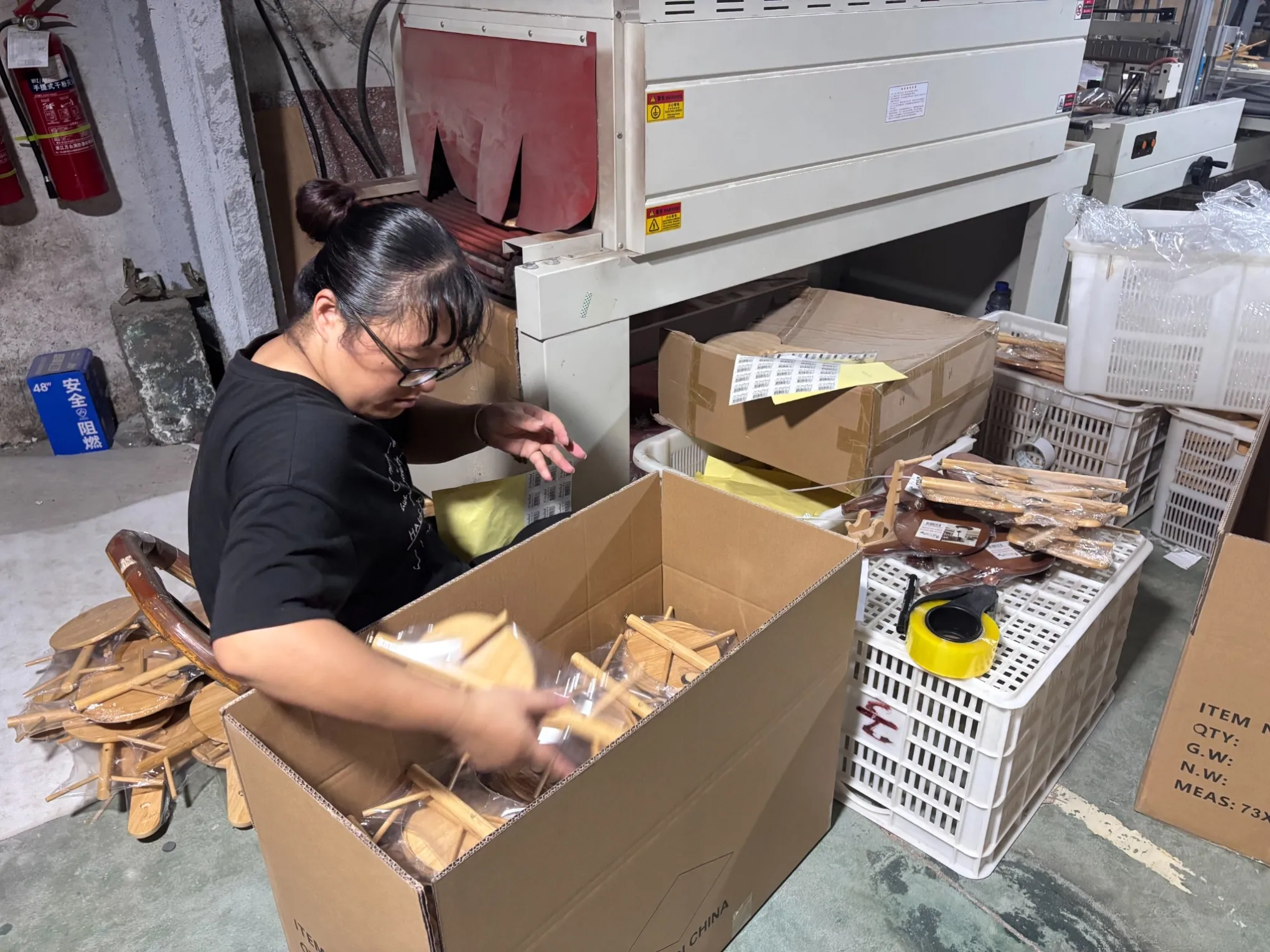
For importers, distributors, retailers and private-label homeware brands, a bamboo mug drying rack may look like a simple countertop product, but consistent bulk production requires control across the components, assembly fit, surface quality, packaging and labeling.
This type of rack is designed to hold mugs or cups upside down on individual pegs, helping them drain and dry while keeping the countertop organized.
The photographs in this case show a real bamboo mug drying rack order during the later stages of bulk production and packing, including bulk component staging, individual flat-pack sets, product labeling, packaging equipment and export-carton preparation.
The finished reference supplied for this project measures approximately 34 cm in overall height with an 18 cm round base.
Because the photographs do not document every earlier machining or finishing stage, this guide focuses specifically on what can be verified from the project: component control, assembly readiness, flat-pack packaging, labeling, carton packing and final quality checks.
Quick Answer: What Should Buyers Control in a Bamboo Mug Drying Rack Bulk Order?
For a bamboo mug drying rack or bamboo cup drying rack, professional buyers should normally confirm:
- Overall product dimensions
- Base diameter and construction
- Center-post dimensions
- Peg quantity, position and orientation
- Component fit
- Finished-product alignment
- Surface and edge quality
- Stability after assembly
- Correct component quantity in every individual pack
- Mug-hanging clearance
- Assembly instructions where required
- Logo and label requirements
- Individual packaging
- Export-carton configuration
- Final pre-shipment inspection
For a flat-pack product, component completeness and assembly fit are just as important as the appearance of the bamboo parts themselves.
1. Define the Finished Bamboo Mug Drying Rack Before Bulk Production
The first step is to define the complete finished product rather than evaluating each bamboo component separately.
The reference product in this project consists of:
- A round bamboo base
- A vertical center post
- Multiple outward-facing bamboo pegs
- A knock-down structure for individual packing and later assembly
The supplied finished-product reference shows:
- Overall height: approximately 34 cm
- Round base diameter: approximately 18 cm

Finished bamboo mug drying rack reference showing approximately 34 cm overall height and an 18 cm round base.
For a professional bulk order, the specification should go beyond these two basic measurements.
Buyers should also confirm:
- Center-post diameter
- Base thickness
- Peg length
- Peg diameter
- Peg position
- Peg orientation
- Distance between hanging points
- Clearance for mugs or cups
- Assembly method
- Surface finish
- Logo requirement
- Packaging method
- Label requirements
Two bamboo mug drying racks can have the same overall height but perform differently if the peg positions, spacing or base proportions are inconsistent.
2. The Product Should Be Evaluated as a Drying Rack, Not Only as a Display Stand
The function of this product is important when defining its specification.
A bamboo mug drying rack is intended to hold mugs or cups on individual pegs, typically in an upside-down or angled position for draining, drying and organized storage.
This means buyers should consider more than appearance.
Functional questions may include:
- Is there enough distance between neighboring mugs?
- Can common mug handles fit around the peg arrangement?
- Does one mug interfere with another?
- Are the pegs long enough to support the intended cups?
- Does the rack remain stable when several mugs are placed on it?
- Is the base proportion appropriate for the finished structure?
The exact load and mug configuration should be evaluated according to the approved design rather than assumed from the product photograph alone.
3. Component Fit Is Critical for a Flat-Pack Bamboo Cup Drying Rack
The production photographs show large quantities of bamboo components prepared before individual packing.
For a knock-down or flat-pack product, those parts must work together consistently after the customer opens the package.
A complete set may contain:
- Round bamboo base
- Vertical center post
- Bamboo hanging pegs
- Connection points
- Other assembly components where applicable
A problem with only one component can prevent the complete drying rack from assembling correctly.
Typical risks include:
- Connection points that are too tight
- Connections that are too loose
- Inconsistent peg diameters
- Incorrect drilling positions
- Misaligned holes
- Components from different versions being mixed
- Pegs that do not remain securely positioned after assembly
This is why component compatibility should be checked before the entire production batch is packed.
4. Large Production Batches Need Clear Component Control
When hundreds or thousands of similar bamboo components are produced together, visual similarity can create a mixing risk.
The production photograph shows a substantial quantity of bamboo drying-rack components grouped before individual set packing.
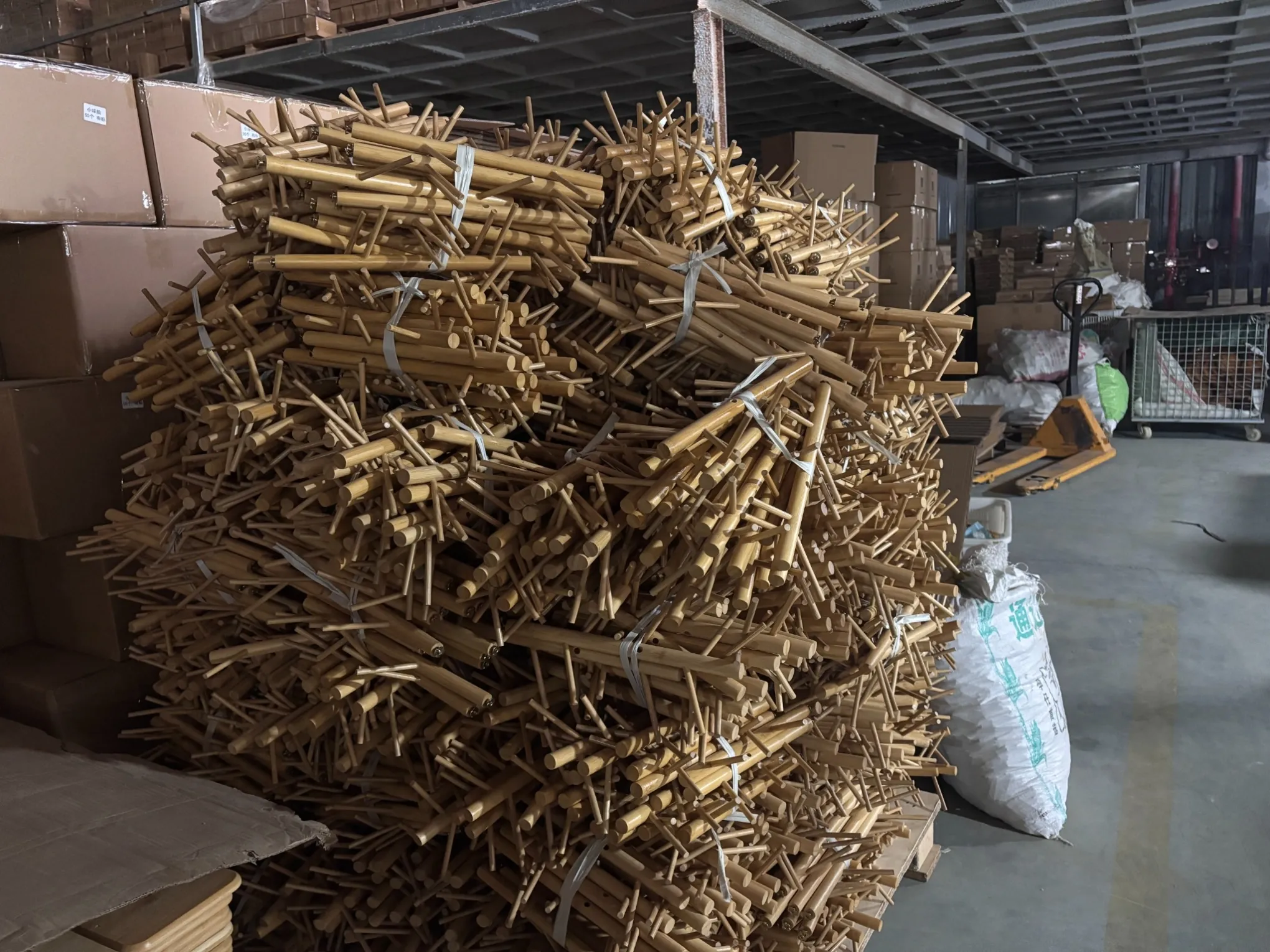
Bamboo mug drying rack components grouped in quantity before individual set packing.
Batch control becomes particularly important when the factory is handling:
- Different product models
- Different dimensions
- Different peg configurations
- Different finishes
- Different customer orders
- Different packaging versions
Practical internal controls may involve:
- Product codes
- Batch groups
- Temporary labels
- Packaging references
- Production-stage identification
The objective is simple:
The correct components must stay connected to the correct finished SKU.
5. Peg Position and Spacing Affect Mug Drying Function
The hanging pegs are one of the most important functional features of the product.
They should not be positioned only according to visual judgment.
The approved sample should provide a reference for:
- Vertical position
- Direction
- Peg orientation
- Spacing
- Projection from the center post
- Relationship between neighboring pegs
If the peg positions vary significantly, two problems may occur.
First, the finished racks may look inconsistent.
Second, the space available for hanging mugs may also vary.
Professional buyers should therefore evaluate the product using actual mugs or cups representative of the intended use during sample development.
This is more useful than evaluating the empty rack alone.
6. The Base Should Be Checked as Part of the Complete Rack
The supplied reference uses a round base approximately 18 cm in diameter.
The base should not be evaluated only as a separate bamboo disc.
For the assembled bamboo mug drying rack, buyers should consider:
- Base diameter
- Base thickness
- Flatness
- Center connection position
- Edge quality
- Surface quality
- Relationship between the base and center post
- Stability with mugs installed
If the base is distorted or the center connection is off-position, the entire rack may appear tilted or unstable.
Finished-product assembly checking is therefore necessary even when the individual components have already passed separate dimensional checks.
7. Surface Quality Should Be Checked Before Individual Packing
The bamboo mug drying rack contains several areas that the end customer will handle directly.
These include:
- Hanging pegs
- Center post
- Peg ends
- Base edge
- Base top surface
Before individual packing, visual and hand-feel checks should look for problems such as:
- Rough fibers
- Splinters
- Chipped edges
- Deep scratches
- Strong machining marks
- Open bamboo joints
- Glue residue
- Surface contamination
- Obvious appearance outliers
Bamboo is a natural material, so some variation in grain and tone is normal.
The objective is not to make every product artificially identical.
The goal is to prevent pieces that clearly fall outside the approved appearance standard from being packed into acceptable production sets.
8. Assembly Testing Should Be Completed Before the Entire Batch Is Packed
Flat-pack packaging is commercially useful only when the customer can assemble the product correctly after receiving it.
Representative production sets should therefore be assembled before the entire order is sealed.
Assembly checks should include:
- Are all required components present?
- Do the parts fit correctly?
- Does the center post remain aligned?
- Does the base sit flat?
- Do the pegs install as intended?
- Is any connection excessively loose?
- Does assembly require unreasonable force?
- Does the completed rack match the approved sample?
- Can representative mugs be placed on the rack correctly?
This type of fit testing becomes especially important when different components are produced in separate batches.
A component may individually meet its drawing dimension but still create poor assembly when combined with another component at the opposite end of its production tolerance.
9. Why Flat-Pack Packaging Makes Sense for a Bamboo Mug Drying Rack
A fully assembled mug drying rack contains multiple projecting pegs around the center post.
If it is shipped fully assembled, those projecting components can:
- Increase package dimensions
- Create unnecessary empty space
- Be more exposed to impact
- Reduce carton utilization
- Increase the chance of peg damage
The production photographs show the bamboo components grouped as individual flat-pack product sets before export-carton packing.
For this type of product, flat packing may help:
- Reduce individual package volume
- Protect projecting pegs
- Improve export-carton utilization
- Reduce unnecessary empty space
- Make individual sets easier to handle
- Lower the risk of projecting components catching against other products
However, flat packing creates another critical requirement:
Every individual package must contain the correct and complete component set.
A missing peg, incorrect center post or wrong base can make the finished retail product unusable.
10. Individual Set Packing Requires Component Verification
The packaging photographs show bamboo mug drying rack components grouped into individual clear protective packages before being placed into larger cartons.

Bamboo mug drying rack components grouped into individual flat-pack sets before export-carton packing.
Before each individual package is closed, practical checks should include:
Packing Check | What Should Be Confirmed |
|---|---|
Base | Correct size and surface condition |
Center Post | Correct model and finish |
Pegs | Correct quantity and configuration |
Other Parts | Complete where applicable |
Logo | Correct method and position if customized |
Label | Correct SKU or buyer label |
Packaging | Correct individual-pack version |
Complete Set | No components mixed from another model |
For private-label buyers, this stage is particularly important because the identification label must match the physical product inside.
11. Product Labels Must Stay Connected to the Correct SKU
Individual labels are visible on the packed products in the production photographs.
Depending on the buyer and sales channel, product identification may include:
- SKU
- Barcode
- FNSKU where applicable
- Item number
- Product name
- Buyer reference
- Country-of-origin information where required
- Retailer-specific labels
Not every project requires every label type.
The important point is that labeling should be confirmed before final export-carton packing, rather than corrected after different products have already been mixed together.
For multi-SKU orders, clear labeling also supports:
- Warehouse receiving
- Inventory management
- E-commerce fulfillment
- Retail distribution
12. Packaging Equipment Supports a Repeatable Packing Process
The workshop photographs also show the product packing stage being carried out alongside packaging equipment.
At this point, the objective is to create a repeatable packing configuration for the finished product set.
Relevant checks may include:
- Product orientation
- Component grouping
- Packaging dimensions
- Film or bag condition
- Label placement
- Packaging seal
- Surface protection
- Product visibility where required
The final packaging method should match the actual sales channel and logistics plan.
One buyer may use a simple protective package.
Another may require:
- Kraft box
- Printed color box
- Mail-order packaging
- Instruction card
- Barcode label
- Private-label artwork
Packaging should therefore be treated as part of the product specification rather than a last-minute decision.
13. Assembly Instructions Can Reduce Customer Confusion
A bamboo mug drying rack may appear easy to assemble to the factory team because workers handle the same components repeatedly.
That does not mean every retail customer will immediately understand the correct assembly sequence.
For flat-pack products, buyers should consider whether the retail package needs:
- Simple assembly instructions
- Step-by-step illustrations
- Component identification
- QR-code instructions
- Care instructions
Instructions should match the actual final production version.
If the component layout or assembly method changes during product development, the instruction artwork should also be updated before printing.
14. Export Carton Packing Must Protect the Individual Sets
After individual flat-pack sets are prepared, they are grouped into larger export cartons.
The production photographs show multiple individually packed bamboo mug drying rack sets inside an outer carton.
Export-carton planning should consider:
- Quantity per carton
- Product orientation
- Carton dimensions
- Gross weight
- Empty space
- Movement during transportation
- Compression during stacking
- Protective material where required
- Shipping marks
- Carton labels
An oversized carton may allow products to move excessively.
A carton that is too tight may place unnecessary pressure on the bamboo components or individual packaging.
The final carton configuration should therefore be checked using actual packed production units.
15. Flat-Pack Packaging Can Affect Landed Cost
For professional importers, flat-pack design is not only a packaging decision.
It can also affect transportation economics.
Relevant factors may include:
- Individual package dimensions
- Units per export carton
- Export-carton CBM
- Carton gross weight
- Container utilization
- Parcel dimensions for e-commerce fulfillment
This means buyers should not evaluate packaging only by asking:
“Does the package look attractive?”
A more useful commercial question is:
“Does this packaging protect the product while making sense for my logistics model?”
For a mug drying rack with several projecting pegs, the difference between fully assembled and flat-packed shipping can materially change package geometry.
16. Sample-to-Bulk Consistency Should Include Packaging and Assembly
A common mistake is approving the physical bamboo drying rack while leaving packaging and assembly details uncontrolled.
The final approved reference should ideally include:
- Overall dimensions
- Base dimensions
- Peg configuration
- Assembly method
- Bamboo appearance range
- Surface finish
- Logo
- Component count
- Individual packaging
- Product label
- Assembly instructions where required
- Export-carton configuration
For a flat-pack product, the packing sequence and component count are part of the product specification.
A good development sample should therefore answer more than:
“Does the bamboo mug drying rack look correct?”
It should also answer:
“Can the production version be packed, assembled and received consistently?”
For a broader supplier-qualification checklist, buyers can also review our bamboo and wood houseware manufacturer evaluation guide.
Bamboo Mug Drying Rack Quality-Control Checklist
QC Area | What Buyers Should Confirm |
|---|---|
Overall Size | Finished rack matches approved dimensions |
Base | Diameter, flatness, edge quality and center position |
Center Post | Correct size, straightness and surface condition |
Pegs | Correct quantity, dimensions and surface finish |
Peg Position | Consistent spacing and orientation |
Mug Clearance | Adequate space for the intended mug configuration |
Assembly | Components fit without excessive looseness or force |
Finished Rack | Correct alignment and functional stability |
Bamboo Surface | No serious chips, splinters, cracks or scratches |
Component Count | Every flat-pack set is complete |
Label | Correct SKU and buyer information |
Individual Pack | Correct packaging version and protection |
Export Carton | Correct quantity, shipping mark and packing configuration |
17. Common Bamboo Mug Drying Rack Production Risks
Potential Issue | Possible Cause | Recommended Control |
|---|---|---|
Pegs are loose | Connection tolerance too large | Check fit during representative assembly |
Pegs are difficult to install | Connection tolerance too tight | Test production components before packing |
Rack appears tilted | Base or center connection inconsistency | Inspect completed assembled units |
Mugs interfere with each other | Poor peg spacing | Approve spacing using representative mugs |
Rough hand-contact areas | Incomplete sanding | Add hand-feel inspection before packing |
Components are missing | Weak packing control | Use a component checklist for every set |
Wrong label applied | Mixed SKU handling | Connect labels to controlled packing batches |
Peg damage in transport | Poor packaging configuration | Use appropriate flat-pack protection |
Excessive carton volume | Inefficient package structure | Confirm package dimensions before mass production |
Customer cannot assemble product | Unclear instructions | Add simple assembly guidance where required |
18. What These Production Photos Can—and Cannot—Prove
Real workshop photographs are valuable because they show actual physical production and packing activity.
The photographs in this article can support the presence of:
- Bamboo mug drying rack components
- Bulk component staging
- Individual set packing
- Product labeling
- Packaging equipment
- Export-carton packing
- Flat-pack product configuration
The supplied finished-product reference also shows approximately 34 cm overall height and an 18 cm round base.
However, these photographs alone do not prove:
- Exact order quantity
- Final MOQ
- Monthly production capacity
- Specific surface coating
- Testing results
- Certification scope
- Customer identity
- Destination market
- Final inspection results
Those points require separate specifications, records or project documentation.
For professional buyers, real factory photographs are useful evidence, but they should be evaluated together with approved samples, specifications, packaging requirements and quality-control records.
How Rewood Supports Custom Bamboo Mug Drying Rack Projects
Rewood supports importers, distributors, retailers and private-label homeware brands with bamboo and wooden houseware development and bulk-order coordination.
Depending on the bamboo mug drying rack project, customization may include:
- Overall dimensions
- Base size
- Peg quantity
- Peg position and configuration
- Bamboo appearance
- Surface finish
- Logo application
- Flat-pack configuration
- Private-label packaging
- Assembly instructions
- Barcode and label coordination
- Export-carton configuration
- Production follow-up
- Quality-control requirements
The final specification, MOQ, packaging and production arrangement are confirmed according to the actual project.
Buyers preparing a customized product can also review our guide to requesting a quote for custom bamboo and wood houseware before sending an RFQ.
What Information Is Needed for a Bamboo Mug Drying Rack Quotation?
For an initial quotation, buyers should provide:
- Product reference or drawing
- Required overall dimensions
- Base dimensions
- Preferred peg quantity and configuration
- Estimated order quantity
- Surface-finish requirement
- Logo requirement
- Packaging preference
- Flat-pack or assembled requirement
- Barcode or label requirement
- Target market
- Delivery destination
If the buyer does not yet have a complete technical drawing, a clear reference image and target dimensions can still be used for the first evaluation.
Frequently Asked Questions
What Is the Correct English Name for This Product?
The preferred core name is Bamboo Mug Drying Rack.
Depending on the market and search terminology, it may also be described as a Bamboo Cup Drying Rack, Mug Drying Stand or Bamboo Cup Holder Stand.
What Is the Product Used For?
The rack is designed to hold mugs or cups on individual pegs for draining, drying and organized countertop storage.
What Size Is the Bamboo Mug Drying Rack Shown in This Project?
The supplied reference shows approximately 34 cm overall height with an 18 cm round base.
Can the Bamboo Mug Drying Rack Be Shipped Flat-Packed?
Yes. A knock-down configuration can be evaluated for this product type. The production photographs in this case show components grouped as individual sets before export-carton packing.
Why Use Flat-Pack Packaging?
Flat packing can reduce package volume, protect projecting components and improve carton utilization. Component completeness and assembly fit must therefore be controlled carefully.
Can the Product Size Be Customized?
Different overall heights, base sizes and component configurations can be evaluated according to the project and manufacturing feasibility.
Can the Peg Quantity or Arrangement Be Customized?
Yes. Peg quantity, position and layout can be evaluated during product development. The final configuration should be confirmed through sample approval.
Can a Custom Logo Be Added?
Logo options can be evaluated according to the product design, requested branding method and placement.
Can Rewood Provide Private-Label Packaging?
Yes. Packaging requirements can be evaluated according to the product, order quantity, sales channel and buyer’s branding needs.
Should Assembly Instructions Be Included?
For flat-pack retail products, simple assembly instructions can be useful. Whether they are required should be confirmed according to the sales channel and buyer preference.
What Should Buyers Check Before Bulk Shipment?
Buyers should check dimensions, component fit, peg configuration, surface quality, component count, labels, individual packaging and export-carton configuration against the approved reference.
Discuss Your Bamboo Mug Drying Rack Project with Rewood
A simple-looking bamboo mug drying rack still requires coordinated control across the product, components, assembly and packaging.
For bulk production, the important question is not only whether one sample looks good.
The supplier must also consistently reproduce the correct components, maintain mug-hanging spacing, group complete sets, ensure assembly fit, protect the product during transportation and keep the packaging connected to the correct SKU.
Send Rewood your product reference, required dimensions, target quantity, logo, packaging requirements and destination market.
About the Author
Written by Jessie Jiang
Overseas Business Development, Rewood Houseware
Jessie works with importers, distributors, retailers and private-label brands on bamboo and wood houseware manufacturing, OEM/ODM product development, sampling, private-label packaging, quality control and export projects.
Reviewed by the Rewood Product Development & Quality Control Team
This article is based on real bamboo mug drying rack production and packing photographs and Rewood’s practical experience supporting bamboo and wooden houseware bulk-order projects.
Last updated: August 31, 2026