B2B Buying & Sourcing Guides
Bamboo vs Plastic Bathroom Organizers: Which Is Better for Your Store Range?
Bamboo or plastic for your bathroom range? A buyer's comparison of humidity performance, returns, shelf impact and margin structure — and where each material earns its place in the assortment.
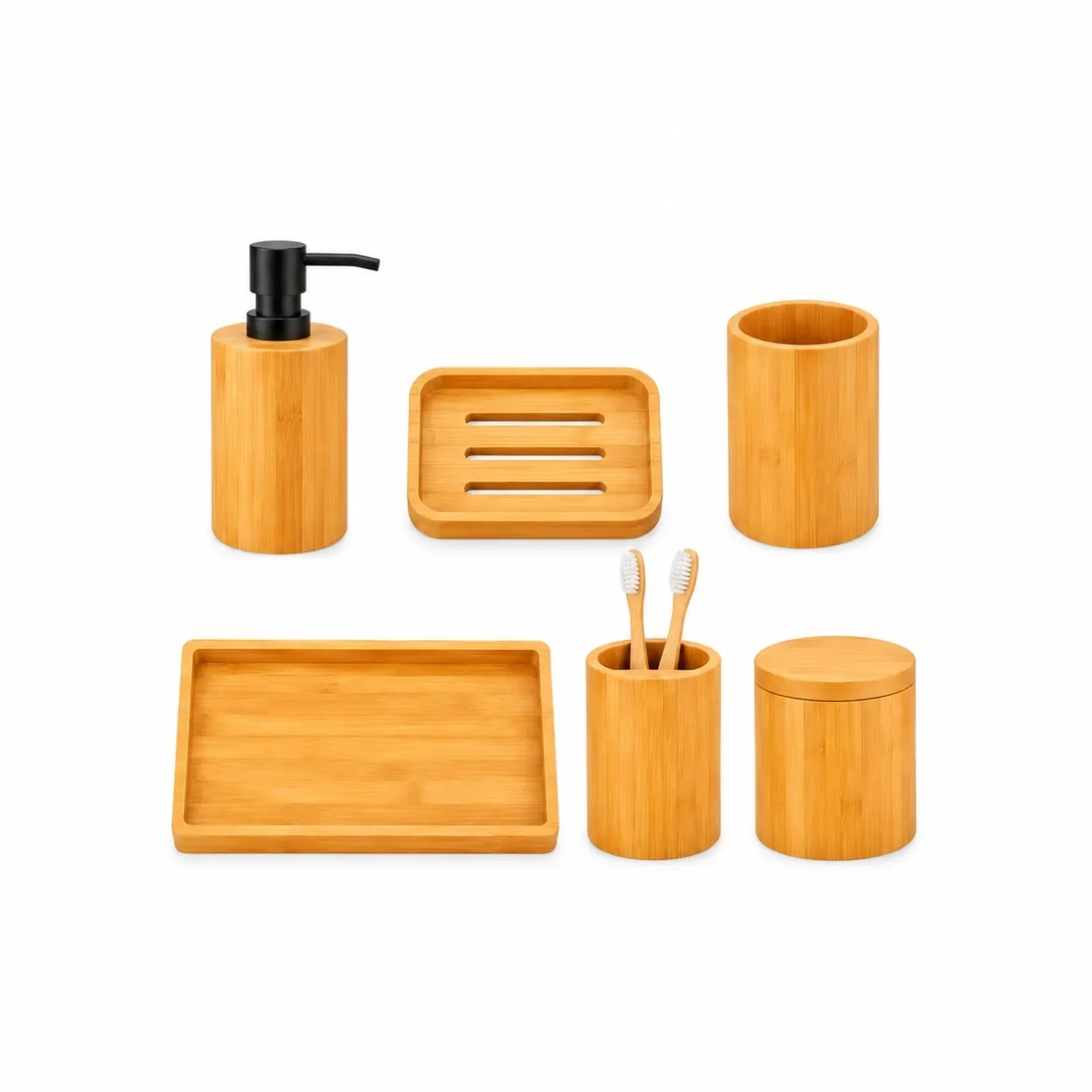
For most retail bathroom ranges, the answer is not bamboo or plastic — it is bamboo where the customer sees and touches the product, and plastic where the product's shape or job makes moulding the sensible route. Bamboo carries the visible, giftable, private-label end of the range: countertop organizers, accessory sets, trays and holders. Plastic earns its place in one-piece moulded items, standing-water jobs and the entry price tier. The buying mistake is forcing one material across the whole assortment and accepting the returns and the margin structure that come with it.
The Short Answer: Split the Range by Product Role
Product role in the range | Material that usually fits | Why |
Countertop organizers, trays, toothbrush holders, soap dishes | Bamboo | Visible every day, carries the brand, sells as coordinated sets |
Multi-piece bathroom accessory sets for retail and private label | Bamboo (own-factory) | One material, finish and colour standard across every piece |
Pedal bins, inner buckets, one-piece moulded bodies | Plastic or plastic with bamboo accents | Moulding produces sealed, complex shapes in one piece |
Items that sit in standing water or inside the shower spray zone | Plastic, or bamboo only with a verified finish | Constant water contact is the harshest test in the bathroom |
Entry-tier promotional lines | Plastic | Lowest unit cost route when the shelf price is fixed first |
This split is also how the range is usually supplied: the bamboo core from a manufacturer, the moulded pieces sourced alongside it. Our bamboo bathroom organizers wholesale range is built that way — own-factory bamboo organizers and sets, with partner-sourced pieces completing the program in the same shipment.
Humidity: The Bathroom Tests the Material First
A bathroom is steam, splashes and standing water, and it exposes weak material control faster than any other room. For bamboo, the defence is set before the product is packed: Rewood dries bamboo and wood to a moisture content below 12% before production and applies a water-resistant surface finish suited to humid rooms. Note the wording — water-resistant, not waterproof. A buyer should ask any bamboo supplier for its moisture target and finish specification in writing, and check both again on the production sample, because a bamboo organizer that leaves the factory too wet is the one that warps or mildews in the customer's bathroom and comes back to your store.
Plastic handles humidity differently: a moulded body has no grain, no joints and no finish to fail, so water does not change the material itself. For items in constant water contact, that counts. What humidity does expose on plastic is surface behaviour over time — soap residue and limescale show on glossy moulded surfaces, and thin-walled mouldings flex. Neither material is maintenance-free in a bathroom; they fail in different places.
Durability and Returns: What Actually Comes Back
Range decisions should be made on return patterns, not on how a sample feels on day one. Bamboo organizers that come back usually fail at moisture points: a finish that wore through at the base, a joint that opened, a board that warped because the material was packed too wet. These are production-control failures, and they are preventable at the supplier end — moisture control below 12%, finish coverage on edges and undersides, and sample-to-bulk consistency are the checks that keep them out of your returns pile.
Plastic returns look different: cracked corners from drops, split seams on two-part mouldings, broken pump heads and hinges — the moving and moulded parts rather than the material. For a buyer, the practical difference is where you spend your QC attention. On bamboo, you audit the material and the finish. On plastic, you audit wall thickness, moulding quality and the mechanism parts. A supplier who cannot explain which failure mode belongs to which material is guessing about both.
Price Band and Margin Structure
No useful comparison can be made on unit price alone, because the two materials sit in different price bands and behave differently inside them. Plastic bathroom accessories occupy the entry band: low unit cost, thin margin per piece, and a range that competes on price against every other plastic set on the shelf. Bamboo sits in the mid band, where the margin is protected by presentation — a coordinated bamboo set is compared by the shopper against other sets, not against the cheapest single item.
Two structural points matter more than the band itself. First, bamboo sets raise the basket: organizers, trays and accessory pieces bought as one program carry a higher total ticket than the same functions bought as loose plastic items. Second, the bamboo band tolerates private-label pricing better, because the branding, packaging and material story give the retailer something to price against besides the shelf neighbour. If your channel is discount-led and the shelf price is set before the product is chosen, plastic will usually win that brief — and it should. If your channel sells sets, gifts or branded ranges, bamboo is where the margin structure works.
Shelf Presence and Brand Perception
Bathroom products are displayed, not stored, in most retail formats — the customer sees the material before they read the box. Bamboo gives a range a single recognisable look across organizers, shelves and sets, which makes planograms simpler and makes a small range look like a designed collection. It also photographs consistently for e-commerce listings, where the material is often the first filter a shopper applies.
Plastic's shelf strength is colour and shape freedom: moulding produces exact colour matching across a set and shapes bamboo cannot be cut or joined into. A colour-led bathroom program — matching a retailer's seasonal palette, for example — is a legitimate reason to build that part of the range in plastic. What plastic rarely provides is a reason for the shopper to choose your set over the identical-looking set in the next store, which is why plastic ranges compete harder on price.
Private Label and Packaging Execution
For private-label buyers, the material decides how the branding is applied and how it survives. On bamboo, a logo is typically laser-engraved or printed and confirmed on samples before production; engraving does not peel or fade in a humid room, which matters for a product that lives next to a sink. Packaging for bamboo retail sets — kraft boxes, retail colour boxes and e-commerce mailer formats — is part of the same program, with barcodes and labels handled in the same order.
On plastic, branding is usually printed or labelled, and on sourced sets the options are confirmed item by item with the supplier rather than assumed from the bamboo program. The risk is assuming the two behave the same. Our OEM and private label page sets out how logo, packaging and specification options are confirmed for a program before production starts.
Replenishment and Range Extension
A bathroom range is a repeat-order program, not a one-off buy, so judge both materials on what happens at the second and third order. A bamboo range extends by addition: a new organizer, a shelf, a matching set piece can be developed in the same material and finish standard and added to the program without redesigning the existing SKUs. Reorders repeat an approved specification, so the buyer's main job is keeping the finish and colour standard identical from batch to batch — a sample-retention discipline, not a new development project.
Plastic extends by mould: a new shape needs new tooling, while a new colour of an existing shape is straightforward. So a plastic range recolours quickly but reshapes slowly; a bamboo range adds shapes without new tooling. Plan the extension path when you choose the material split, not after the first range sells through.
Compliance and Documentation
Bathroom organizers are not food-contact products, so the documentation conversation is usually about material claims and market labelling rather than food-contact testing. The claim buyers most often want is FSC. Rewood holds FSC certification, with documentation confirmed per product and order rather than assumed across the whole range — an FSC statement on your retail packaging has to match the documentation issued for the specific items in that order.
The same discipline applies in reverse on the sourcing track: certificates held for Rewood's own bamboo production do not extend automatically to partner-sourced plastic items. If a sourced set will carry any material or certification claim in your market, confirm the supporting documentation with the supplier before the claim is printed, not after the goods arrive.
Where Plastic Is the Right Call
Some jobs plastic simply does better. One-piece moulded shapes — pedal bins, inner buckets, pump bottles, toilet brush holders — come out of a mould sealed and finished in a way that cut-and-joined bamboo cannot match at a workable cost. Items that live in standing water belong in plastic unless a bamboo finish has been verified for that exact use. Entry-tier and promotional lines, where the shelf price is fixed first and the product is chosen second, are plastic's home ground. And where an exact colour match across a large set is the whole point of the program, moulding delivers it more reliably than a natural material with grain variation.
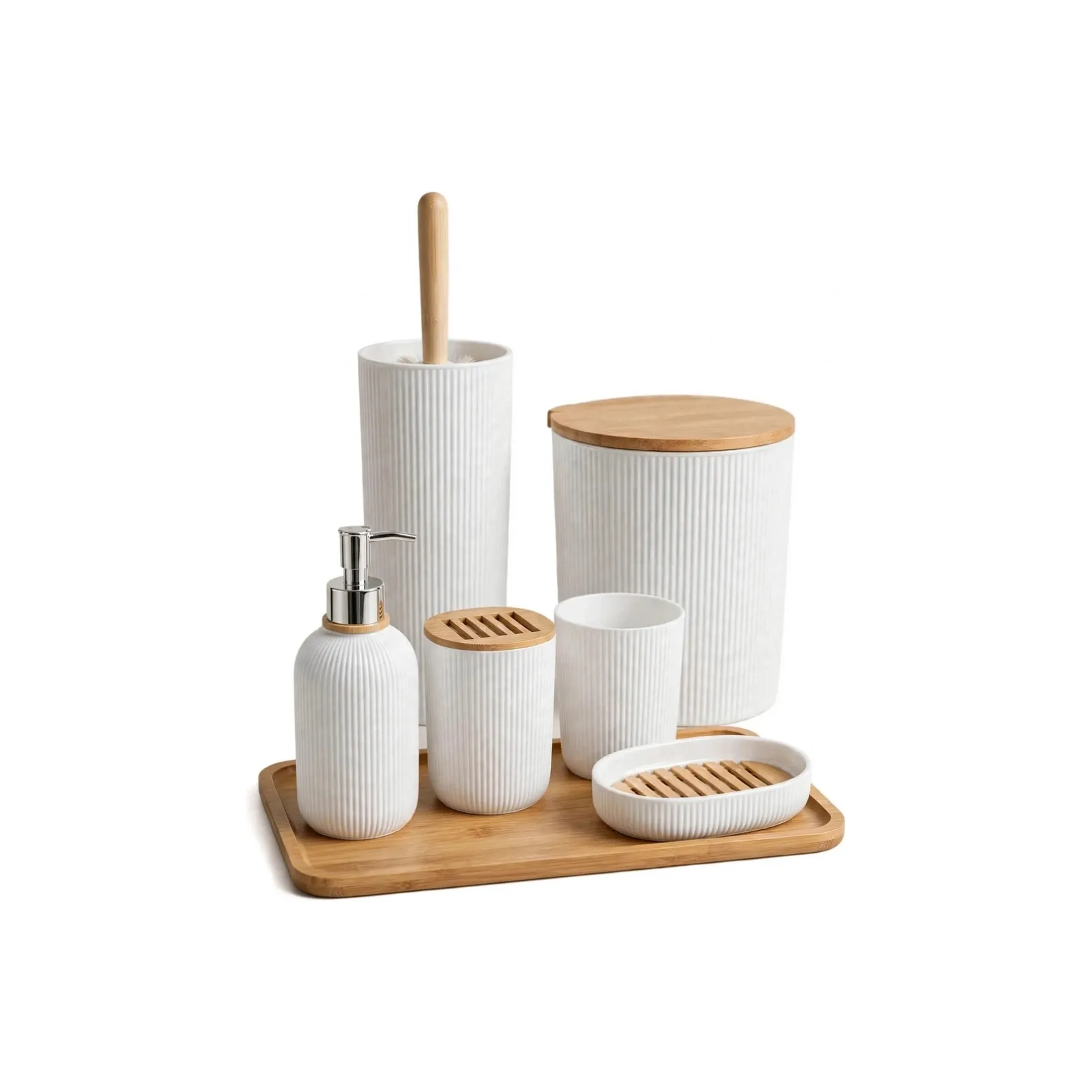
Rewood supplies this track itself rather than arguing buyers out of it: our sourcing program includes a 6-piece bathroom accessory set with bamboo lids — ribbed plastic bodies with bamboo lids, tray and accents — sourced from vetted partner factories and inspected by our Yiwu team before shipment. The bamboo lid keeps the set inside the look of a bamboo-led range while the moulded bodies do the wet work.
How the Two Tracks Are Supplied
Rewood manufactures its bamboo and wood bathroom range at its own factory in Longquan, and sources complementary plastic and mixed-material pieces through partner factories coordinated by the Yiwu team. The two tracks are quoted and documented separately, because their terms differ. MOQ 500 pcs per design applies to products made by Rewood; partner-sourced items are confirmed per item with the supplier. Samples and production timelines follow the same split — the figures quoted for Rewood-made bamboo do not carry over to sourced items, which are confirmed per item in the quotation. Both tracks can be consolidated into one shipment, which is what makes a mixed-material bathroom range practical to buy.
If you are still deciding which natural material the bamboo side of the range should use, our material guide on how B2B buyers choose between bamboo, acacia and beech wood covers the species-level comparison this article deliberately leaves out.
A Buyer's Checklist for Splitting the Range
- List every planned SKU and mark its job: display and branding, wet work, moulded shape, or entry price point.
- Assign bamboo to the display and set pieces; assign plastic to moulded, standing-water and entry-tier pieces.
- Ask the bamboo supplier for its moisture target (below 12%) and finish specification in writing, and recheck both on samples.
- Confirm which items are made by the supplier's own factory and which are partner-sourced — before quotation, not after.
- Confirm FSC documentation per product and order for any item that will carry the claim on packaging.
- Approve set composition, finish standard and branding on samples as one unit, not piece by piece.
- Plan the second-order extension path — new shapes, new colours, new set pieces — against each material's tooling reality.
Frequently Asked Questions
Is bamboo hygienic enough for bathroom products?
Hygiene in a bathroom organizer is a surface question, not a material slogan. A bamboo organizer with a sound water-resistant finish wipes clean like other bathroom surfaces, and the risk points are worn finish and standing water trapped under the base — both controlled by finish quality and moisture control below 12% before production. Plastic's moulded surfaces are equally cleanable; neither material should be sold on an antibacterial claim the supplier cannot document.
Will bamboo bathroom organizers warp or grow mould?
They can, if the material is packed too wet or the finish fails — which is why the moisture target and finish specification belong in the order documents, not in a sales conversation. Bamboo dried and controlled to a moisture content below 12% and finished for humid rooms is made for bathroom use; bamboo without that control is where the failures come from. Ask for both points in writing and verify them again on the production sample.
Can I mix bamboo and plastic items in one bathroom range and one shipment?
Yes — that is the normal structure of a two-track range. The bamboo items are manufactured as one program and the plastic or mixed-material items are sourced alongside, inspected before shipment and consolidated into the same container. The commercial terms stay separate: MOQ 500 pcs per design applies to products made by Rewood; partner-sourced items are confirmed per item with the supplier.
Which material is better for a private-label bathroom set?
For a branded set, bamboo usually carries the program better: the logo can be laser-engraved so it does not peel in a humid room, the pieces share one material and finish standard, and the set presentation supports a mid-band price. Plastic sets can also be private-labelled, with printing and packaging options confirmed per item with the supplier. Many ranges use both — bamboo for the branded set, plastic for the moulded pieces around it.
Does an FSC claim cover the plastic items in a mixed range?
No. FSC documentation follows the certified wood-based material and the specific order it is issued for. Rewood holds FSC certification, with documentation confirmed per product and order; a plastic item in the same range or the same shipment does not inherit that claim. Confirm the documentation for each item before any claim is printed on its packaging.
To build your bathroom range on the right material split, send us your SKU list — which pieces you see as bamboo, which as moulded or sourced items, your target market and your packaging requirements — and we will reply within 24 hours with the supply track, MOQ and sample options for each item.
Author: Rewood Houseware editorial team
Reviewed by: Rewood export team, Yiwu
Last updated: 27 November 2026