Sep 2, 2026Materials, Quality & Compliance
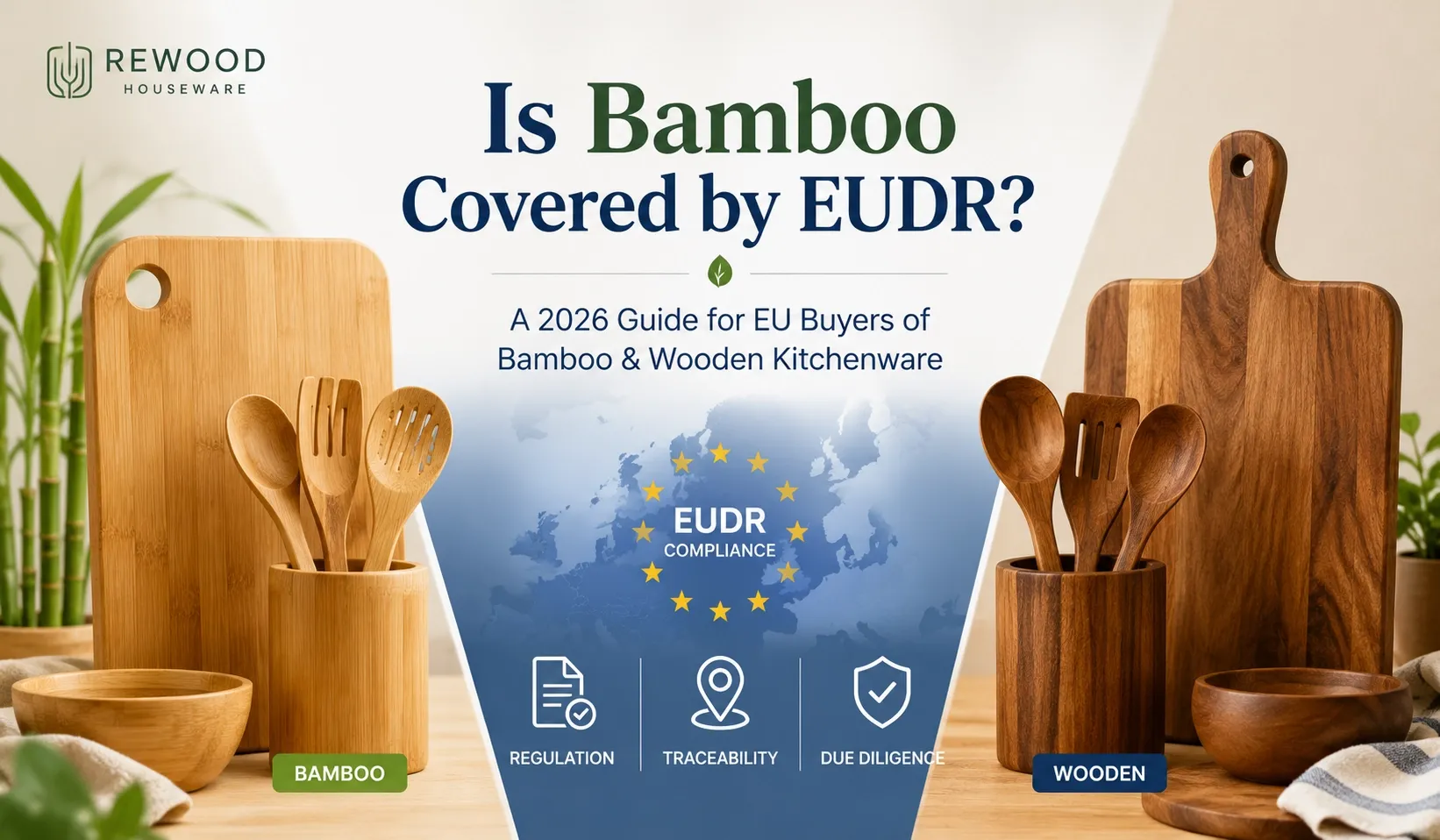
Is Bamboo Covered by EUDR? A 2026 Guide for EU Buyers of Bamboo & Wooden Kitchenware
Is bamboo covered by EUDR? Learn how EUDR applies to bamboo, wooden kitchenware, mixed materials, FSC, traceability and EU importers in 2026.
For European importers sourcing bamboo cutting boards, wooden utensils, serving boards, drawer organizers, and other natural-material housewares, the EU Deforestation Regulation has created an important question:
Does EUDR apply to bamboo products?
The short answer is:
Products made solely from bamboo are currently outside the scope of the EUDR.
However, many products made from actual wood — including relevant wooden tableware and kitchenware — can fall within the Regulation.
The distinction becomes particularly important when a product combines bamboo with acacia, beech, rubberwood, teak, or another wood species.
The European Commission's latest EUDR guidance confirms that products made solely from bamboo are outside the scope because bamboo is treated as a non-wood forest product rather than the EUDR commodity “wood.” The Commission also clarifies that when wood products contain bamboo components, the bamboo components themselves are not subject to EUDR due-diligence obligations.
For importers, however, this does not mean that every product commercially described as “bamboo” can automatically be treated as exempt.
Material composition, customs classification, wood components, and supply-chain documentation still need to be checked.
This guide explains how EU buyers should approach that distinction in 2026.
Quick Answer: Is Bamboo Covered by EUDR?
Product Situation | General EUDR Position |
|---|---|
Product made solely from bamboo | Not in scope of EUDR |
Wooden kitchenware covered by Annex I | Potentially in scope |
Bamboo product containing actual wood components | Requires material and product-scope review |
Wooden product containing bamboo components | Wood may be in scope; bamboo component itself is not subject to due diligence |
FSC-certified wooden product | FSC may support traceability, but does not replace EUDR compliance |
Product manufactured in China | Manufacturing location alone does not determine whether EUDR applies |
The key principle is:
Do not decide EUDR scope from the product name alone.
Buyers should check:
- What the product is actually made from;
- Whether it contains an EUDR-relevant commodity;
- Its applicable customs classification;
- Where the relevant wood was produced;
- Whether the relevant product falls within Annex I of the EUDR.
1. Why Is Bamboo Not Treated as “Wood” Under EUDR?
This is where much of the confusion starts.
In customs classifications, bamboo products can appear under headings that also contain the word “wood.”
For example, bamboo chopping boards and other bamboo kitchenware may appear under subdivisions of HS heading 4419.
It is therefore easy to assume:
4419 = wood product = EUDR.
That assumption is incomplete.
The EUDR covers seven relevant commodities:
- Cattle
- Cocoa
- Coffee
- Oil palm
- Rubber
- Soya
- Wood
Bamboo is not included as a relevant commodity.
European Commission guidance explains that bamboo is treated as a non-wood forest product. Therefore, products made solely from bamboo are outside EUDR scope even where their customs classification may sit within a heading associated with wooden products.
This distinction is particularly important for importers of bamboo kitchenware and housewares.
2. What About Bamboo Cutting Boards and Bamboo Kitchenware?
Consider a cutting board manufactured entirely from laminated bamboo.
If the material is genuinely bamboo and the finished product contains no relevant wood commodity, the European Commission's current interpretation is that the product is not within EUDR scope.
The same general principle can apply to products such as:
- Bamboo cutting boards
- Bamboo serving boards
- Bamboo chopsticks
- Bamboo utensils
- Bamboo trays
- Bamboo organizers
- Bamboo drawer dividers
- Other products manufactured solely from bamboo
provided that the actual material composition supports that classification.
This is why accurate material identification matters.
A buyer should not rely only on a marketplace title such as:
“Bamboo Kitchen Organizer”
or:
“Eco Bamboo Cutting Board.”
The actual bill of materials should confirm whether the product is genuinely 100% bamboo or whether it contains additional forest-based components.
3. What About Acacia, Beech, Teak and Other Wooden Kitchenware?
This is a different situation.
The EUDR covers wood as one of its seven relevant commodities, and Annex I includes numerous wood-derived product categories.
One particularly important heading for kitchenware importers is:
4419 — Tableware and kitchenware, of wood.
Therefore, relevant products such as:
- Acacia cutting boards
- Beech cutting boards
- Wooden serving boards
- Wooden bowls
- Wooden spoons
- Wooden spatulas
- Wooden kitchen utensils
may fall within EUDR scope where their product classification and material meet the Regulation's requirements.
This creates an important sourcing distinction:
A bamboo cutting board and an acacia cutting board may look similar and perform exactly the same function, but their EUDR treatment can be different because the underlying commodity is different.
For European buyers, material selection has therefore become more than a question of appearance, hardness, price, or branding.
It can also affect the regulatory and traceability workflow.
4. What If a Product Contains Both Bamboo and Wood?
Mixed-material products require more careful evaluation.
European Commission guidance clarifies that when wood products also contain bamboo components, the bamboo components themselves are not subject to EUDR due diligence.
However, this does not mean that the finished product can automatically be considered outside the EUDR.
Example A: Pure Bamboo Cutting Board
Material:
- Laminated bamboo
- Food-contact adhesive
- Mineral oil finish
No actual wood commodity is used.
General position: the bamboo material itself is outside EUDR scope.
Example B: Acacia Cutting Board
Material:
- Solid or laminated acacia wood
- Food-contact finish
General position: the wood component may fall within EUDR because relevant wooden kitchenware is included in Annex I.
Example C: Bamboo Organizer with Wooden Components
Material:
- Bamboo body
- Acacia wood handle or insert
This should not simply be described as “a bamboo product” for regulatory assessment.
The buyer should review:
- The customs classification of the finished product;
- The actual material composition;
- Whether the wood component affects EUDR scope;
- The traceability requirements associated with that wood.
Example D: Wooden Product with Bamboo Components
Material:
- Acacia wood body
- Bamboo divider or insert
The bamboo component itself does not require EUDR due diligence, but the relevant wood still needs to be assessed.
For mixed-material products, buyers should therefore obtain a clear bill of materials before confirming EUDR status.
5. When Does EUDR Start Applying in 2026?
This is another area where buyers may encounter outdated information online.
The implementation timeline has changed since the EUDR was first adopted.
Under the current timetable:
Business Type | Current Application Date |
|---|---|
Large and medium operators | 30 December 2026 |
Micro and small operators | 30 June 2027 |
Certain micro and small operators dealing with products previously covered by EUTR | 30 December 2026 |
The exact transitional treatment can depend on the product and business situation.
For buyers preparing 2027 collections, however, December 2026 is already close in sourcing terms.
A new private-label product may require:
- Supplier qualification;
- Raw-material verification;
- Sample development;
- Packaging development;
- Compliance review;
- Bulk production;
- Ocean freight;
- Customs clearance.
For this reason, EU buyers sourcing wooden houseware should begin discussing EUDR traceability before the purchase order is ready to ship, rather than requesting documentation only after production has been completed.
6. What Does EUDR Require for Relevant Wooden Products?
For products falling within scope, EUDR due diligence involves considerably more than requesting a supplier certificate.
The process broadly involves:
Information Collection
The operator collects the information and supporting evidence required by the Regulation.
Risk Assessment
The available information is reviewed to determine whether there is a risk that the relevant products are non-compliant.
Risk Mitigation
Where necessary, additional measures are taken to reduce identified risk to no or only negligible risk.
Depending on the applicable requirements, relevant information can include:
- Product description;
- Quantity;
- Wood species;
- Country of production;
- Supplier information;
- Geolocation of production plots;
- Production or harvest period;
- Legality-related documentation;
- Supply-chain traceability.
This is very different from asking a supplier:
“Do you have FSC?”
7. What Information Should EU Buyers Request from a Wooden Kitchenware Supplier?
For a relevant wood product, importers should start the documentation conversation early.
A practical supplier-information request may include the following.
Product Identification
Confirm:
- Product model or SKU;
- Product description;
- Material;
- Dimensions;
- Quantity;
- Applicable customs classification.
Wood Species
Identify the actual wood species rather than using a vague description such as:
“natural wood.”
Where applicable, the scientific species name should also be available.
Country of Production of the Wood
Do not confuse:
country of manufacture
with:
country where the relevant commodity was produced.
A finished kitchen product can be manufactured in China using wood originating from another country.
For EUDR purposes, the production origin of the relevant commodity is important.
Plot Geolocation
For relevant commodities within scope, applicable EUDR information requirements can include identifying the plots of land where the commodity was produced.
Production or Harvest Information
Relevant production-date or production-period information should be connected to the traceability records where required.
Supply-Chain Information
Buyers should understand the chain between:
raw material → timber supplier → processing → product manufacturing → exporter → EU importer
Legality Information
Relevant products also need to comply with applicable legislation in the country of production.
SKU and Batch Connection
Documentation is much more useful when it can be connected to the actual production order and material batch.
A folder containing unrelated forest documents is not the same as order-level traceability.
8. Does FSC Certification Automatically Mean EUDR Compliance?
No.
This is an important distinction.
FSC and EUDR can support related responsible-sourcing objectives, but they are not the same system.
FSC Chain of Custody focuses on managing eligible forest-based materials through a controlled chain-of-custody system.
EUDR is an EU regulatory framework involving issues such as:
- Product scope;
- Deforestation-free status;
- Legality;
- Traceability;
- Geolocation;
- Risk assessment;
- Due diligence;
- Regulatory declarations.
Certification and third-party schemes may provide useful supporting information, including traceability information, but certification does not automatically replace the operator's EUDR obligations.
In simple terms:
FSC ≠ automatic EUDR compliance.
At the same time:
Relevant FSC documentation can still support an EUDR due-diligence system when the information is applicable, verifiable, and connected to the actual supply chain.
For buyers who want to understand the difference between FSC and other requirements, see our related guide:
9. China Is Currently Low Risk — Does That Mean No EUDR Documents Are Needed?
No.
China is currently classified as a low-risk country under the EU's EUDR country benchmarking system.
This can be commercially relevant for buyers sourcing from China because qualifying low-risk sourcing can allow simplified due-diligence procedures.
However:
Low risk does not mean outside EUDR scope.
A relevant operator may still need to collect the required information and complete the applicable compliance procedures.
Another important distinction is between:
where the finished product is manufactured
and:
where the relevant wood was produced.
For example, an acacia cutting board may be manufactured in China while the raw wood originates from another country.
The traceability process therefore cannot rely only on the factory's Chinese address.
10. Does a Bamboo Product Need EUDR Documents Just Because the HS Code Starts with 44?
Not necessarily.
This is one of the most useful points for purchasing teams to understand.
HS Chapter 44 generally concerns wood and articles of wood, but the nomenclature also contains categories involving bamboo products.
A product is not necessarily brought into EUDR scope simply because its customs code appears within Chapter 44.
The relevant product must also contain or be made from a relevant EUDR commodity.
Because bamboo itself is not the EUDR commodity “wood,” a product manufactured solely from bamboo can be outside EUDR even where its customs classification appears within a heading commonly associated with wooden products.
For purchasing teams:
HS code review + material composition review should be performed together.
11. Does Being Outside EUDR Mean Bamboo Kitchenware Has No EU Compliance Requirements?
No.
EUDR is only one part of the compliance picture.
A pure bamboo food-contact product may be outside EUDR while still requiring consideration of:
- EU food-contact requirements;
- National food-contact requirements;
- Chemical restrictions;
- Coatings;
- Adhesives;
- Printing inks;
- Product safety requirements;
- Packaging requirements;
- Retailer-specific specifications;
- Importer-specific testing requirements.
This is why buyers should not replace the question:
“Do I need EUDR?”
with:
“Do I need compliance?”
They are different questions.
For bamboo kitchenware, EUDR may not apply while food-contact, chemical, packaging, and quality requirements remain relevant.
12. A Practical EUDR Sourcing Workflow for Bamboo and Wooden Houseware Buyers
Before requesting a quotation, classify the project properly.
Step 1: Confirm the Exact Material
Is it:
- Bamboo?
- Acacia?
- Beech?
- Teak?
- Rubberwood?
- Mixed bamboo and wood?
- Bamboo combined with silicone, steel, ceramic, or plastic?
Step 2: Confirm the Product Classification
Do not assume that every houseware product is covered in the same way.
Check whether the relevant finished product appears within Annex I.
Step 3: Separate Bamboo from Actual Wood
If the product is solely bamboo, record that material determination clearly.
If actual wood is present, continue the EUDR assessment.
Step 4: Identify the Wood Supply Chain
Determine:
- Species;
- Production country;
- Raw-material supplier;
- Traceability structure;
- Relevant plot information.
Step 5: Review Existing Supporting Documents
Depending on the project, these may include:
- Material declarations;
- Supplier records;
- Forest-sourcing documentation;
- FSC-related documentation where relevant;
- Geolocation information;
- Legality documentation;
- Batch records.
Step 6: Identify Missing Data Before Mass Production
Do not wait until the container is ready.
Missing raw-material traceability can be significantly more difficult to reconstruct after manufacturing has already been completed.
Step 7: Keep Material Changes Under Control
If the original specification says:
Acacia wood
and the supplier later proposes:
another wood species
because of availability or cost, the compliance impact should be reviewed before accepting the change.
This is one reason good change-control procedures are becoming increasingly important for EU sourcing projects.
13. What Buyers Should Add to Their RFQ
For EU wooden houseware projects, an RFQ should contain more than:
Size + quantity + logo.
A stronger RFQ could include:
Product: Acacia Cutting Board
Market: European Union
Material: Acacia wood, species to be confirmed
Quantity: 1,000 pcs
Branding: Laser engraved logo
Packaging: Custom retail color box
Food Contact: Applicable EU requirements to be reviewed
EUDR: Supplier to confirm raw-material traceability capability and available supporting information
FSC: Required / not required / to be evaluated
Inspection: Agreed QC standard before shipment
This gives the supplier a much clearer understanding of the project.
It also reduces the risk of discovering important documentation requirements only after price, sample, and production have already been confirmed.
14. Bamboo vs. Wooden Kitchenware: The EUDR Difference at a Glance
Issue | Pure Bamboo | Relevant Wooden Kitchenware |
|---|---|---|
EUDR relevant commodity | No | Yes — wood |
Automatically EUDR-covered? | No | Depends on Annex I product scope |
Plot geolocation under EUDR | Generally not required for bamboo itself | Required where applicable |
Wood species information | Not a wood commodity | Relevant |
EUDR due diligence | Not for solely bamboo products | Applicable to relevant products |
FSC may be requested | Possible depending on buyer/project | Possible depending on buyer/project |
Food-contact requirements | May apply | May apply |
REACH / chemical requirements | May apply | May apply |
This is why the commercial choice between bamboo and wood can influence more than product appearance and price.
For European buyers, material selection can also change the compliance workflow.
15. How Rewood Approaches EUDR-Related Bamboo and Wood Projects
At Rewood, the first step is to distinguish clearly between:
bamboo products
and:
products made from actual wood species.
For EU projects involving bamboo, acacia, beech, teak, or other natural materials, the review may consider:
- Exact material composition;
- Product classification;
- Wood species;
- Manufacturing location;
- Raw-material source;
- Existing traceability information;
- FSC requirements where applicable;
- Food-contact requirements;
- Surface coatings and adhesives;
- Private-label packaging;
- Buyer or retailer documentation requirements.
For in-scope wood projects, EUDR-related documentation should be connected to the actual material, supply chain, and order rather than treated as a generic supplier certificate.
Where FSC is required, the applicable manufacturing entity, Chain of Custody scope, and order arrangement should also be confirmed before making FSC claims.
For mixed-material projects, we recommend identifying every major material before quotation and sampling so that the compliance approach can be reviewed before production.
Frequently Asked Questions
Is a bamboo cutting board covered by EUDR?
A cutting board made solely from bamboo is currently outside EUDR scope because bamboo is not treated as the EUDR commodity “wood.”
However, the actual material composition should always be verified.
Is an acacia cutting board covered by EUDR?
Potentially yes.
Wood is a relevant EUDR commodity, and tableware and kitchenware of wood are included in Annex I. The exact product, material, and customs classification should be confirmed.
Are bamboo utensils covered by EUDR?
If the utensils are manufactured solely from bamboo, they are generally outside EUDR under current European Commission guidance.
Other EU food-contact or chemical requirements can still apply.
What happens if a bamboo product contains some wood?
The finished product should be reviewed based on its customs classification and actual material composition.
Bamboo components themselves are not treated as the relevant commodity “wood,” but relevant wood components may still require an EUDR assessment.
Does FSC certification replace EUDR due diligence?
No.
FSC or other certification schemes may provide useful supporting information, but they do not automatically replace the legal responsibilities imposed by EUDR.
Does China's low-risk status mean wooden products from China are exempt?
No.
Low-risk status can simplify certain aspects of due diligence where applicable, but it does not remove EUDR obligations for products that fall within scope.
Do importers need geolocation data for relevant wood?
For relevant products within scope, EUDR information requirements can include geolocation of the plots where the relevant commodity was produced, together with applicable production-date or production-period information.
Does EUDR replace LFGB, REACH or food-contact testing?
No.
EUDR addresses deforestation-free sourcing, legality, traceability, and supply-chain due diligence.
Food-contact regulations, REACH, chemical restrictions, and product-safety requirements address different compliance risks.
Planning a Bamboo or Wooden Houseware Project for the EU?
If you are developing:
- Bamboo cutting boards;
- Acacia or beech cutting boards;
- Wooden kitchen utensils;
- Bamboo organizers;
- Wooden serving products;
- Mixed bamboo-and-wood houseware;
- OEM/ODM private-label kitchenware;
send us your:
- Product photo or specification;
- Material;
- Target quantity;
- Destination market;
- Logo requirements;
- Packaging requirements;
- FSC requirements, if any;
- Testing or retailer requirements.
Rewood can review the product structure and material requirements, coordinate project-specific sourcing and manufacturing information, and help identify the documentation that should be discussed before sampling and mass production.
About the Author
Written by Jessie Jiang
Overseas Business Development, Rewood Houseware
Jessie works with importers, distributors, retailers, and private-label brands on bamboo and wooden houseware sourcing, OEM/ODM product development, material selection, private-label packaging, quality control, and export projects.
Reviewed by the Rewood Product Development & Quality Control Team
This article provides practical B2B sourcing information and is not legal advice. EUDR scope and obligations can depend on the actual product, material, customs classification, supply-chain structure, operator status, and current EU legislation. Buyers should confirm project-specific requirements with their importer, customs adviser, competent authority, or regulatory specialist where necessary.
Last updated: September 2, 2026
Official Regulatory References
European Commission — Frequently Asked Questions on EUDR Implementation
Official guidance explaining EUDR scope, including the treatment of products made solely from bamboo and bamboo components in wood products.
European Commission — Guidance Document for Regulation (EU) 2023/1115
Official guidance covering EUDR implementation, operators, due diligence, traceability, geolocation, and related requirements.
Regulation (EU) 2023/1115 — EU Deforestation Regulation (EUDR)
The Regulation and Annex I define the relevant commodities and products, including applicable categories of wooden tableware and kitchenware.
European Commission — EUDR Country Benchmarking
Current country-risk classification used for the EUDR due-diligence framework.