Sep 3, 2026Materials, Quality & Compliance
How to Prevent Mold in Bamboo & Wooden Houseware During Ocean Shipping: A B2B Importer’s Guide
Why can bamboo and wooden houseware mold during ocean shipping? A practical B2B guide to moisture, condensation, packaging, container checks and pre-shipment QC.
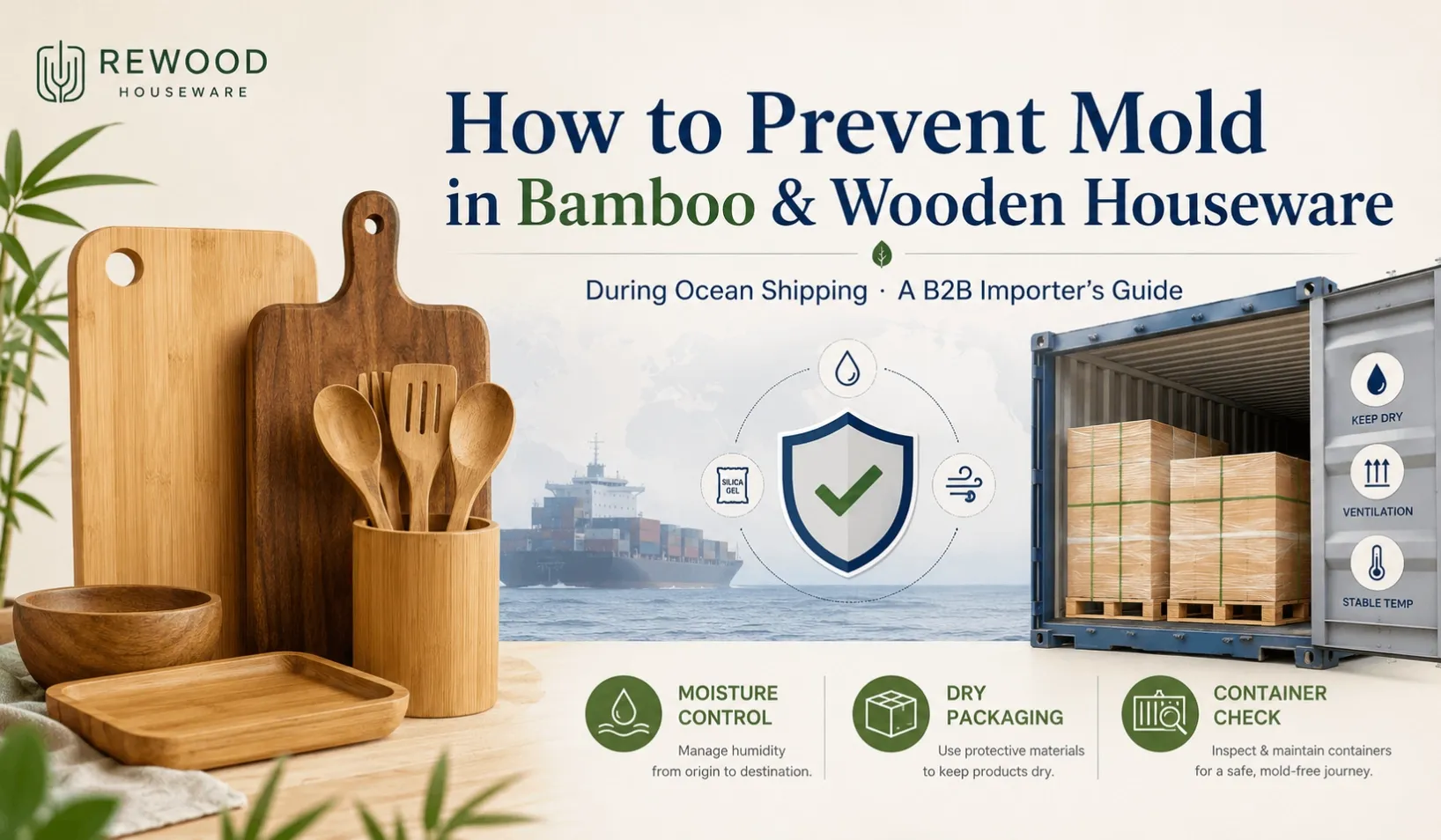
Bamboo and wooden houseware can leave a factory looking dry, clean and completely acceptable — yet arrive after several weeks of ocean freight with mold spots, odor, damp cartons or surface discoloration.
For importers, this creates an important question:
How can mold be prevented before bamboo and wooden products are loaded into a shipping container?
The answer is not simply:
“Keep the moisture content below one fixed number.”
Mold risk during international shipping is influenced by several factors working together:
- The moisture condition of the bamboo or wood;
- Relative humidity in the factory and warehouse;
- Moisture in cartons, pallets and other packing materials;
- Whether the product was packed before it had stabilized;
- Container condition;
- Temperature changes during transit;
- Condensation or “container sweat”;
- Packaging structure and airflow;
- Voyage duration and destination climate.
For this reason, professional moisture control should be treated as a production + storage + packaging + logistics system, rather than as a single final-inspection measurement.
This guide explains what B2B buyers should check when sourcing bamboo cutting boards, wooden utensils, organizers, serving products and other natural-material houseware for ocean shipment.
Quick Answer: What Causes Mold During Ocean Shipping?
Risk Factor | Why It Matters |
|---|---|
High product moisture | Provides favorable conditions for microbial growth and dimensional instability |
High warehouse humidity | Finished goods can reabsorb moisture before packing |
Damp cartons or pallets | Packaging and dunnage can introduce additional moisture into the container |
Packing too early | Moisture or heat may remain trapped inside packaging |
Wet or recently washed container | Residual moisture can increase condensation risk |
Large temperature changes | Water vapor can condense on the container roof and walls |
Inappropriate plastic wrapping | Can trap moisture instead of protecting the product |
Insufficient moisture-control planning | Desiccants alone may not compensate for excessive moisture entering the container |
The practical rule for buyers is:
Do not ask only, “What is the product moisture content?”
Also ask:
“How is moisture controlled from production until the container doors are closed?”
1. Why Are Bamboo and Wooden Products Sensitive to Moisture?
Bamboo and wood are hygroscopic materials.
This means they can exchange moisture with the surrounding air.
When environmental relative humidity changes, bamboo and wood can gradually absorb or release moisture.
For wooden products, this relationship is commonly described through equilibrium moisture content (EMC) — the condition at which the wood is neither gaining nor losing moisture under a particular temperature and relative humidity.
This has an important implication for importers:
A product that was properly dried during production does not necessarily remain at exactly the same moisture level forever.
If finished products are stored for several days in a humid warehouse, exposed to rainy-season air, placed in damp cartons or loaded into a humid container, their moisture condition can change again.
Bamboo also responds to environmental humidity, and research on bamboo storage has shown that high-humidity conditions can contribute to mold deterioration and material-quality changes.
Therefore, moisture management must continue after material drying.
2. Product Moisture Content Is Only One Part of the Problem
When mold appears after shipment, buyers often assume:
“The factory did not dry the wood properly.”
That is one possible cause, but it is not the only one.
There are at least three moisture sources that should be considered.
Moisture Inside the Product
Bamboo or wood may contain excessive moisture because of:
- Insufficient material drying;
- Uneven moisture within thick or laminated components;
- Wet processing;
- Humid storage;
- Reabsorption before packing.
Moisture from Packaging and Dunnage
Moisture may also come from:
- Corrugated cartons;
- Paper inserts;
- Wooden pallets;
- Timber bracing;
- Fabric bags;
- Other hygroscopic packaging materials.
Dry products packed together with damp packaging can still be exposed to a humid microclimate.
Moisture from the Transport Environment
The third source is the shipping environment itself.
A closed container can experience substantial temperature changes during a long voyage.
As temperatures rise and fall, water vapor inside the container may condense on colder surfaces.
This is why a shipment can suffer moisture damage even when the products appeared dry when they left the factory.
3. What Is “Container Sweat”?
One of the most important concepts for ocean shipments is container sweat.
During transportation, the temperature of a freight container can change substantially between daytime and nighttime and as the vessel moves through different climatic zones.
When warm, moisture-containing air inside the container comes into contact with a sufficiently cold container roof or wall, water vapor can condense into liquid water.
Droplets may form on the roof and eventually fall onto cartons or products.
Condensation can also run down container walls and wet packaging from the side or bottom.
This is commonly called:
container sweat.
The IMO/ILO/UNECE Code of Practice for Packing of Cargo Transport Units explains that closed containers carrying moisture-containing cargo or associated packaging can develop their own internal humidity conditions. Temperature changes can then lead to condensation, including water droplets forming on the container roof.
For bamboo and wooden houseware, this creates several possible problems:
- Mold;
- Carton softening;
- Staining;
- Odor;
- Packaging deformation;
- Surface discoloration;
- Swelling;
- Cracking or warping after later moisture changes.
Therefore, mold prevention cannot end at factory QC.
The loading and transportation environment also matter.
4. Is There One Correct Moisture Content for All Bamboo and Wooden Houseware?
No.
This is one of the most important points for professional buyers.
A single universal moisture-content requirement should not automatically be applied to every:
- Bamboo product;
- Acacia product;
- Beech product;
- Teak product;
- Cutting board;
- Utensil;
- Bowl;
- Organizer;
- Furniture component;
- Destination market.
The appropriate specification can depend on:
- Material species;
- Product construction;
- Component thickness;
- Laminated vs. solid construction;
- Manufacturing process;
- Intended end use;
- Destination climate;
- Seasonal conditions;
- Measurement method;
- Buyer or retailer standard.
For wood, the technical objective is generally to bring the product reasonably close to the moisture condition expected in service, rather than relying on one arbitrary number for every situation.
This is also why a buyer should be cautious when a supplier says:
“All wooden products must be 8–12%.”
That range may be used as a practical target in some projects, but it should not be treated as a universal international rule for every material and product.
A better purchasing requirement is:
Agree on a project-specific moisture specification, measurement method, sampling plan and acceptance range before mass production.
5. Why Can a “Dry” Product Still Develop Mold?
A factory may measure acceptable moisture during production and still experience a mold problem later.
Several scenarios can explain this.
The Product Reabsorbs Moisture
After drying, bamboo and wood can absorb moisture again when stored in humid air.
This can happen during:
- Rainy seasons;
- Long warehouse storage;
- Delayed shipment;
- Open-door storage;
- High-humidity production environments.
Packaging Is Damp
The product itself may be dry while the cartons, pallets or inserts contain excessive moisture.
Once the container is closed, this moisture becomes part of the container environment.
The Product Is Packed Too Soon
Some production steps involve moisture, heat, coatings or cleaning.
Packing products immediately after processing can trap moisture or prevent the product from stabilizing.
The Container Is Not Completely Dry
A container may have:
- Recently been washed;
- Water on the floor;
- Roof leakage;
- Residual moisture;
- Damp odor;
- Previous cargo contamination.
Temperature Changes Create Condensation
Even when the initial conditions look acceptable, repeated temperature cycles during ocean transit can create condensation.
Therefore:
“The product was dry when we packed it” is not a complete moisture-control strategy.
6. Moisture Control Should Start During Production
For bamboo and wooden houseware, moisture control should begin before final packaging.
Depending on the product and project specification, useful controls may include:
Material Conditioning
Bamboo or wood should be processed at a moisture condition appropriate for the product and intended market.
Moisture Checks at Relevant Stages
For certain products, checking only the finished carton may be too late.
Moisture measurements may be considered at stages such as:
- Incoming material;
- After major machining;
- Before finishing;
- Before assembly;
- Before packaging;
- Before shipment.
The appropriate stages depend on the product structure and manufacturing process.
Batch Variation Control
A shipment should not be evaluated using only one convenient piece.
Moisture condition can vary:
- Between boards;
- Between cartons;
- Between production batches;
- Between the outside and center of thicker components.
The buyer and supplier should therefore agree on a reasonable sampling method.
Adequate Stabilization
Where applicable, finished products should have sufficient time to cool, dry or stabilize before being enclosed in retail packaging.
7. Warehouse Conditions Matter Before Shipment
Finished goods may remain in storage for days or weeks before container loading.
During this period, poor storage conditions can undo earlier moisture-control work.
Importers should ask how finished bamboo and wooden products are stored before shipment.
Useful practices can include:
- Keeping cartons away from direct water exposure;
- Avoiding contact with damp floors;
- Avoiding storage against wet walls;
- Maintaining a clean and dry warehouse;
- Protecting finished goods during rainy weather;
- Monitoring environmental conditions where necessary;
- Avoiding unnecessary long-term storage in uncontrolled humidity;
- Checking products again when shipment has been delayed significantly.
This is especially important during humid or rainy seasons.
A shipment that passes QC and then waits several weeks in inappropriate storage conditions may no longer have the same moisture condition when it is finally loaded.
8. Packaging Can Help — or Make the Problem Worse
Packaging is often treated as protection against moisture, but the wrong packaging strategy can actually trap moisture.
Plastic Wrapping
Plastic bags, shrink film or protective film can provide useful protection against dirt and direct external moisture.
However:
If a damp product is sealed inside plastic, the plastic does not remove the moisture.
Instead, it can create a closed microenvironment where moisture remains trapped around the product.
This is why product condition should be controlled before sealing.
Desiccants
Container desiccants and moisture absorbers can help reduce humidity risk.
They are particularly useful as part of a wider moisture-management plan.
However, buyers should not assume:
“Add some desiccant bags and the problem is solved.”
The amount and type of desiccant should be selected according to factors such as:
- Container size;
- Cargo type;
- Packaging;
- Voyage duration;
- Expected temperature changes;
- Moisture entering with the cargo and packaging.
Desiccants are a risk-control measure, not a substitute for loading wet products or damp cartons.
Carton and Paper Materials
Corrugated cartons and paper packaging are also moisture-sensitive.
Carton strength can decrease when packaging becomes damp, creating both product-quality and logistics risks.
Anti-Mold Chemicals or Treatments
For food-contact kitchenware, buyers should be particularly careful with chemical anti-mold treatments.
A fungicide, anti-mold agent or surface treatment should not be added simply because it reduces mold risk.
Its suitability may need to be evaluated according to:
- Product use;
- Target country;
- Chemical composition;
- Migration or safety requirements;
- Retailer specifications.
For food-contact bamboo and wooden kitchenware, moisture prevention and process control should come before unverified chemical treatment.
9. What Should Be Checked Before Container Loading?
Container inspection is an important final control point.
Before loading moisture-sensitive bamboo or wooden goods, the container should be checked for obvious conditions that could damage the cargo.
A practical check may include:
Container Check | What to Look For |
|---|---|
Interior floor | Dry, clean and free from standing water |
Roof and walls | No obvious holes or signs of leakage |
Door seals | Intact and closing correctly |
Odor | No strong damp, chemical or contamination odor |
Previous moisture | No obvious wet surfaces after washing |
Cleanliness | No residue or contamination from previous cargo |
Pallets / dunnage | Dry and suitable for use |
Weather during loading | Prevent cartons from being exposed to rain |
Desiccants | Correct type, quantity and positioning where specified |
Loading photos | Record container condition and final cargo arrangement |
For long-distance ocean freight, this is much more useful than assuming that every empty container supplied by the carrier is automatically suitable.
10. What Should Importers Put in the PO or QC Specification?
One of the best ways to reduce disputes is to define moisture-control expectations before production.
Instead of writing only:
“No mold allowed.”
consider specifying the controls that support that result.
A project specification may include:
Material:
Confirmed bamboo or wood species and construction.
Moisture Requirement:
Project-specific target or acceptance range where applicable.
Measurement Method:
Agreed meter type, correction method or laboratory method where required.
Sampling:
Number of units, cartons or production points to be checked.
Visual Standard:
No visible mold, mildew, abnormal staining or moisture-related defects.
Storage:
Finished goods to be stored in clean, dry conditions before shipment.
Packaging:
Approved retail packaging, protective materials and moisture-control method.
Desiccants:
Type and quantity to be confirmed according to shipment requirements where used.
Container Condition:
Container to be visually checked for dryness, cleanliness, odor and obvious leakage before loading.
Shipment Records:
Loading photos and relevant inspection records where required.
This creates a much clearer quality standard than simply asking the factory to:
“Make sure it doesn't mold.”
11. A Practical Pre-Shipment Mold-Prevention Checklist
Before approving a bamboo or wooden houseware shipment, buyers can review the following areas:
QC Area | Buyer Check |
|---|---|
Material | Correct bamboo or wood species |
Construction | Solid, laminated and assembled components as approved |
Moisture | Within the agreed project specification |
Surface | No mold, mildew, unusual stains or damp odor |
Finish | Fully cured and suitable for intended use |
Cartons | Dry and structurally sound |
Inner packaging | Product is not being sealed while damp |
Warehouse | Finished goods stored in dry conditions |
Pallets | Dry and clean where used |
Container | Dry, clean and free from obvious leakage |
Desiccants | Used according to the agreed shipping plan where necessary |
Loading | Protected from rain and wet surfaces |
Documentation | QC and loading records retained where required |
For higher-risk shipments, buyers may also consider third-party pre-shipment inspection or additional moisture checks according to the agreed specification.
12. What If Mold Is Found After the Shipment Arrives?
If mold is discovered at destination, the first step should not be to immediately wipe everything clean and discard the evidence.
A structured investigation is more useful.
The buyer should document:
- Which SKUs are affected;
- Which cartons are affected;
- Whether damage is concentrated near container doors, walls, roof or floor;
- Whether outer cartons are damp;
- Whether inner packaging is damp;
- Whether mold is only on the product surface or has penetrated deeper;
- Whether there is abnormal odor;
- Whether unaffected cartons from the same shipment show similar moisture conditions.
Photographs and carton-position information can help identify whether the likely cause relates to:
- Product moisture;
- Packaging moisture;
- Container leakage;
- Condensation;
- Warehouse exposure;
- A specific production batch.
Where food-contact safety or significant contamination is involved, appropriate testing or specialist assessment may be necessary before deciding whether products can be cleaned, reworked, sold or must be rejected.
The objective should be to identify the root cause, not simply remove the visible mold.
13. Common Mistakes Importers Should Avoid
Mistake 1: Using One Moisture Number for Every Product
Different materials and products may require different specifications.
Mistake 2: Checking Moisture Only Once
A product can reabsorb moisture after production.
Mistake 3: Ignoring Cartons and Pallets
Packaging and dunnage can contribute moisture to the container environment.
Mistake 4: Treating Desiccants as a Complete Solution
Desiccants cannot compensate for uncontrolled product, packaging or container moisture in every situation.
Mistake 5: Sealing Damp Products in Plastic
Barrier packaging is useful only when the product condition is suitable before sealing.
Mistake 6: Loading Without Inspecting the Container
A wet, leaking or contaminated container can compromise otherwise acceptable goods.
Mistake 7: Waiting Until Shipment to Define QC Requirements
Moisture-control requirements should be discussed during quotation, sampling and pre-production planning.
14. How Rewood Approaches Moisture and Mold Risk for Export Projects
For bamboo and wooden houseware projects, moisture risk should be evaluated together with the actual product construction, material, packaging and destination market.
At Rewood, project discussions can include:
- Bamboo or wood species;
- Product structure and thickness;
- Surface finish;
- Moisture-control requirements;
- Sampling and inspection expectations;
- Private-label packaging;
- Storage before shipment;
- Export-carton configuration;
- Pallet requirements where applicable;
- Container-loading preparation;
- Destination market and transit method.
For customized or higher-risk projects, moisture specifications and inspection requirements should be agreed before mass production rather than introduced only at final inspection.
If a buyer has a retailer-specific moisture standard, testing method or pre-shipment requirement, it should be provided during quotation or sample development so that production and QC requirements can be evaluated in advance.
The objective is not to promise that natural materials will never react to environmental humidity.
The objective is to identify controllable risks, define measurable requirements and manage the product from production through export preparation as consistently as possible.
Frequently Asked Questions
What moisture content should bamboo products have before shipping?
There is no single moisture-content number that should automatically be applied to every bamboo product.
The appropriate target can depend on the bamboo material, construction, product thickness, manufacturing process, destination climate, intended use and buyer specification.
A project-specific requirement should be agreed with the supplier.
Is 8–12% the correct moisture content for all wooden kitchenware?
Not necessarily.
An 8–12% range may be used in some commercial projects, but it should not be treated as a universal rule for every wood species, product or destination.
Moisture targets should be matched to the product and expected service environment.
Can desiccants completely prevent mold?
No.
Desiccants can help manage humidity inside the container, but they work best as part of a wider moisture-control plan.
Products, cartons, pallets and the container itself should not enter the shipment with excessive moisture.
Can plastic wrapping prevent mold?
Plastic wrapping can protect products from external contamination and direct moisture, but it can also trap moisture when a product is sealed while damp.
Product condition should therefore be controlled before wrapping.
Why do products sometimes mold only after ocean shipping?
Long transit periods, temperature fluctuations, high humidity and condensation can create conditions that were not present during factory inspection.
Container sweat can wet cartons or products even when they appeared acceptable before loading.
Should anti-mold chemicals be used on wooden kitchenware?
Not automatically.
For food-contact products, any chemical treatment should be assessed for its suitability, safety and regulatory requirements in the target market.
Process, drying, storage, packaging and transport moisture control should be addressed first.
What should buyers ask the supplier before shipment?
At minimum, buyers should clarify the material, agreed moisture specification, measurement method where applicable, storage condition, packaging method, desiccant plan if used, final visual inspection and container-loading checks.
Planning a Bamboo or Wooden Houseware Shipment?
If you are sourcing:
- Bamboo cutting boards;
- Wooden cutting boards;
- Bamboo organizers;
- Wooden utensils;
- Serving boards;
- Bowls and trays;
- Bamboo or wooden private-label houseware;
send us your:
- Product specification or reference;
- Material;
- Target quantity;
- Destination market;
- Packaging requirements;
- Required moisture or QC standard;
- Inspection requirements;
- Shipping method.
Rewood can review the product and packaging requirements with you before sampling or mass production and help identify practical moisture-control, QC and export-preparation points for the project.
About the Author
Written by Jessie Jiang
Overseas Business Development, Rewood Houseware
Jessie works with importers, distributors, retailers and private-label brands on bamboo and wooden houseware sourcing, OEM/ODM product development, material selection, private-label packaging, quality control and export projects.
Reviewed by the Rewood Product Development & Quality Control Team
This article is intended as practical B2B sourcing and quality-control information. Appropriate moisture specifications and mold-prevention measures depend on the material, product, packaging, destination, transportation conditions and buyer requirements.
Last updated: September 3, 2026
Technical References
IMO / ILO / UNECE — Code of Practice for Packing of Cargo Transport Units (CTU Code)
Includes guidance on climatic conditions, humidity and prevention of condensation damage in freight containers.
USDA Forest Products Laboratory — Wood Handbook: Wood as an Engineering Material
Explains the relationship between wood moisture content, relative humidity, temperature and equilibrium moisture content.
USDA Forest Products Laboratory — Drying and Control of Moisture Content and Dimensional Changes
Provides technical guidance on drying and matching wood moisture condition to expected service environments.