
Aug 5, 2026B2B Buying & Sourcing Guides
Why Bamboo Drawer Dividers Are a Good Private Label Product for Home Organization Brands
Why Bamboo Drawer Dividers Are a Good Private Label Product for Home Organization Brands Home organization has become an important category for many retailers, Amazon sellers, Shopify brands
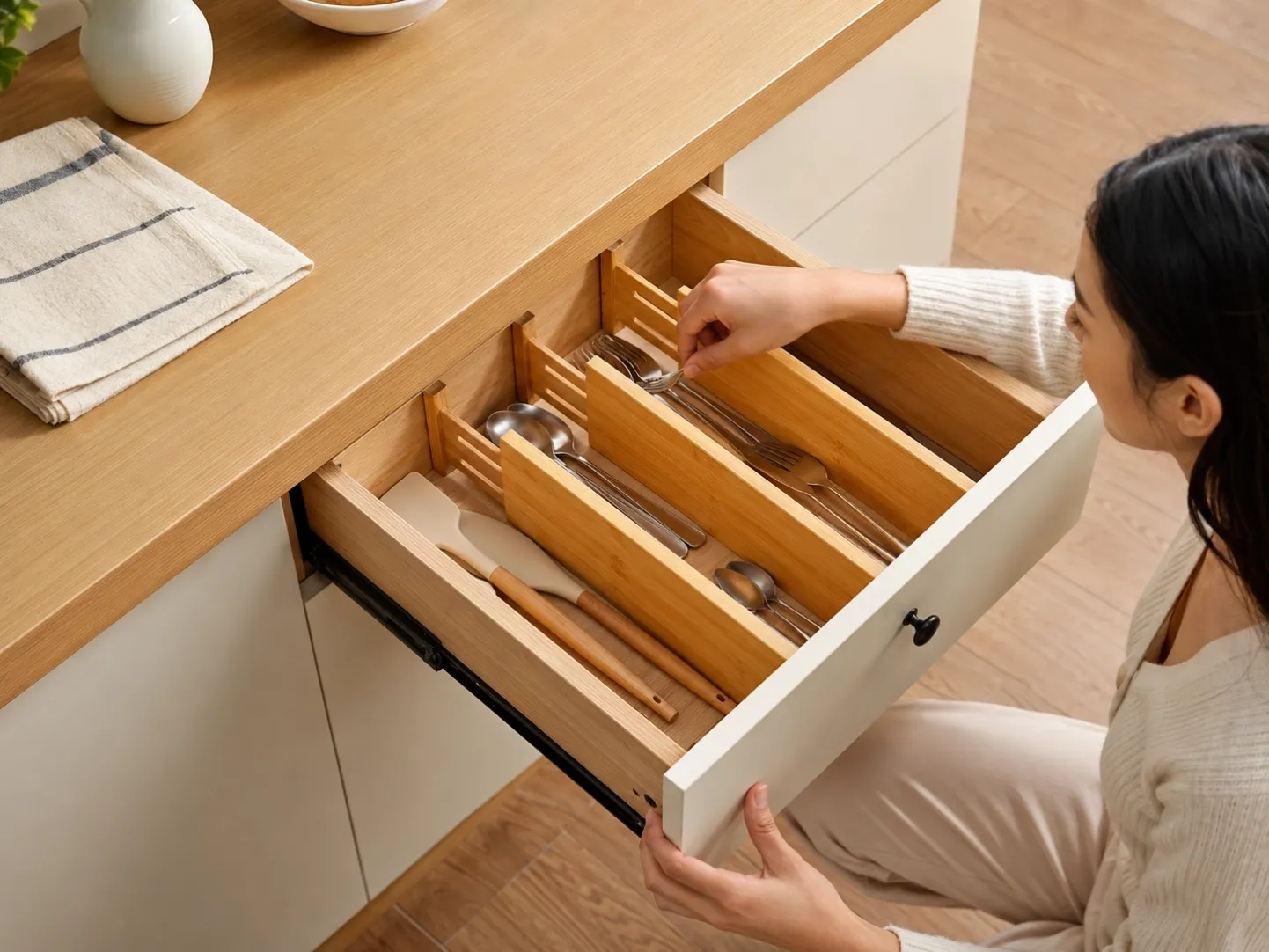
Bamboo drawer dividers can be a practical private label product for home organization, kitchen storage and closet organization brands—but only when product fit, spring performance, surface quality, packaging protection and batch consistency are properly controlled.
Their commercial value comes from a simple consumer benefit: one adjustable product can divide different drawers without permanent installation. For a professional buyer, however, the sourcing decision should not be based only on natural bamboo appearance or a low unit price.
The product must fit the intended drawer range, maintain stable tension, protect furniture surfaces, survive transport and remain consistent across every set in a bulk order.
This guide explains how importers, distributors, retailers and private label brands should evaluate bamboo drawer dividers before sampling or placing an order.
Quick Answer: Are Bamboo Drawer Dividers Suitable for Private Label?
Yes, bamboo drawer dividers can be suitable for private label programs when the brand already sells home organization, kitchen storage, closet storage, nursery organization or natural-material houseware.
They offer several useful commercial characteristics:
- A clear and easy-to-demonstrate function;
- Applications across several rooms;
- Adjustable rather than fixed-size use;
- Natural bamboo positioning;
- Multiple set-quantity options;
- Custom logo and packaging opportunities;
- Compatibility with retail, wholesale and e-commerce channels.
However, they are not automatically a successful product.
The main sourcing risks include:
- An unsuitable adjustable range;
- Spring tension that is too weak or too strong;
- Loose or poorly attached EVA pads;
- Rough bamboo surfaces or splinters;
- Inconsistent dimensions between pieces;
- Natural color variation outside the approved range;
- Products moving and rubbing inside the packaging;
- Oversized packaging that increases freight cost;
- Unclear size communication that causes end-user complaints.
The correct question is therefore not only whether bamboo drawer dividers are marketable, but whether the specification, quality standard and packaging plan are appropriate for the buyer’s channel.
Private Label Evaluation Checklist
Evaluation Area | What the Buyer Should Confirm |
|---|---|
Product Fit | Minimum and maximum drawer depth, divider height and thickness |
Spring System | Holding force, ease of installation and repeated-use performance |
End Protection | EVA material, thickness, position and adhesion |
Bamboo Quality | Surface smoothness, joints, edges, color range and visible defects |
Set Configuration | Two-pack, four-pack, six-pack or custom quantity |
Branding | Logo method, position, size and visibility after installation |
Packaging | Surface protection, internal fixation, labels and carton efficiency |
Retail Positioning | Dresser, kitchen, nursery, closet, bathroom or multi-room use |
Quality Control | Dimensional, functional, appearance and packaging checks |
Repeat Orders | Retained specification, approved sample and change control |
Logistics | Individual-pack dimensions, carton quantity, weight and total CBM |
1. Understand the Product Structure
An adjustable bamboo drawer divider normally consists of:
- A bamboo outer body;
- An internal sliding or telescopic section;
- A spring-loaded tension mechanism;
- Protective EVA pads at both ends;
- A sanded or finished bamboo surface.
The spring mechanism allows the divider to extend inside a drawer and remain in position through tension. The EVA ends help increase grip and reduce direct contact between the bamboo body and drawer walls.
No screws or permanent installation are normally required.
Although the product appears simple, its performance depends on several components working together. A smooth bamboo panel does not compensate for weak spring tension, and a strong spring does not compensate for poorly attached protective pads.
The complete system must be evaluated.
2. Confirm the Correct Adjustable Size Range
The adjustable length is one of the most important specifications.
Rewood’s current standard reference model is designed for drawers approximately 12.5 to 17 inches deep, with an approximate height of 4.65 inches. Custom dimensions can be evaluated according to the buyer’s target market and product program.
Before confirming a model, buyers should measure the internal drawer dimensions used by their target customers.
Important specifications include:
- Minimum usable length;
- Maximum recommended length;
- Divider height;
- Bamboo-body thickness;
- Extension overlap;
- Compressed length;
- Space required for the spring mechanism;
- End-pad thickness.
The maximum extension shown in marketing materials should reflect a stable working range rather than the absolute mechanical limit.
Extending the product beyond its designed range may reduce overlap, stability and useful spring force.
For online sales, the packaging and product page should clearly show:
- The compatible internal drawer-depth range;
- Divider height and thickness;
- How to measure the drawer;
- The recommended installation method;
- Any drawer types that may not be suitable.
Clear size communication is an important part of product quality because it reduces avoidable fit complaints.
3. Evaluate Spring Tension and Functional Performance
The spring system is the main functional component of an adjustable drawer divider.
It must provide enough force to hold the product in position, but it should not require excessive effort or place unnecessary pressure on the drawer sides.
Buyers should evaluate:
- Initial spring force;
- Holding performance at different extension lengths;
- Ease of compression during installation;
- Smooth movement of the sliding section;
- Alignment between the fixed and moving parts;
- Noise or friction during adjustment;
- Stability after installation;
- Performance after repeated compression and release.
A divider may perform well at the middle of its adjustable range but become unstable near the maximum extension. Functional checks should therefore cover several positions rather than only one sample position.
For larger retail programs, the buyer and supplier can agree on a repeated compression-cycle test. The cycle quantity and acceptance criteria should be confirmed before production instead of being assumed.
Possible failure signs include:
- Noticeably weaker spring force after repeated use;
- A sliding section that becomes loose;
- Misalignment between bamboo components;
- Internal friction that prevents smooth adjustment;
- A spring that becomes noisy or catches;
- A divider that moves during normal drawer use.
These issues should be identified during sample evaluation, not after the retail packaging has been printed.
4. Check the EVA End Pads
EVA end pads are small components, but they affect product stability, furniture protection and customer perception.
The buyer should confirm:
- Pad dimensions;
- Pad thickness;
- Density and compression;
- Surface texture;
- Position on both ends;
- Adhesive coverage;
- Alignment;
- Resistance to peeling;
- Appearance after compression.
The pads should remain attached during installation, repeated adjustment and transport.
Poor adhesion can lead to several problems:
- The pad falls off inside the packaging;
- Adhesive residue remains on the bamboo;
- The divider becomes unstable;
- Bamboo contacts the drawer wall directly;
- The finished product appears defective.
The pad should also be reviewed together with spring force. Very soft foam may compress too easily, while very hard material may provide less protection or grip.
5. Inspect Bamboo Material and Surface Quality
The bamboo surface is one of the product’s main visual features.
Professional buyers should define a practical appearance standard covering:
- Surface smoothness;
- Rough fibers or splinters;
- Cracks and splits;
- Open joints;
- Glue marks;
- Dark stains;
- Scratches;
- Chipped corners;
- Edge shape;
- Color and grain variation;
- Surface-finish consistency.
Natural bamboo will not look identical from one piece to another. Small differences in grain and tone are normal.
The buyer and supplier should nevertheless agree on an acceptable visual range. Strong color contrast, obvious stains, poorly matched pieces or visible defects should not automatically be accepted simply because bamboo is a natural material.
For multi-piece sets, it may be useful to coordinate the appearance of the dividers within each retail set rather than packing pieces completely at random.
The edges and corners also require careful inspection. Customers frequently handle the divider during installation, so rough ends, sharp edges and splinters can create immediate complaints.
6. Decide the Best Set Configuration
Bamboo drawer dividers can be offered in several set quantities, commonly including:
- Two-piece sets;
- Four-piece sets;
- Six-piece sets;
- Custom retail packs.
The best configuration depends on the selling channel and target application.
Two-Piece Set
A smaller set may suit:
- Trial products;
- Smaller drawers;
- Lower retail price points;
- Promotional programs;
- Add-on sales.
The unit packaging may be compact, but the buyer should confirm whether the retail value is strong enough after packaging and freight costs are included.
Four-Piece Set
A four-piece set offers a balance between:
- Usable organization capacity;
- Retail price;
- Package size;
- Shipping weight;
- Consumer flexibility.
It may work well for one large dresser or several smaller drawers.
Six-Piece Set
A six-piece set provides a broader organization solution and can support multi-room or whole-drawer positioning.
However, a larger set also increases:
- Product weight;
- Package length and thickness;
- Carton volume;
- Surface-to-surface contact;
- Risk of scratches during transport;
- Retail price.
The correct set quantity should be selected after reviewing landed cost, expected retail price and packaging dimensions—not only because a larger pack appears to offer more value.
7. Develop Meaningful Private Label Differentiation
Adding a logo is useful, but it is not enough to create a differentiated private label product.
Brands can consider differentiation through:
- Adjustable size range;
- Divider height;
- Set quantity;
- Natural or customized finish;
- Rounded-edge profile;
- EVA pad design;
- Logo position;
- Room-specific packaging;
- Installation instructions;
- Measurement guide;
- Care information;
- Retail photography and content strategy.
A home organization brand might position the product for dresser and wardrobe use, while a kitchenware brand may focus on utensils, cutlery and pantry accessories.
The physical product can remain similar, but the product specification, set quantity, packaging and communication should match the actual category strategy.
Brands should avoid unsupported environmental claims.
Bamboo can be described accurately as the product material, but claims such as “100% sustainable,” “zero waste” or “environmentally certified” should only be used when the applicable supply-chain documentation and claim requirements have been verified.
8. Choose Packaging Based on the Sales Channel
Packaging for long bamboo products must protect the surface, EVA ends and spring structure while controlling shipping volume.
A packaging option should not be selected only because it looks attractive.
Fully Enclosed Kraft Box
A kraft box can provide:
- Full product protection;
- A natural visual position;
- Space for instructions and branding;
- Better control of loose components;
- Compatibility with wholesale and retail programs.
Internal paper protection or separators may still be required to prevent the bamboo pieces from rubbing against each other.
Printed Color Box
A color box can support:
- Branded retail presentation;
- Product images;
- Size instructions;
- Installation steps;
- Multi-language information;
- Barcode and compliance labels.
Print quality, color references and artwork version control must be approved before production.
E-Commerce Mail-Order Box
For direct-to-consumer shipping, the packaging should be evaluated as a shipping system rather than only as a retail box.
The buyer should consider:
- Internal movement;
- Edge protection;
- Pad protection;
- Box compression;
- Drop and impact risk;
- Label position;
- Product presentation after delivery.
Where required, the buyer and supplier can agree on an appropriate packaging or drop-test method.
Paper Sleeve or Belly Band
A paper sleeve can provide simple branding, but it is suitable only when:
- It holds the set securely;
- The product remains adequately protected;
- The sleeve does not slide during handling;
- The bamboo surface is protected from rubbing;
- The retail channel accepts partially exposed products.
For long, rigid drawer dividers, a sleeve alone may not provide enough shipping protection. It should not be treated as the default packaging solution for every project.
9. Review Packaging Dimensions and Freight Efficiency
Drawer dividers are relatively long products, so packaging dimensions can have a significant effect on shipping cost.
Before finalizing the retail pack, buyers should confirm:
- Number of pieces per set;
- Product orientation;
- Individual-box dimensions;
- Protective-material thickness;
- Units per export carton;
- Carton dimensions;
- Net and gross weight;
- Total number of cartons;
- Total CBM;
- Pallet requirements where applicable.
A visually oversized box may improve shelf presence but increase landed cost.
An overly tight box may reduce CBM but create scratches, crushed EVA pads or difficult repacking during inspection.
Packaging development should therefore balance:
- Protection;
- Presentation;
- Shipping efficiency;
- Unpacking experience;
- Retail requirements.
For large orders, a small change in box thickness or carton configuration may affect total freight cost across the complete shipment.
10. Establish a Product-Specific Quality-Control Plan
“Final inspection” is not enough to describe quality control.
A practical inspection plan for bamboo drawer dividers may include the following stages.
Incoming Material and Component Check
Confirm:
- Bamboo panel condition;
- Relevant dimensions;
- Surface defects;
- Spring components;
- EVA pads;
- Adhesive and accessories.
In-Process Check
Confirm:
- Bamboo-body dimensions;
- Extension structure;
- Alignment;
- Edge sanding;
- Assembly quality;
- Spring installation;
- Pad position.
Functional Check
Confirm:
- Minimum and maximum working range;
- Smooth adjustment;
- Holding stability;
- Spring tension;
- Repeated compression performance where specified;
- Movement after installation.
Appearance Check
Confirm:
- Scratches;
- Rough surfaces;
- Splinters;
- Cracks;
- Glue marks;
- Color range;
- Edge consistency;
- Logo appearance.
Packaging Check
Confirm:
- Correct set quantity;
- Surface protection;
- Internal fixation;
- Instruction card;
- Barcode;
- Warning or care labels;
- Artwork version;
- Export-carton information.
Pre-Shipment Inspection
Depending on the project, the final inspection may use:
- Internal sampling;
- Agreed critical-feature checks;
- Defined AQL criteria;
- Selected 100% inspection items;
- Third-party pre-shipment inspection.
The inspection method should be agreed before production because different requirements affect cost, timing and production planning.
Common Quality Risks
Potential Issue | Possible Cause | Recommended Control |
|---|---|---|
Divider does not remain in place | Weak spring or unsuitable adjustable range | Test at several extension positions |
Product is difficult to install | Excessive spring force or poor sliding alignment | Confirm installation force during sample approval |
EVA pad falls off | Insufficient adhesive or poor surface preparation | Adhesion and repeated-compression checks |
Bamboo scratches during shipping | Pieces rub inside packaging | Add separators or individual protection |
Rough edge or splinter | Incomplete sanding | Edge and hand-contact inspection |
Different lengths within one set | Dimensional or assembly inconsistency | Set-level dimensional check |
Strong visual mismatch | Uncontrolled bamboo color sorting | Agree on acceptable visual range |
Logo appears inconsistent | Positioning or engraving variation | Approved logo sample and placement guide |
Retail box is damaged | Insufficient box strength or excessive internal movement | Packaging test and carton review |
Customer orders wrong size | Unclear size communication | Measurement diagram and fit instructions |
11. Control Sample-to-Bulk Consistency
A good development sample does not guarantee that the bulk order will be identical.
Before production, the project should have:
- An approved reference sample;
- A dated product specification;
- Confirmed adjustable range;
- Approved spring performance;
- Approved EVA-pad specification;
- Approved bamboo appearance range;
- Confirmed logo position;
- Approved packaging artwork;
- Agreed inspection criteria.
Changes made during sampling should be recorded.
For example, when a buyer adjusts the divider height, spring force or foam thickness, the latest version must be communicated to production, packaging and quality-control teams.
For repeat orders, the supplier should retain the final specification, packaging files, logo parameters and relevant production notes.
Importers comparing suppliers can also review our bamboo and wood houseware manufacturer evaluation checklist.
12. Commercial Questions Buyers Should Ask
Before adding bamboo drawer dividers to a private label collection, buyers should evaluate the complete commercial structure.
Key questions include:
- Does the product fit our existing category?
- Which consumer problem does it solve?
- What drawer range is common in our target market?
- Which set quantity supports our intended retail price?
- Is the packaging appropriate for our channel?
- What is the individual-pack CBM?
- How many sets fit in one export carton?
- What quality risks could create returns?
- Which features genuinely differentiate the product?
- Can the supplier retain specifications for repeat orders?
- Are compliance or material-traceability documents required?
- Does the final landed cost leave sufficient margin?
The product should be evaluated as a complete retail program rather than as one bamboo item with a logo.
Which Buyers Are the Best Fit?
Bamboo drawer dividers may be especially relevant for:
- Home organization brands;
- Kitchen storage brands;
- Closet and wardrobe brands;
- Nursery organization brands;
- Importers and distributors;
- Homeware wholesalers;
- Retail chains;
- Private label home-and-living programs;
- Established e-commerce brands;
- Buyers expanding from bamboo kitchenware into home storage.
They may be less suitable when:
- The brand has no connection to storage or home organization;
- The target drawer dimensions are unknown;
- The expected retail price cannot support packaging and freight;
- The buyer only wants a logo without a differentiated product plan;
- The sales channel requires an unusually compact package;
- The product has not been functionally tested for the target size range.
How Rewood Supports Bamboo Drawer Divider Projects
Rewood supports importers, distributors, retailers and private label brands with bamboo drawer divider development and bulk-order execution.
The current standard reference model includes:
- Six-piece set configuration;
- Natural bamboo construction;
- Spring-loaded adjustable structure;
- Soft EVA foam ends;
- Approximate 12.5–17 inch adjustable drawer-depth range;
- Approximate 4.65 inch divider height;
- Tool-free installation.
Project support can include:
- Specification review;
- Custom size evaluation;
- Set-quantity development;
- Logo engraving or printing;
- Packaging artwork coordination;
- Kraft or color-box development;
- E-commerce packaging;
- Instruction cards and labels;
- Sample development;
- Production tracking;
- Quality inspection;
- Export-carton preparation.
The final specification, MOQ, sample time, production schedule and packaging method are confirmed according to the order quantity and customization requirements.
Buyers can review our custom bamboo drawer dividers product page for the current reference model and available customization options.
What Information Is Needed for a Quotation?
To prepare a practical quotation, please provide:
- Target market;
- Sales channel;
- Reference product or drawing;
- Required adjustable range;
- Divider height;
- Number of pieces per set;
- Estimated order quantity;
- Logo artwork;
- Packaging preference;
- Barcode or label requirements;
- Inspection requirements;
- Delivery destination;
- Required schedule.
When dimensions are not finalized, reference drawer measurements or a current competitor sample can be used to begin the evaluation.
Our guide on how to request a quote for custom bamboo and wood houseware also explains the information needed for an accurate quotation.
Discuss Your Bamboo Drawer Divider Project
Send Rewood your product requirements, target quantity, logo, packaging concept, target market and delivery destination.
Our team will review the specification, customization requirements, packaging structure, quality-control points and production feasibility before preparing the next step.
Frequently Asked Questions
Are bamboo drawer dividers a good private label product?
They can be a good private label product for brands already selling home organization, kitchen storage, closet storage, nursery products or natural-material houseware.
The product should still be evaluated based on fit range, spring performance, set configuration, packaging, landed cost and expected retail positioning.
What drawer sizes does the standard model fit?
The current standard reference model is designed for drawers approximately 12.5 to 17 inches deep.
Buyers should confirm the internal drawer size used in their target market. Custom sizes can be evaluated for OEM and private label projects.
Can the bamboo drawer dividers be customized?
Yes. Depending on project feasibility, customization may include:
- Adjustable length;
- Divider height;
- Set quantity;
- Bamboo finish;
- Logo method;
- Logo position;
- EVA pad details;
- Instruction card;
- Labels;
- Retail packaging.
Final specifications should be approved through drawings, samples and a dated specification.
What quality checks are important?
Important checks include:
- Product dimensions;
- Adjustable range;
- Spring tension;
- Sliding alignment;
- Stability after installation;
- EVA-pad adhesion;
- Bamboo surface quality;
- Edge smoothness;
- Natural color range;
- Logo appearance;
- Set quantity;
- Packaging protection.
Repeated-compression testing or third-party inspection can be arranged when required by the project.
What packaging is most suitable?
Fully enclosed kraft boxes, printed color boxes and e-commerce mail-order boxes generally provide stronger protection for long bamboo dividers.
A paper sleeve may be suitable for certain retail programs, but only when the products remain secure and adequately protected during handling and transport.
What is the MOQ?
For the current standard reference model, the usual MOQ is approximately 500 pieces.
The final MOQ depends on set quantity, size, logo method, packaging and customization level.
How long does sampling and production take?
The current reference estimate is usually around 7–15 days for samples and approximately 25–35 days for mass production after sample confirmation.
The final schedule depends on the product specification, quantity, packaging artwork and factory production plan.
Can FSC-related documentation be provided?
FSC requirements must be evaluated according to the actual material source, supply chain, manufacturing entity and order requirements.
Buyers should provide their required FSC claim or documentation standard before quotation. Availability should be confirmed for the specific project rather than assumed for every product.
About the Author
Written by Jessie Jiang
Overseas Business Development, Rewood Houseware
Jessie works with importers, distributors, retailers and private label brands on bamboo and wood houseware manufacturing, product development, material selection, custom packaging, quality coordination and export projects.
Reviewed by the Rewood Product Development & Quality Control Team
This article is based on Rewood’s practical experience supporting bamboo home organization products, private label packaging, bulk-order quality control and export projects.
Last updated: August 5, 2026