Aug 31, 2026B2B Buying & Sourcing Guides
How to Choose Packaging for Your First Private Label Bamboo & Wood Houseware Order
Private-label packaging options should balance branding, product protection, order quantity, sales channel and shipping efficiency.
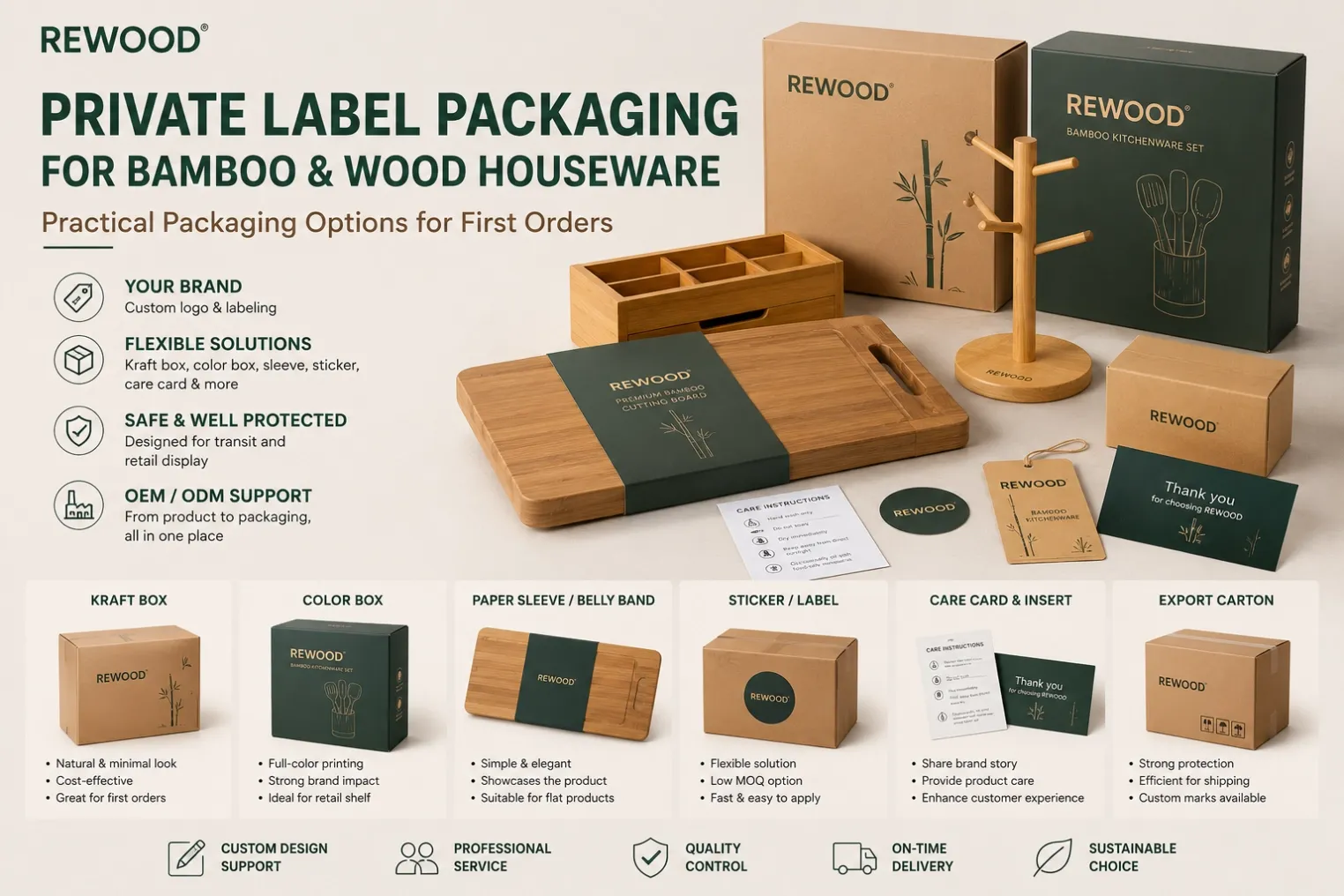
Choosing packaging for your first private-label bamboo or wooden houseware order can be more complicated than choosing the product itself.
A new buyer may already know the product, quantity and logo, but still be unsure whether to use:
- A kraft box
- A printed color box
- A standard box with a custom sticker
- A paper sleeve or belly band
- A hang tag
- A care card
- A simple protective package
- A more premium retail box
The best packaging is not automatically the most expensive or visually complex option.
For a first order, packaging should balance product protection, brand presentation, order quantity, sales channel, shipping efficiency and total cost.
This guide explains how first-time importers, e-commerce sellers and private-label brands can choose practical packaging for bamboo and wooden houseware without overcomplicating their first order.
Quick Answer: What Packaging Should a First-Time Private Label Buyer Choose?
There is no single packaging format that is best for every bamboo or wooden product.
A practical starting point is:
Buyer Situation | Packaging Direction to Evaluate |
|---|---|
Small first market test | Standard or kraft box + custom label |
Online / e-commerce sales | Protective, space-efficient packaging |
Amazon or marketplace fulfillment | Protective packaging + required product labels |
Retail shelf | Printed color box, sleeve or other retail-ready presentation |
Premium private label | More developed branded packaging |
Large flat products | Sleeve, belly band or suitable protective box |
Multi-piece set | Box with controlled internal arrangement |
Knock-down product | Flat-pack packaging + assembly instructions where required |
The key principle is simple:
Choose packaging around the product and sales model—not around appearance alone.
1. Start With the Sales Channel Before Choosing the Box
One of the easiest mistakes for a first-time buyer is designing packaging before deciding how the product will actually be sold.
Different sales channels create different priorities.
E-Commerce
For products sold online, buyers may place more emphasis on:
- Product protection
- Efficient package dimensions
- Barcode requirements
- FNSKU where applicable
- Easy warehouse handling
- Parcel-shipping suitability
- Reduced unnecessary empty space
Brand presentation still matters, but the package also needs to survive warehousing, handling and customer delivery.
Retail Stores
Retail packaging may place more emphasis on:
- Shelf presentation
- Brand visibility
- Product information
- Barcode placement
- Product photography
- Color consistency
- Hang tags or sleeves where appropriate
- Easy product identification
Premium or Gift-Oriented Brands
Premium packaging may place more emphasis on:
- Presentation
- Unboxing experience
- Material feel
- Printing quality
- Internal arrangement
- Brand story
- Gift-ready appearance
However, premium-looking packaging that creates excessive shipping volume can still be commercially inefficient.
The first question should therefore be:
Where and how will this product be sold?
Not:
Which box looks the most expensive?
Buyers who are still developing their first sourcing project can also review our guide to starting a private-label bamboo and wood houseware brand.
2. Product MOQ and Packaging MOQ Are Not Always the Same
This is one of the most common areas of confusion for first-time buyers.
A manufacturer may be able to produce a certain trial quantity of a bamboo or wooden product, while the packaging supplier may have a different minimum quantity for customized printed packaging.
That means:
Product MOQ ≠ Logo MOQ ≠ Packaging MOQ
Separate minimum quantities may apply to:
- Printed color boxes
- Custom kraft boxes
- Printed paper sleeves
- Special inserts
- Printed instruction manuals
- Molded packaging components
- Custom accessories
- Special printing or finishing processes
The actual MOQ depends on packaging structure, dimensions, printing process and supplier.
Buyers should therefore ask three separate questions:
- What is the MOQ for the product?
- What is the MOQ for adding my logo?
- What is the MOQ for the packaging I want?
A first private-label order does not necessarily need the highest level of packaging customization.
In many cases, a simpler first-order solution is commercially more practical.
3. Private Label Packaging Does Not Always Mean a Fully Printed Color Box
Many new buyers assume that private label means:
Custom product + full-color printed box + completely original packaging
That is only one option.
Private-label presentation can be developed at different levels.
Level 1: Standard Packaging + Product Logo
The product carries the buyer's logo while the packaging remains relatively simple.
This can be suitable for an early market test.
Level 2: Standard or Kraft Box + Custom Label
The buyer may add:
- Logo sticker
- Product label
- Barcode
- Care card
- Thank-you card
This creates visible branding without immediately developing a fully customized retail box.
Level 3: Custom Printed Packaging
The buyer develops:
- Custom artwork
- Brand colors
- Product information
- Photography or illustrations
- Barcode
- Instructions
- Brand story
Level 4: Premium Packaging System
A more developed project may include:
- Custom structural box
- Internal inserts
- Sleeves
- Printed tissue
- Cards
- Multiple printing finishes
- Retail or gift presentation
The right level depends on the product, sales channel, quantity, budget and expected sales volume.
A new brand does not need to begin at Level 4.
4. Kraft Box vs. Color Box: Which Is Better?
Both are common options for bamboo and wooden houseware.
Neither is automatically better.
Kraft Box
A kraft box can work well when the brand direction is:
- Natural
- Minimal
- Simple
- Functional
- Home and lifestyle focused
Branding may be added through:
- Printed logo
- Sticker
- Label
- Sleeve
- Insert card
Kraft packaging can create a clean visual relationship with natural bamboo and wood products.
However, buyers should not assume that every kraft box is automatically cheaper.
Cost still depends on:
- Box dimensions
- Paper specification
- Structure
- Printing
- Quantity
- Inserts
- Finishing requirements
Printed Color Box
A color box gives more space for:
- Full brand artwork
- Product photography
- Usage information
- Selling points
- Instructions
- Multilingual copy
- Retail presentation
It can be particularly useful when the product needs to communicate more information on a retail shelf.
However, artwork development, printing and packaging MOQ should be considered before production.
The correct question is therefore not:
“Is kraft cheaper than color printing?”
It is:
“Which packaging format makes sense for this product, quantity and sales channel?”
5. A Standard Box With a Custom Sticker Can Be a Smart First-Order Option
For many first-time buyers, one of the simplest private-label packaging routes is:
Standard box + custom logo or product label
This may allow the buyer to add:
- Brand name
- Logo
- Barcode
- SKU
- Product information
- Website
- Basic care information
without immediately redesigning the complete box structure.
This approach may be useful when:
- The product is being market-tested
- First-order volume is limited
- Packaging artwork is still developing
- The buyer wants to launch more quickly
- The product may be revised after initial customer feedback
It also creates more flexibility if the buyer later changes:
- Product size
- Set quantity
- Product photography
- Brand colors
- Retail positioning
A fully printed box becomes harder to change after a large quantity has already been produced.
6. When Does a Paper Sleeve or Belly Band Make Sense?
Paper sleeves and belly bands can be useful for selected bamboo and wooden products.
They may work particularly well for products such as:
- Cutting boards
- Serving boards
- Trays
- Selected flat bamboo products
- Certain simple product sets
A sleeve can provide space for:
- Logo
- Product name
- Barcode
- Basic product information
- Brand message
while still allowing the natural bamboo or wood surface to remain visible.
However:
A belly band is not suitable for every product.
For products with:
- Irregular shapes
- Multiple loose components
- Projecting parts
- Fragile structures
- Complex sets
another packaging method may provide better protection.
Packaging should follow the physical product rather than forcing every SKU into the same branding format.
7. Hang Tags Can Work When the Product Does Not Need a Full Retail Box
Some bamboo and wooden products may be suitable for a hang tag rather than a fully enclosed retail package.
A hang tag can carry:
- Brand
- Product name
- Barcode
- Basic instructions
- Material information
- Care information
This can be useful when retailers want customers to see or touch the natural product directly.
However, the buyer still needs to consider transportation protection.
A product may work well on a retail shelf without a box but still require protective packaging during international transportation.
Retail presentation and export protection do not always need to be the same packaging layer.
8. Packaging Must Protect Bamboo and Wood Surfaces
Packaging is not only about branding.
For natural-material houseware, it is also part of quality control.
Possible transportation risks include:
- Scratching
- Edge damage
- Surface rubbing
- Dents
- Component movement
- Parts hitting each other
- Dust or contamination
- Pressure damage
- Damage to projecting components
Different product structures require different protection.
Cutting Boards and Trays
Buyers may need to consider:
- Surface protection
- Edge protection
- Separation between multiple pieces
- Movement inside the box
Wooden Utensil Sets
Buyers may need to control:
- Component quantity
- Product arrangement
- Handle movement
- Contact between utensils
- Holder protection where included
Organizers and Storage Products
Potential concerns may include:
- Corners
- Drawers
- Sliding components
- Internal parts
- Assembly accessories
Knock-Down Products
Flat-packed items should be checked for:
- Complete component count
- Separation between parts
- Hardware control where applicable
- Assembly instructions
- Protection of long or narrow components
Packaging should therefore be evaluated with the physical product rather than approved only from a digital rendering.
9. Finalize the Product Before Locking Packaging Artwork
One of the most expensive packaging mistakes is printing too early.
Before final artwork approval, buyers should confirm the physical product specification.
This may include:
- Product dimensions
- Product weight
- Material
- Set quantity
- Product configuration
- Logo position
- Accessories
- Assembly method
- Individual package dimensions
A small product change can affect:
- Box dimensions
- Product photography
- Printed dimensions
- Instructions
- Barcode information
- Internal inserts
- Carton quantity
A safer sequence is usually:
Product Specification → Sample → Product Approval → Packaging Fit → Artwork Approval → Printing
Not:
Artwork Printing → Product Revision → Packaging No Longer Fits
10. Approve Packaging With the Physical Product
A digital packaging rendering can look perfect on screen and still fail when the real product is inserted.
Before bulk packaging production, buyers should check:
- Does the product actually fit?
- Is the packaging too tight?
- Is there excessive empty space?
- Can components move?
- Is the product easy to remove?
- Are corners protected?
- Is the label visible?
- Does the packaging deform?
- Are instructions easy to find?
- Does the finished package match the approved concept?
For multi-piece sets, buyers should also confirm the internal arrangement.
The correct question is not only:
“Is the artwork correct?”
It is:
“Is the complete product-and-packaging system correct?”
11. Packaging Size Can Affect Landed Cost
A visually attractive box can become expensive if it uses unnecessary volume.
For international B2B orders, buyers should consider:
- Individual package dimensions
- Number of units per export carton
- Export-carton dimensions
- CBM
- Gross weight
- Container utilization
- Pallet configuration where required
- E-commerce parcel dimensions
A packaging change may therefore affect more than packaging cost.
It can also affect freight cost.
Increasing a box by only a few centimeters may appear minor at unit level.
But when multiplied across:
- Hundreds of units
- Multiple export cartons
- Pallets
- Container shipments
the total volume difference can become commercially significant.
Packaging should therefore be evaluated together with landed cost, rather than separately from logistics.
12. Flat-Pack Packaging Can Reduce Unnecessary Shipping Volume
Some products can be designed or packaged in a knock-down configuration.
Examples may include:
- Mug drying racks
- Small stands
- Selected organizers
- Certain racks
- Products with detachable components
Flat packing can sometimes help:
- Reduce package volume
- Protect projecting components
- Improve carton utilization
- Reduce unnecessary empty space
However, flat-pack packaging creates additional QC responsibilities.
The supplier must control:
- Component quantity
- Correct component combinations
- Assembly fit
- Instructions where required
- Hardware where applicable
Packaging efficiency should never come at the cost of an unusable finished product.
13. Packaging for Amazon and E-Commerce Requires a Different Mindset
A first-time Amazon or e-commerce seller may focus heavily on attractive packaging.
Brand presentation is useful, but the packaging also has to work operationally.
Depending on the project and fulfillment route, buyers may need to consider:
- Barcode placement
- FNSKU where applicable
- Product identification
- Package protection
- Warehouse handling
- Parcel delivery
- Product dimensions
- Master-carton labeling
Marketplace and fulfillment requirements can change, so buyers should confirm current requirements with their marketplace, warehouse or logistics provider before final printing.
From the supplier side, the important point is to receive required labeling and packaging instructions before mass packing begins.
A late barcode or labeling change can create significant rework.
14. Retail Packaging Should Explain the Product Quickly
A physical retail customer often sees the packaging before using the product.
Retail-ready packaging may therefore need to explain:
- What the product is
- What it includes
- How it is used
- Product dimensions
- Material
- Care information
- Brand
- Barcode
Clarity matters.
A box containing too much text can become difficult to read.
A box with attractive branding but no clear product explanation may also communicate poorly.
For many homeware products, the front of the packaging should answer three questions quickly:
What is it?
What does it do?
Why is this product relevant to the customer?
15. Packaging Copy Should Match the Actual Product
Claims printed on packaging should be controlled carefully.
Do not print statements that have not been verified.
Examples may include:
- Material claims
- Certification claims
- Sustainability claims
- Food-contact claims
- Country-of-origin statements
- Capacity claims
- Special performance claims
If the product or material changes after the packaging artwork has been created, the printed wording should be reviewed again.
For a first private-label order, simple and accurate packaging is better than aggressive marketing claims that cannot be supported.
16. Barcode, SKU and Label Information Should Be Confirmed Before Packing
Private-label packaging often needs more than a logo.
Buyer-specific information may include:
- SKU
- UPC / EAN barcode
- FNSKU where applicable
- Product name
- Model number
- Country-of-origin marking where required
- Retailer label
- Carton mark
- Shipping label
The correct requirements depend on the sales channel, market and logistics arrangement.
For multi-SKU orders, applying the wrong label becomes a more significant risk.
A packaging control sheet can help connect:
Product SKU → Retail Packaging → Barcode → Export Carton
This is particularly useful when several similar products are being packed at the same time.
17. Care Cards and Instruction Cards Can Add Value Without Redesigning the Whole Box
A separate insert card can be a practical way to add information while keeping the outer packaging simple.
Depending on the product, an insert may contain:
- Product care
- Assembly instructions
- Brand introduction
- Usage information
- QR code
- Customer-service information
- Thank-you message
For first-time brands, this can create useful flexibility.
If instructions or brand messaging change, updating a small card may be easier than reprinting an entire box.
However, the card dimensions and placement should still be confirmed before bulk packing.
18. Multi-Language Packaging Should Be Planned Early
If a product will be sold in several countries, the buyer may require multiple languages.
This can affect:
- Available artwork space
- Font size
- Care instructions
- Product name
- Warning text where applicable
- Instruction layout
Do not wait until the final artwork is complete before deciding that several additional languages must be added.
Multi-language requirements should be included in the packaging brief from the beginning.
19. Export Cartons Are Part of the Packaging System Too
Retail packaging receives most of the attention, but export cartons are also important for B2B shipments.
The outer carton needs to support:
- Product protection
- Handling
- Stacking
- Warehouse identification
- Shipment preparation
Depending on the project, buyers may need to confirm:
- Units per carton
- Carton dimensions
- Gross weight
- Net weight
- Shipping marks
- SKU
- PO number
- Destination information
- Barcode or warehouse labels where required
A retail box can be perfectly designed while the export-carton configuration remains inefficient.
Both packaging layers should therefore be evaluated together.
20. Do Not Choose Packaging Based Only on Unit Cost
Suppose Packaging A costs less per unit than Packaging B.
That does not automatically mean Packaging A creates the lower total cost.
The buyer should consider:
Packaging Cost
plus
Product Protection
plus
Freight Cost
plus
Warehouse Handling
plus
Potential Damage or Repacking
The lowest box price is therefore not always the most economical packaging solution.
Similarly, the most premium box is not automatically the best business decision.
The objective is to find a packaging configuration that supports both the product and the commercial model.
21. A Practical First-Order Packaging Decision Table
Question | If Yes | Direction to Evaluate |
|---|---|---|
Is this mainly a market test? | Yes | Keep packaging relatively simple |
Must the product look premium on a retail shelf? | Yes | Evaluate custom printed packaging |
Is the product sold mainly online? | Yes | Prioritize protection and package efficiency |
Is order volume limited? | Yes | Check packaging MOQ before designing complex packaging |
Is the product flat and visually attractive? | Yes | Sleeve or belly band may be possible |
Does the product contain multiple loose components? | Yes | Use controlled internal packing |
Is the product knock-down? | Yes | Add component control and assembly guidance |
Does the product need multiple languages? | Yes | Reserve artwork space early |
Are final product dimensions still changing? | Yes | Do not lock printed packaging yet |
Will the buyer use marketplace fulfillment? | Yes | Confirm current labeling requirements first |
22. A Simple Packaging Strategy for a First Private Label Order
For a first order, a practical process may be:
Step 1 — Confirm the Product
Define:
- Size
- Material
- Set quantity
- Structure
- Logo
Step 2 — Confirm the Sales Channel
Determine whether the product will be sold through:
- Amazon
- Shopify
- Independent website
- Retail stores
- Distributor network
- Gift channel
Step 3 — Choose the Packaging Level
Evaluate:
- Simple protective packaging
- Standard box
- Kraft box
- Box + sticker
- Sleeve
- Color box
- Premium packaging
Step 4 — Check Packaging MOQ
Do this before artwork development becomes too advanced.
Step 5 — Test Packaging With the Product
Check fit, protection and presentation.
Step 6 — Confirm Artwork
Lock:
- Logo
- Text
- Barcode
- Dimensions
- Product information
- Language
- Images
Step 7 — Confirm Export Carton
Check:
- Units per carton
- Carton size
- Weight
- Shipping marks
- Logistics requirements
This sequence reduces the risk of making packaging decisions too early.
23. What Should You Send a Supplier for Packaging Development?
You do not need a complete packaging engineering file for the first discussion.
Useful information includes:
- Product reference
- Product dimensions
- Estimated quantity
- Logo file
- Brand colors
- Target market
- Sales channel
- Packaging reference images
- Preferred box type
- Required barcode
- Insert-card requirements
- Language requirements
- Delivery destination
If you do not yet know the final packaging structure, tell the supplier what you need the packaging to accomplish.
For example:
“This is our first online order. We want simple private-label packaging with good protection and no unnecessary package volume.”
or:
“This product will be sold in physical retail stores, so we need stronger shelf presentation and full branded artwork.”
That information is more useful than simply requesting:
“Please quote custom packaging.”
Buyers preparing a new project can also review our guide to requesting a quote for custom bamboo and wood houseware.
24. What Should Be Approved Before Bulk Packaging Production?
Before printing or producing final packaging, buyers should confirm:
Product
- Final dimensions
- Material
- Product configuration
- Set quantity
- Logo
Packaging Structure
- Box dimensions
- Material
- Internal arrangement
- Opening method
- Inserts where applicable
Artwork
- Logo
- Product name
- Product image
- Brand colors
- Barcode
- Instructions
- Claims
- Languages
Packing
- Product orientation
- Components per set
- Card placement
- Label position
Export Carton
- Units per carton
- Carton dimensions
- Carton marks
- Label requirements
Once these points are approved, production and QC teams have a much clearer reference.
25. Common First-Time Packaging Mistakes
Mistake 1: Designing the Box Before Finalizing the Product
A later size change can make the packaging unusable.
Mistake 2: Assuming Product MOQ Equals Packaging MOQ
Packaging may have its own manufacturing minimum.
Mistake 3: Choosing a Premium Box Before Calculating Freight
Additional volume can affect landed cost.
Mistake 4: Copying a Competitor's Packaging Structure Without Checking the Product
Similar products may have different dimensions, protection requirements and sales channels.
Mistake 5: Treating Packaging as Decoration Only
Packaging also controls product protection, identification and logistics.
Mistake 6: Printing Too Many Claims
Only use product, material and compliance claims that can be supported.
Mistake 7: Forgetting Barcode and Warehouse Requirements
Late labeling changes can create unnecessary rework.
Mistake 8: Using the Same Packaging for Every SKU
Different product structures may require different packaging solutions.
Mistake 9: Ignoring Export-Carton Efficiency
Retail packaging affects how many products fit into each master carton.
Mistake 10: Approving Artwork Without a Physical Packaging Check
A good digital rendering does not guarantee a good packed product.
26. How Rewood Supports Private Label Packaging Projects
Rewood supports importers, distributors, retailers and private-label brands with packaging coordination for bamboo and wooden houseware projects.
Depending on the product and order, packaging options can be evaluated around:
- Kraft boxes
- Printed color boxes
- Paper sleeves or belly bands where suitable
- Stickers and labels
- Hang tags
- Care cards
- Thank-you cards
- Instruction cards
- Barcode labels
- Private-label artwork
- Individual protective packaging
- Flat-pack configurations
- Export-carton preparation
- Shipping marks
Packaging is evaluated together with the actual product specification, quantity and sales channel.
For products outside our core bamboo and wood manufacturing scope, selected complementary items may also involve partner-factory sourcing and coordinated packaging. In those cases, the manufacturing source and packaging responsibilities should be clearly defined for the project.
The goal is not to recommend the most complicated packaging.
The goal is to identify a packaging solution that makes practical sense for the product and the buyer's business model.
For buyers comparing suppliers more broadly, our bamboo and wood houseware manufacturer evaluation guide explains why packaging execution should be considered together with specifications, sampling, QC and bulk-order consistency.
Frequently Asked Questions
Do I Need Custom Packaging for My First Private Label Order?
Not necessarily.
A first private-label order may use a standard or kraft package together with a custom logo, sticker, barcode or insert card.
A fully customized printed box can be developed when it makes sense for the quantity, product and sales channel.
What Is the MOQ for Custom Packaging?
Packaging MOQ depends on the packaging type, dimensions, printing process, supplier and customization level.
It should be confirmed separately from the product MOQ.
Is a Kraft Box Better Than a Color Box?
Neither is universally better.
A kraft box may suit a natural or minimal brand direction, while a printed color box provides more space for retail branding and product communication.
The correct choice depends on the project.
Is a Kraft Box Always Cheaper?
No.
Cost depends on dimensions, structure, paper, printing, finishing and quantity.
Do not compare packaging only by the words “kraft box” and “color box.”
Can I Use a Sticker Instead of Printing the Whole Box?
Yes, depending on the project.
A standard or kraft box with a custom sticker can be a practical first-order private-label solution.
Can I Use a Belly Band for Bamboo Cutting Boards?
It can be evaluated for many flat products such as cutting boards and serving boards, but it is not suitable for every product structure.
Protection and packaging stability still need to be considered.
What Packaging Is Best for Amazon?
There is no single packaging type that is best for every Amazon product.
Buyers should consider product protection, package dimensions, labeling requirements, warehouse handling and current marketplace requirements.
Does Packaging Affect Shipping Cost?
Yes.
Package dimensions, carton quantity and empty space can affect CBM and transportation efficiency.
Packaging should therefore be considered as part of landed cost.
Should I Approve the Product Before Printing the Box?
The physical product specification should generally be stable before final packaging artwork and bulk printing are locked.
Product changes can affect box size, imagery, instructions and internal arrangement.
Can Rewood Add My Logo, Barcode and Care Card?
These requirements can be evaluated as part of a private-label packaging project according to the product, quantity and packaging method.
Can Rewood Help Me Choose Packaging If I Do Not Know What I Need?
Yes.
A buyer can begin by sharing the product, estimated quantity, sales channel, target market and brand direction.
Packaging options can then be evaluated according to the actual project.
Planning Your First Private Label Packaging?
Your first packaging decision does not need to be perfect or overly complicated.
Start with five questions:
- What product am I selling?
- Where will I sell it?
- How much protection does it need?
- What branding does my first order really require?
- How will the package affect my total landed cost?
Once those points are clear, the supplier can evaluate a practical packaging direction.
For many new brands, a simple and well-controlled package is more useful than an expensive packaging concept that creates higher MOQ, higher freight cost or unnecessary complexity.
Send Rewood your product reference, estimated quantity, logo, sales channel, target market and preferred packaging style.
About the Author
Written by Jessie Jiang
Overseas Business Development, Rewood Houseware
Jessie works with importers, distributors, retailers and private-label brands on bamboo and wood houseware manufacturing, OEM/ODM development, product sampling, packaging, quality control and export projects.
Reviewed by the Rewood Product Development & Quality Control Team
This guide is intended to help B2B buyers understand practical packaging decisions for private-label bamboo and wooden houseware. Final packaging specifications, MOQ, labeling and logistics requirements should be confirmed according to the actual product, quantity, target market and sales channel.
Last updated: August 31, 2026