
B2B Buying & Sourcing Guides
How to Source Your First Cutting Board from China: Single Board, Set, or Set with Holder
Choose your first cutting board from China as a single board, a size set, or a set with a holder. Then lock specs, sample, packaging and RFQ before bulk production.
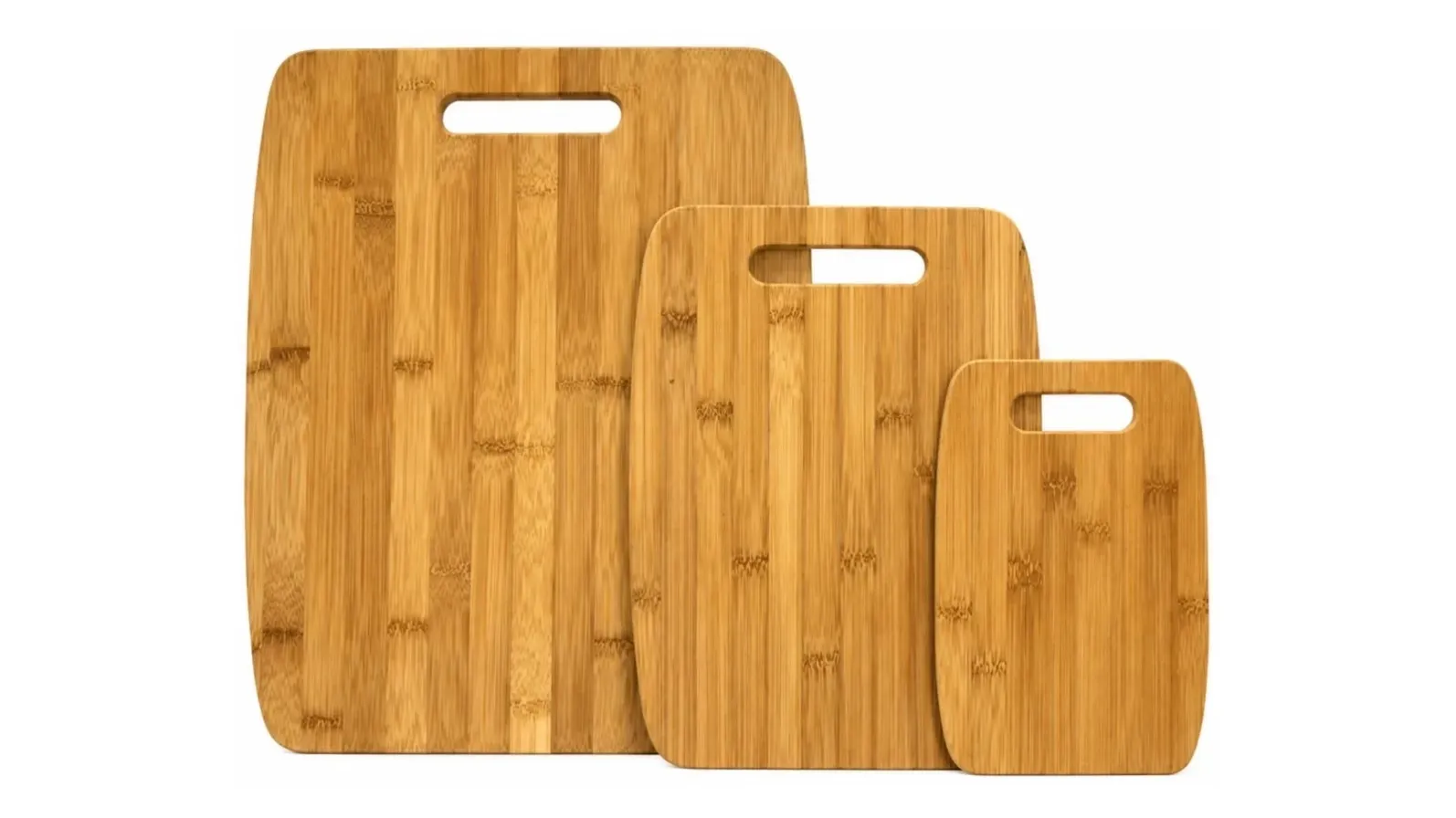
A first cutting board order from China should start with one clear product format: a single board, a graduated size set, or a set with a holder. After that format is chosen, confirm the material, dimensions, thickness, juice groove, surface finish, logo method and packaging on an approved sample before placing the bulk order.
Typical starting points include a 3-piece bamboo cutting board set with holder, a 3-piece bamboo cutting board set in three sizes, or a single acacia wood cutting board with handle.
For many of these programs, the standard MOQ is 500 complete sets or 500 pcs, depending on whether you are buying a set or an individual board. Sample lead time is usually 7–15 days. Bulk production usually takes about 20–35 days after sample approval, depending on quantity, customization and packaging.
This guide is for first-time importers, new private-label kitchen brands, and buyers entering homeware who want one sellable cutting board SKU — not a full collection on the first order.
Start With One Format, Not a Full Collection
A cutting board is a practical first private-label product because the buyer can see and feel the result: size, thickness, groove, edge, finish and packaging all show up clearly on a sample.
The most common first-order mistake is to treat the first purchase as a complete collection. A broader assortment can be planned later. For the first order, one well-defined format is easier to sample, quote, pack and quality-check.
If you later want several SKUs in one range, use Rewood’s guide on how to source a bamboo and wood cutting board collection from China after the first product is confirmed.
Single Board, Size Set, or Set with Holder?
Choose the format according to how the product will be sold, not only according to how it looks in a photograph.
Format | What the first SKU usually includes | Best first-order fit | What you must confirm |
|---|---|---|---|
Single board | One board, often with a handle, hanging hole, juice groove or serving shape | A focused hero product, a gift SKU, or a lower first-order complexity | Overall size, whether length includes the handle, thickness, edge profile and logo position |
Size set | Two or more boards in graduated sizes, sold as one unit | Retail and e-commerce programs that want one SKU covering everyday prep tasks | Each board’s size and thickness, how the set is packed, and whether MOQ is counted per set |
Set with holder | A size set plus a matching holder or stand | Programs that want a complete countertop presentation and a stronger retail set | Holder structure and fit, board spacing, whether the holder is packed in the same set, and set-level QC |
A 3-piece bamboo cutting board set with holder is a common first-set option: three boards in different sizes, deep juice grooves, a smooth bamboo surface, and a matching storage holder. Finish options on this program include natural bamboo or a darker carbonized look, subject to sample approval.
A 3-piece bamboo cutting board set in three sizes is the simpler size-set route, without a holder. The current reference set uses approximately 9 × 6 × 3/8 in (22.9 × 15.2 × 1.0 cm) for the small board, 12 × 9 × 3/8 in (30.5 × 22.9 × 1.0 cm) for the medium board, and 15 × 12 × 5/8 in (38.1 × 30.5 × 1.6 cm) for the large board. Final dimensions should be confirmed against the approved sample.
A single acacia wood cutting board with handle is a focused first SKU when you want a wood-grain look rather than a multi-piece set. The current reference size is 13.7 × 7 × 0.7 in (34.8 × 17.8 × 1.8 cm), with total length including the handle.
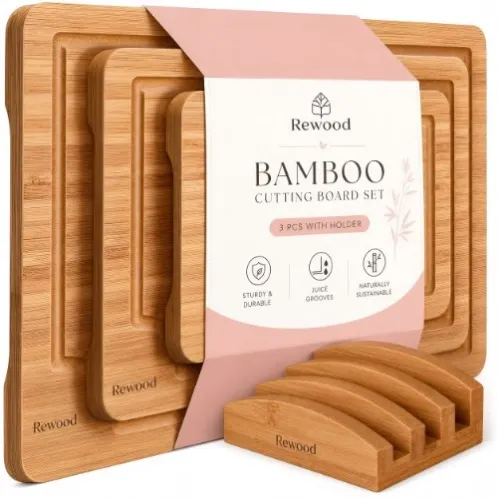
A 3-piece bamboo cutting board set with juice grooves, a paper sleeve and a matching holder. Any Rewood logo shown on the sample or sleeve is for branding reference only and can be replaced for a confirmed private-label order.
There is no universally “best” format. A single board is easier to specify and pack. A size set gives the customer more working surfaces in one SKU. A set with a holder adds organization and retail presentation, but you must also approve the holder fit, not only the boards.
Choose a Material for the First SKU
For a first cutting board order, the usual choice is bamboo or acacia. The right material depends on the look you want, the product format and the market position. It should not be chosen from a photograph alone.
Bamboo is often used for coordinated sets because it can present a clean, even appearance across several board sizes. Acacia is often used when the buyer wants a more distinctive wood grain, including single serving or handle boards and wood cutting board sets.
For a fuller comparison of appearance, positioning and typical applications, see how B2B buyers choose between bamboo, acacia and beech. Beech is more commonly discussed for utensils and other household items than as the first cutting board SKU in Rewood’s current cutting board range.
If you specifically want an end-grain butcher block, state that construction clearly in the RFQ. It is a different product type from the typical bamboo or acacia preparation boards shown in the current collection.
Natural grain, tone and color vary from piece to piece. During sample approval, agree an acceptable appearance range rather than expecting every bulk board to match one photograph exactly.
Lock the Specification Before You Compare Prices
A useful first quotation is based on a defined product, not only a reference image and a request for “your best price.”
Before comparing offers, try to confirm:
Specification area | What to define |
|---|---|
Format | Single board, size set, or set with holder |
Material | Bamboo, acacia, or another agreed wood |
Dimensions | Length × width for each board; state whether a handle is included in the length |
Thickness | Thickness for each size, especially if the large board is thicker than the small ones |
Juice groove | Yes or no; one side or reversible; position and depth if already known |
Handle or hanging hole | Handle shape, cut-out handle, hanging hole, or no handle |
Holder or stand | If included: structure, fit, and whether it is part of the same set |
Edge and corner profile | Square, eased, or rounded edges |
Surface finish | The finish to be confirmed on the approved sample |
Logo | Laser engraving, printing, packaging branding, or a combination; position and size |
Packaging | Sleeve, kraft box, color box, gift box, or mail-order packaging |
Target market and channel | Destination country and whether the goods will be sold at retail, wholesale or online |
Quantity | First-order quantity, and whether the unit is one board or one complete set |
Reference dimensions are a starting point, not a substitute for sample approval. For example, a current 3-piece acacia wood cutting board set with holder uses approximate board sizes of 40 × 30 × 2 cm, 33 × 24 × 2 cm and 26 × 18 × 2 cm, with juice grooves, anti-slip feet, reversible use and a wooden holder. Those figures should still be checked on the production sample before bulk production.
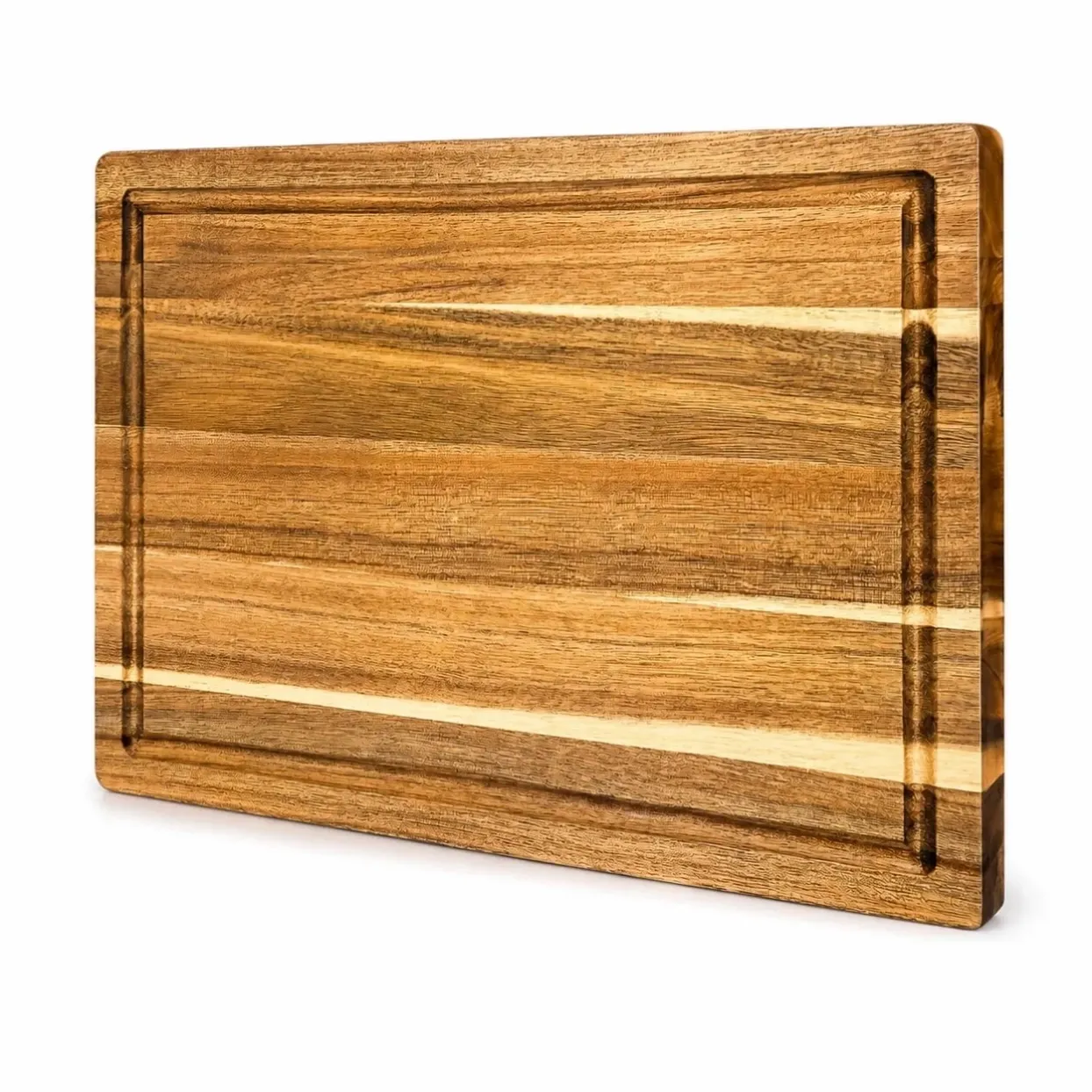
An acacia cutting board with a perimeter juice groove and visible thickness. Groove position, depth, edge profile and surface appearance should be confirmed on the approved sample.
What to Check on Your First Cutting Board Sample
The sample is the point at which the first order becomes controllable. Do not approve it only because “it looks fine.” Record what you are approving.
A practical first-sample check includes:
- Material and overall appearance against the agreed range.
- Length, width and thickness of each board, including whether handle length is part of the stated size.
- Flatness and any visible warping.
- Juice groove position, depth and consistency, if a groove is part of the design.
- Handle, hanging hole or holder fit, including whether each board seats correctly in the holder.
- Edge and corner finishing: no sharp edges, chips or splinters.
- Surface sanding and smoothness, including both faces if the board is reversible.
- Inspection for cracks, open joints or visible glue marks.
- Logo position, size, clarity and spelling, if branding is applied on the sample.
- Individual packaging fit, including whether all boards and the holder, if any, sit correctly in the sleeve or box.
- Odor and surface feel after a simple hand-wash and dry, because kitchen boards will be cleaned by the end user.
Rewood’s usual factory practice is to send an approved sample to the customer and to keep a retained bulk/production sample, then arrange production against that retained sample. Material is screened at the start to reject scarred or defective stock. A further check is normally done after sanding to keep sanding consistency and batch stability, another check is done before packing, and packed outer cartons are checked again.
Any change after sample approval — thickness, groove, logo, finish or box — should be written into the final specification before bulk production starts.
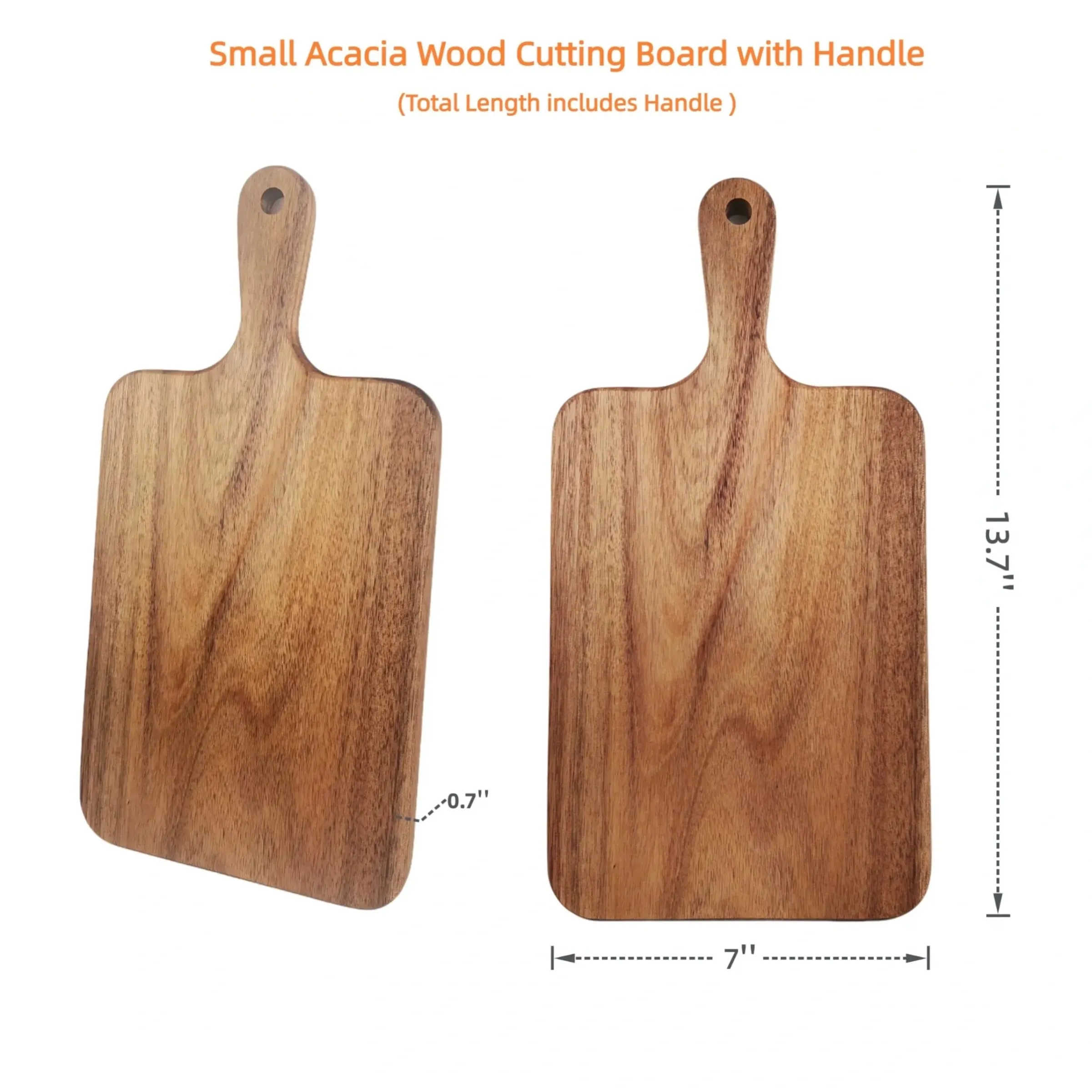
A small acacia cutting board with handle. The current reference size is 13.7 × 7 × 0.7 in, with total length including the handle. Confirm the same measurement method on your sample and in the bulk specification.
Packaging for a First Private-Label Order
Packaging should be chosen for the sales channel and for product protection, not only for branding.
Common options for cutting board programs include shrink wrap or a paper sleeve, a kraft box, a printed color box, a gift box, or mail-order packaging. For a set, the packaging must hold every board — and the holder, if there is one — as one complete unit. Corners, edges, grooves and handles need protection against rubbing and impact.
If you need a logo, barcode, care card or inner card, include that in the first brief. Artwork should be prepared to the approved product size, not the other way around: confirm the board and box first, then lock the print file.
Any Rewood logo shown in current product or packaging images is for branding reference only. Your own logo, labels and private-label packaging can be developed for a confirmed bulk project.
Compliance and Documentation: Ask by Project, Not by Slogan
Cutting boards are food-contact products in most target markets, but no single certificate automatically covers every board, every finish and every destination.
Food-contact documentation and testing, where required, should be reviewed according to the actual material, surface finish, any metal or silicone components, and the destination market. For a structured overview of what to request, see Rewood’s guide to FDA, LFGB, REACH and FSC for bamboo and wooden kitchenware.
FSC-certified sourcing and chain-of-custody documentation can be supported for eligible bamboo or wood projects. If you need an FSC claim, confirm that requirement before quotation so the appropriate material source and documentation can be arranged. This is not automatic for every SKU or every order.
Rewood’s manufacturing facility is amfori BSCI-audited. Current audit information can be provided for qualified buyer review where required. BSCI relates to factory social-compliance auditing and is not a product certification.
For applicable EU-bound projects, Rewood can provide material-source, traceability and due-diligence documentation support to help the buyer review EUDR-related requirements. EUDR is not a product certificate, and the available documents depend on the confirmed material, product configuration and supply-chain arrangement.
Include any testing or documentation requirements in the RFQ rather than assuming they are already included.
MOQ, Sampling and Production Timing
For the 3-piece bamboo cutting board set with holder, the standard MOQ is 500 complete sets. Special packaging, custom dimensions or other customization may have a separate minimum. For the acacia cutting board with handle, the standard MOQ is 500 pcs. On some other cutting board programs, MOQ is confirmed according to the product, logo and packaging.
Always ask whether the minimum applies per complete set or per individual board. That single point changes both cost and the size of the first order.
Sample lead time is usually 7–15 days. Bulk production usually takes about 20–35 days after sample approval, depending on quantity, customization and packaging requirements. These are typical timing ranges, not a fixed promise for every project.
How to Write a Clear First RFQ
A first cutting board RFQ does not need a full engineering file. It does need enough detail for a factory to quote the same product you intend to approve.
A practical brief can follow this structure:
- Product format: single board / 3-piece size set / 3-piece set with holder
- Material: bamboo or acacia, or a reference you want to match
- Reference: product link, photo or drawing
- Dimensions and thickness, if known; otherwise ask the factory to quote a current reference size
- Juice groove, handle, hanging hole or holder: yes/no and any known details
- Logo method and approximate position
- Packaging direction: sleeve, kraft box, color box, gift box or mail-order pack
- Target market and sales channel
- Destination country and preferred trade term, if known
- Estimated first-order quantity, and whether that quantity is sets or pieces
- Documentation needs: food-contact, FSC, BSCI, EUDR-related support, or other market requirements
- Sample request: yes/no, and any logo or packaging to include on the sample
If some of those points are still open, say so. It is better to mark a point as “to be confirmed on the sample” than to leave the factory guessing.
Common First-Order Mistakes
- Starting with too many SKUs before one product is approved.
- Quoting from a photo without locking size, thickness and whether a holder is included.
- Counting MOQ as pieces when the product is sold as a set, or the reverse.
- Approving the boards but not the holder fit, groove depth or box fit.
- Changing the logo or box after the sample is approved, without updating the specification.
- Assuming food-contact, FSC or EUDR coverage is universal rather than project-specific.
- Leaving grain and color variation undefined, then rejecting normal natural differences in bulk.
Frequently Asked Questions
Should I start with a single cutting board or a set?
Start with the format you actually intend to sell as the first SKU. A single board is simpler to specify and pack. A size set or a set with a holder can be a stronger retail unit, but only if you are ready to approve every component, including the holder if there is one.
Is bamboo or acacia better for a first private-label cutting board?
Neither is automatically better. Bamboo is often chosen for a clean, coordinated set. Acacia is often chosen for a more distinctive wood appearance. Choose according to positioning, format and market, then confirm the look on a sample.
What thickness should I specify?
Specify thickness for each board size rather than using one generic number. In the current 3-piece bamboo size set, the small and medium reference boards are about 3/8 in (1.0 cm) and the large reference board is about 5/8 in (1.6 cm). Other programs use different thicknesses. Confirm the approved thickness on the sample before bulk production.
Do I need a juice groove?
Only if it supports the way the product will be used and sold. A juice groove can help collect liquids during preparation, but it also reduces part of the flat working area and must be controlled for position and depth. If you want a reversible serving side, say whether the groove is on one side only.
What is the usual MOQ?
It depends on the product. The standard MOQ for the bamboo cutting board set with holder is 500 complete sets. The standard MOQ for the acacia cutting board with handle is 500 pcs. Special packaging or customization may have a separate minimum, and some programs confirm MOQ according to the final specification.
How long do sampling and bulk production take?
Sample lead time is usually 7–15 days. Bulk production usually takes about 20–35 days after sample approval, depending on quantity, customization and packaging.
Can I add my logo and private-label packaging on the first order?
Yes, logo and packaging can be developed for a confirmed project. Common logo methods include laser engraving, printing or branding on the packaging. Confirm the method, position and packaging structure on the sample, or on a packaging prototype, before mass production.
What compliance documents should I ask for?
Ask according to the destination market and the finished product. Food-contact documentation, FSC for eligible materials, BSCI factory audit information, and EUDR-related traceability support for applicable EU orders can be reviewed where relevant. Do not assume one document covers every requirement.
What information should I send Rewood to start?
Send the format you want, a reference photo or link, estimated quantity, target market, logo and packaging direction, and any documentation requirements. If dimensions are not yet fixed, Rewood can start from a current reference product and confirm details during sampling.
Ready to Source Your First Cutting Board?
If you already know the format, send your reference, quantity, target market, logo artwork and packaging brief. If you are still choosing between a single board, a size set and a set with a holder, share the sales channel and the product direction. Rewood can then review a practical first-order specification, arrange a sample and quote the bulk program against the approved version.
You can also write to info@rewoodoffice.com or message WhatsApp +86 15024561325.
About the Author
Written by Jessie Jiang — Overseas Business Development, Rewood Houseware
Jessie works with importers, distributors and private-label brands on bamboo and wood houseware product development, sourcing coordination, packaging, quality control and export projects.
Reviewed by the Rewood Product Development & Quality Control Team
This guide is intended to help first-time B2B buyers structure a first cutting board sourcing project. Final materials, specifications, MOQ, packaging, testing, documentation and lead times are confirmed according to the agreed product and order.
Last Updated: 18 November 2026